Facts
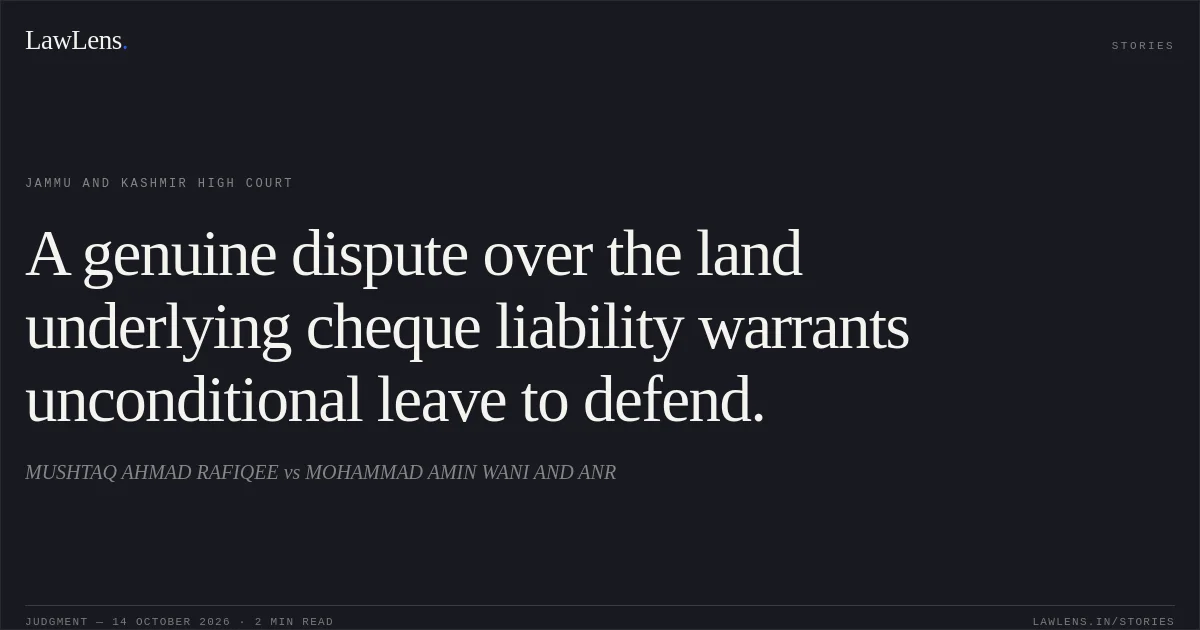
The petitioner filed a summary suit under Order XXXVII CPC to recover ₹1.35 crore, alleging that the respondents had issued cheques as part of an agreement to purchase land and later promised to pay the claimed amount.
Source reference: p. 4–5The respondents sought leave to defend, contending that the cheques were issued as security in an arrangement to find purchasers and that the land was State land, which the petitioner and his co-sharers had no right to sell.
Source reference: p. 5–6The Trial Court granted unconditional leave to defend.
Source reference: p. 1–3The petitioner challenged that order under Article 227, arguing, among other things, that the admitted issuance of the cheques attracted the statutory presumptions under the Negotiable Instruments Act and that the respondents knew of the land dispute.
Source reference: p. 1–3, 7–8Issues
Whether the respondents’ defence concerning the petitioner’s title to the land and the circumstances in which the cheques were issued raised genuine triable issues warranting unconditional leave to defend.
Source reference: p. 9–12Whether the admitted issuance of the cheques, having regard to the petitioner’s pleaded basis for their issuance and the respondents’ challenge to it, required the Trial Court to refuse leave to defend.
Source reference: p. 8–10Law Applied
Under Order XXXVII CPC, leave to defend is ordinarily granted where the defendant raises a substantial defence or a fair, bona fide, or reasonable triable issue; refusal is appropriate where the defence is frivolous or vexatious and no genuine triable issue is raised.
Source reference: p. 9–11Where the genuineness of the issues or the defence is doubtful, the court may impose appropriate conditions rather than deny leave.
Source reference: p. 9–11The petitioner relied on Sections 118(a) and 139 of the Negotiable Instruments Act; the Court considered those presumptions in light of the disputed factual basis on which the petitioner alleged the cheques had been issued.
Source reference: p. 2–3, 8–9Reasoning
The petitioner’s own case was that the cheques were issued in connection with the proposed purchase of land, while the respondents specifically disputed the petitioner’s and co-sharers’ ownership and asserted that the land was State land.
Source reference: p. 9–10, 12The Court held that whether the cheques represented a legally enforceable debt or liability was therefore a triable issue, notwithstanding their admitted issuance.
Source reference: p. 9It also rejected reliance on the agreement to sell dated 2 March 2022 as proof that the respondents knew of a dispute concerning the land underlying the cheques: the agreement was not pleaded in the suit and referred to different survey numbers.
Source reference: p. 7–8Applying B.L. Kashyap, the Court found the respondents’ defence substantial and not doubtful or fanciful.
Source reference: p. 9–11Holding
The Court held that the respondents had raised genuine triable issues and were entitled to unconditional leave to defend.
It found the Trial Court’s order unexceptionable, dismissed the petitioner’s Article 227 petition as without merit, and left the suit to proceed for trial.
Source reference: p. 11–12Acts & Sections Cited
2 provisions across 1 statute referred to in this judgment. Each provision opens on LawLens.
Negotiable Instruments Act, 18812
Original Court PDF
MUSHTAQ AHMAD RAFIQEEvsMOHAMMAD AMIN WANI AND ANR
Click to open original judgment
Original judgment, available to read, download and summarize on LawLens.in