Facts
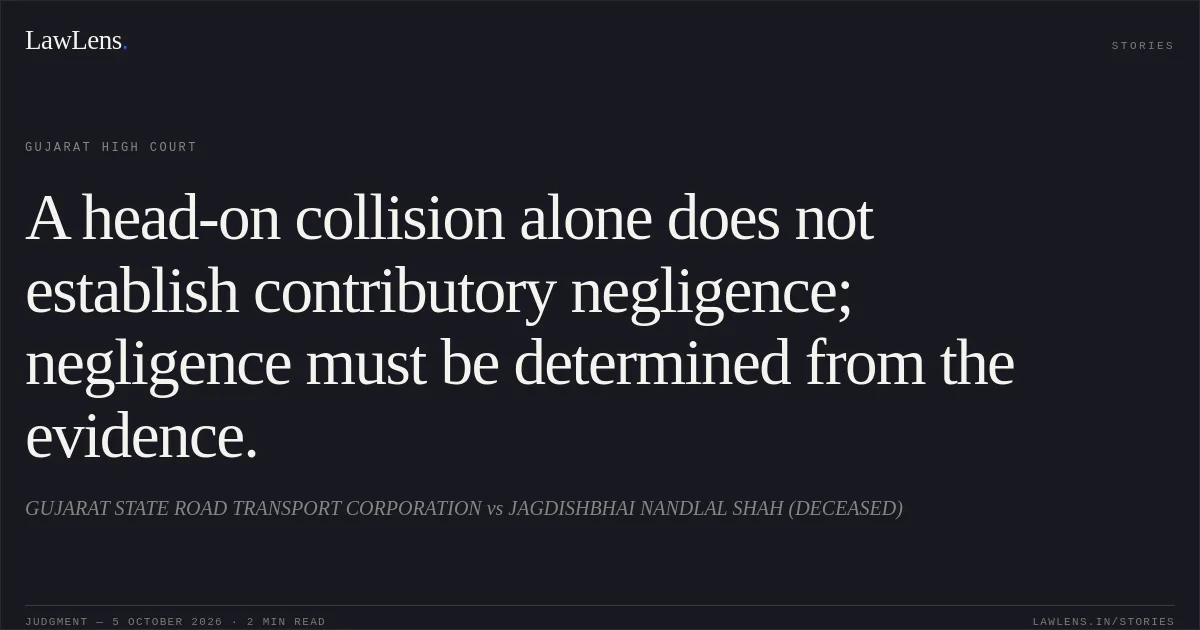
The deceased was driving a Maruti van when it collided head-on with a GSRTC bus, resulting in his death.
Source reference: paras. 1–4, pp. 1–2His parents and legal representatives sought compensation, alleging that the bus driver’s rash and negligent driving caused the accident.
Source reference: paras. 1–4, pp. 1–2The Motor Accident Claims Tribunal awarded ₹11,00,000 with 9% annual interest and held the bus driver solely negligent.
Source reference: paras. 1–4, pp. 1–2GSRTC appealed, contending that the deceased had driven on the wrong side and was contributorily negligent.
Source reference: paras. 1–4, pp. 1–2The claimants relied on the panchnama and the bus driver’s testimony, including evidence that the bus dragged the van after impact and that the driver reported the accident only two days later.
Source reference: paras. 6–7, pp. 2–3Issues
1. Whether the deceased’s conduct amounted to contributory negligence in causing the head-on collision
Source reference: paras. 6, 8–10, pp. 2–92. Whether the Tribunal was justified in holding the GSRTC bus driver solely negligent and fastening complete liability on him
Source reference: paras. 10–12, pp. 9–11Law Applied
Section 173 of the Motor Vehicles Act provides for an appeal against an award of the Claims Tribunal.
Source reference: para. 1, p. 1Applying Pramodkumar Rasikbhai Jhaveri v. Karmsey Kunvargi Tak, contributory negligence requires an act or omission by the claimant that materially contributed to the damage and amounts to a failure to take reasonable care; the inquiry is fact-specific.
Source reference: para. 8, pp. 3–5Under Municipal Corporation of Greater Bombay v. Laxman Iyer, negligence is assessed in light of all the circumstances, and where both parties’ negligence contributes to the damage, liability may be apportioned; a traffic-rule breach alone does not establish sole responsibility.
Source reference: para. 9, pp. 5–8Reasoning
The Court noted that a post-accident panchnama may not always establish the vehicles’ positions at the moment of collision.
Source reference: para. 12, pp. 10–11However, in this case, the bus driver admitted that the bus dragged the van approximately 15 feet after impact and that the road was straight, with visibility for about 100 feet.
Source reference: para. 12, pp. 10–11The driver’s failure to control the bus after collision, together with his departure from the scene and delayed reporting, supported the finding that he was solely negligent.
Source reference: para. 12, pp. 10–11The record did not establish that the deceased’s conduct materially contributed to the accident; accordingly, there was no basis to apportion negligence.
Source reference: para. 12, pp. 10–11Holding
The Court answered the contributory-negligence issue against GSRTC and held that the Tribunal committed no error in finding the bus driver solely negligent.
The appeal was dismissed, and the award of ₹11,00,000 with 9% annual interest was confirmed.
Source reference: paras. 13–15, p. 11The Tribunal was directed to disburse the awarded amount, including any amount held in a fixed deposit, after verification and in accordance with due procedure.
Source reference: paras. 13–15, p. 11Acts & Sections Cited
1 provisions across 1 statute referred to in this judgment. Each provision opens on LawLens.
Motor Vehicles Act, 19881
Original Court PDF
GUJARAT STATE ROAD TRANSPORT CORPORATIONvsJAGDISHBHAI NANDLAL SHAH (DECEASED)
Click to open original judgment
Original judgment, available to read, download and summarize on LawLens.in