Facts
On 28 November 2009, the appellant was riding a motorcycle when it collided with a median, throwing him and his pillion rider onto the opposite side of the road.
Source reference: pp. 2–3, 9A lorry then ran over their legs; the pillion rider died and the appellant sustained serious injuries, including fractures and amputation of part of his left foot.
Source reference: pp. 2–3, 9The appellant brought a claim under Section 166 of the Motor Vehicles Act, 1988. The Tribunal apportioned negligence 60% to the appellant and 40% to the lorry driver and awarded Rs. 4,69,200.
Source reference: pp. 3–4, 8The appellant appealed under Section 173(1), challenging the negligence finding and seeking enhanced compensation.
Source reference: pp. 1–2, 4–5Issues
1. Whether the Tribunal’s finding on contributory negligence and its apportionment of liability called for modification?
Source reference: p. 6, para. 112. Whether the appellant was entitled to enhanced compensation?
Source reference: p. 6, para. 11Law Applied
The claim arose under Section 166 of the Motor Vehicles Act, 1988, and the appeal was brought under Section 173(1) of that Act.
Source reference: pp. 1–2In assessing personal-injury compensation, the court considered the claimant’s income, functional disability, age, multiplier, and future prospects; it relied on Erudhaya Priya v. State Express Transport Corporation Ltd., 2020 SCC OnLine SC 601, for the principle that future prospects may be added in personal-injury claims.
Source reference: p. 9, para. 15The court also assessed negligence from the evidence concerning the accident, including the prosecution records and the circumstances of the collision, and noted the heightened care expected of a heavy-vehicle driver.
Source reference: pp. 6–8, paras. 12–13Reasoning
The FIR, complaint, charge sheet and spot sketch supported the account that the motorcycle collided with the median and the riders were thrown onto the opposite road; the insurer produced no evidence that the lorry driver had taken due care.
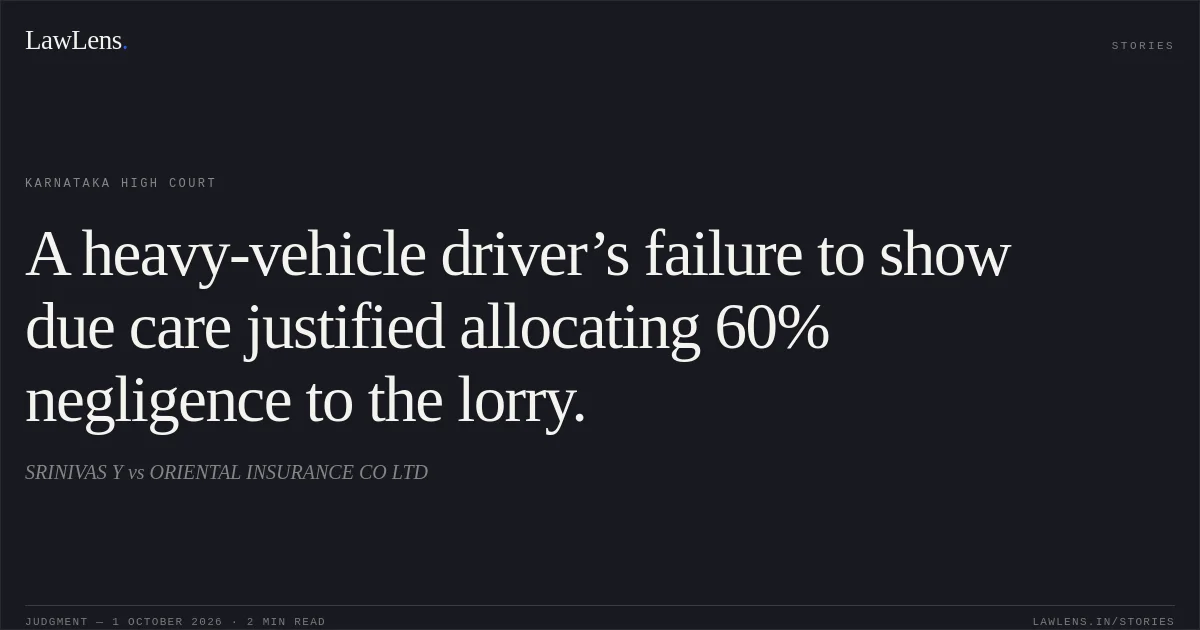
Source reference: pp. 6–8, para. 12In light of those circumstances and the lorry’s size, the court found the Tribunal’s 60:40 apportionment unjustified and reassigned negligence 40% to the appellant and 60% to the lorry driver.
Source reference: p. 8, para. 13For compensation, the court found no proof of the claimed monthly income of Rs. 1,00,000 and adopted a notional income of Rs. 5,000 for 2009. Considering the injuries, amputation and restricted movement, it assessed disability at 40%, applied a multiplier of 15 based on age 36, and included 40% future prospects in calculating future loss of income.
Source reference: pp. 8–10, paras. 14–15It also enhanced amounts for pain and suffering, loss of amenities and future medical expenses, and allowed four months’ loss of income during the laid-up period.
Source reference: pp. 9–11, paras. 14–16Holding
The appeal was allowed in part. The Court modified the Tribunal’s award, stated the reassessed compensation as Rs. 10,44,000, and held the insurer liable for 60%, amounting to Rs. 6,26,400, with interest at 6% per annum from the date of the claim petition until deposit.
The insurer was directed to deposit the amount within six weeks, and the enhanced compensation with interest was ordered to be released to the appellant.
Source reference: p. 12, para. 17Acts & Sections Cited
2 provisions across 1 statute referred to in this judgment. Each provision opens on LawLens.
Motor Vehicles Act, 19882
Original Court PDF
SRINIVAS YvsORIENTAL INSURANCE CO LTD
Click to open original judgment
Original judgment, available to read, download and summarize on LawLens.in