Facts
Hariharakrishnan instituted O.S. No. 3 of 2013 before the III Additional District Court for partition against his brothers, including the present respondents; Natesan Industries, the joint family business, was also impleaded.
Source reference: p.2; para.2During the pendency of the suit, the second defendant filed a revision petition before the High Court seeking to strike off the plaint.
Source reference: p.2; para.2The parties thereafter entered into a compromise, which was recorded by the High Court on 11 March 2013, with a direction to the trial court to pass a final decree in its terms.
Source reference: p.2; para.2The petitioner, the granddaughter of Hariharakrishnan through his son Natesan, claimed that she had a birthright in the ancestral properties covered by the compromise.
Source reference: p.3; para.3She contended that, since she was a minor when the compromise was entered into, the compromise was not binding on her because permission under Section 8 of the Hindu Minority and Guardianship Act, 1956 and Order XXXII Rule 7 of the Code of Civil Procedure had not been obtained.
Source reference: p.3; para.3She accordingly sought leave under Section 151 CPC to file an application to set aside the compromise recorded in the revision proceedings.
Source reference: p.2; para.1Issues
1. Whether the compromise entered into by the manager or karta of a Hindu joint family concerning joint family/coparcenary properties required prior permission under Section 8 of the Hindu Minority and Guardianship Act, 1956?
Source reference: pp.4–5; paras.4–52. Whether permission under Order XXXII Rule 7 CPC was necessary in the absence of the petitioner as a party to the litigation and where the properties dealt with were alleged to be ancestral rather than the minor’s separate properties?
Source reference: p.5; para.63. Whether the petitioner could challenge the compromise in respect of the third-schedule property, which was treated as separate property devolving under Section 15 of the Hindu Succession Act, 1956?
Source reference: pp.5–6; para.74. Whether the petitioner had established that the compromise adversely affected her interest so as to justify granting leave to challenge it after attaining majority?
Source reference: p.6; para.8Law Applied
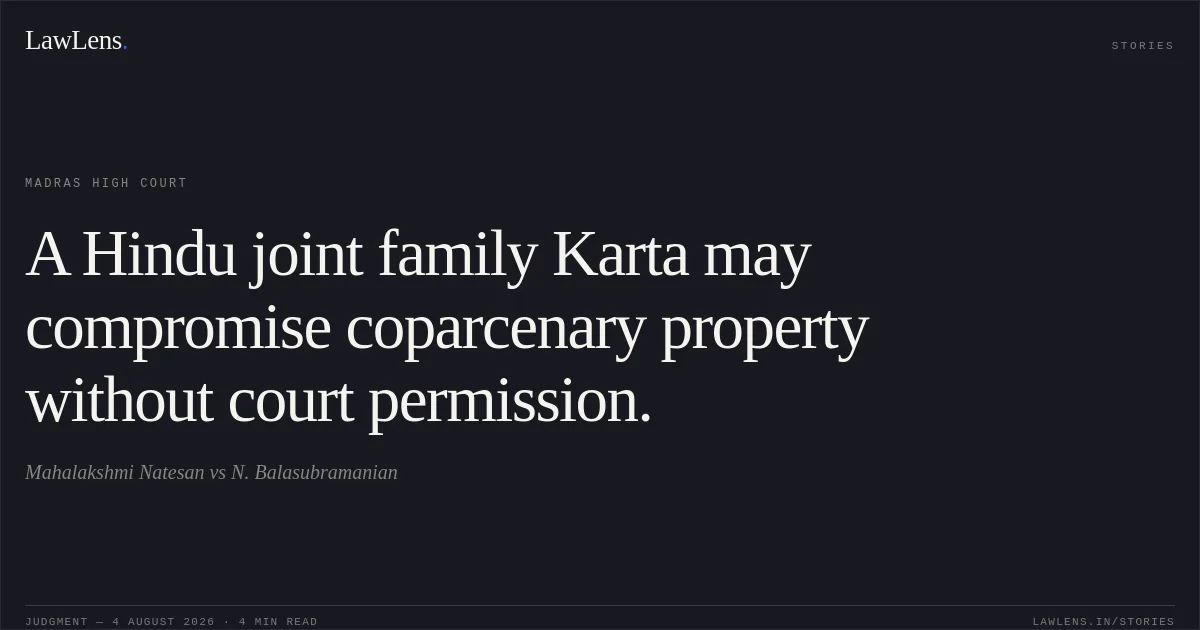
The Court held that the manager or karta of a Hindu joint family has authority to enter into a compromise and deal with joint family property in a manner binding on junior members, subject to challenge if the transaction was against the family interest or the junior members’ interests were not properly considered.
Source reference: p.4; para.4Section 8 of the Hindu Minority and Guardianship Act, 1956 does not apply where a karta deals with joint Hindu family property involving a minor’s undivided coparcenary interest, as held in Sri Narayan Bal v. Sridhar Sutar, (1996) 8 SCC 54.
Source reference: p.4; para.5Order XXXII Rule 7 CPC applies where a minor is a party to the litigation and the compromise concerns the minor’s separate property; it was held inapplicable where the minor was not a party and the properties were ancestral or joint family properties.
Source reference: p.5; para.6Property settled by a person in favour of his wife, which thereafter devolves upon her descendants under Section 15 of the Hindu Succession Act, is treated as separate property of the relevant heirs and not as coparcenary property.
Source reference: pp.5–6; para.7Reasoning
The Court found that the properties in the first and second schedules were described as ancestral or coparcenary properties.
Source reference: pp.4–5; paras.4–5Therefore, the compromise entered into by the family manager did not require permission under Section 8 of the Hindu Minority and Guardianship Act.
Source reference: pp.4–5; paras.4–5Since the petitioner was not a party to the suit and no separate property belonging to her was dealt with, Order XXXII Rule 7 CPC was also held inapplicable.
Source reference: p.5; para.6The third-schedule property stood on a different footing because it had been settled in favour of Hariharakrishnan’s wife and would devolve upon her descendants under Section 15 of the Hindu Succession Act; it was consequently treated as the separate property of the petitioner’s father and his siblings.
Source reference: pp.5–6; para.7The petitioner could not independently challenge the compromise in respect of that property when her father, through whom she claimed, had not challenged it.
Source reference: pp.5–6; para.7Further, even regarding the coparcenary properties, the petitioner’s father had not questioned the compromise.
Source reference: p.6; para.8The petitioner’s affidavit did not identify any specific term of the compromise that was prejudicial to her or contrary to the interests of the joint family.
Source reference: p.6; para.8The Court held that a bare assertion that the minor’s interests had not been considered was insufficient to warrant leave to challenge the compromise after attaining majority.
Source reference: p.6; para.8Holding
The Court answered the issues against the petitioner.
It held that the compromise concerning the joint family properties did not require permission under Section 8 of the Hindu Minority and Guardianship Act or Order XXXII Rule 7 CPC.
Source reference: p.7; para.9The third-schedule property was separate property, and the petitioner lacked an independent basis to challenge the compromise, particularly when her father had not questioned it.
Source reference: p.7; para.9As the petitioner failed to show that the compromise operated against her or the family’s interests, the Court declined to grant leave under Section 151 CPC and dismissed C.M.P.(MD) No. 9220 of 2026.
Source reference: p.7; para.9Acts & Sections Cited
6 provisions across 3 statutes referred to in this judgment. Each provision opens on LawLens.
Code of Civil Procedure, 19082
Hindu Minority and Guardianship Act, 19563
Hindu Succession Act, 19561
Original Court PDF
Mahalakshmi NatesanvsN. Balasubramanian
Click to open original judgment
Original judgment, available to read, download and summarize on LawLens.in