Facts
Durgawati Devi was married to Suresh Chaudhary, the elder brother of Sachita Chaudhary, on 22 May 1990. Two children were born from that marriage. Suresh died on 28 November 1997. Durgawati claimed that, after his death, she married Sachita in accordance with Hindu rites and ceremonies in or around 2002, but was subsequently subjected to cruelty and expelled from the matrimonial home.
Source reference: paras. 2–4; pp. 2–5She obtained maintenance under Section 125 CrPC in Miscellaneous Case No. 56 of 2004, and Sachita’s challenge to that order was dismissed by the High Court in Civil Revision No. 2217 of 2005.
Source reference: paras. 2–4; pp. 2–5Sachita thereafter instituted Title Suit No. 1 of 2011 before the Family Court, Siwan, seeking a declaration that Durgawati was not his legally wedded wife and that no husband-wife relationship existed between them. The Family Court allowed the suit by judgment dated 26 February 2020 and decree dated 18 March 2020. Durgawati challenged that decision in the present miscellaneous appeal.
Source reference: para. 1; p. 1The appellant examined herself and four other witnesses and relied, inter alia, on maintenance orders and voter-list entries. The respondent examined eight witnesses and produced documents concerning Durgawati’s marriage to Suresh, Suresh’s death, and Sachita’s subsequent marriage to Munni Devi.
Source reference: paras. 5–7, 19–30; pp. 3–16Issues
1. Whether Durgawati Devi was the legally wedded wife of Sachita Chaudhary.
Source reference: para. 10(i); p. 52. Whether the alleged marriage between Durgawati Devi and Sachita Chaudhary was solemnised in accordance with Hindu rites and ceremonies.
Source reference: para. 10(ii); p. 53. Whether the evidence and materials on record established the existence of a legally valid marriage between the parties.
Source reference: para. 10(iii); p. 5Law Applied
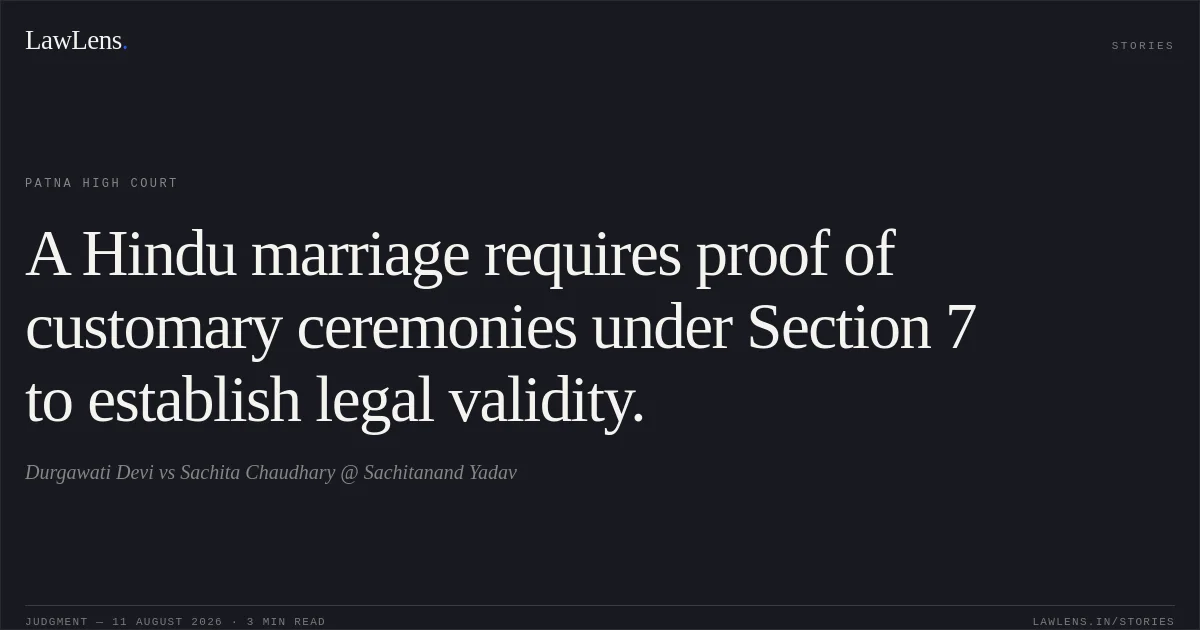
The Court applied Section 7 of the Hindu Marriage Act, 1955, under which a Hindu marriage must be solemnised in accordance with the customary rites and ceremonies of either party; where the applicable ceremony includes saptapadi, the marriage becomes complete and binding upon completion of the seventh step.
Source reference: paras. 33–35; pp. 16–18The Court held that mere assertion of marriage or cohabitation is insufficient where the factum of marriage is specifically disputed; the party asserting the marriage must establish its solemnisation and the requisite ceremonies.
Source reference: paras. 13, 34–35; pp. 6, 17–18It relied on Dolly Rani v. Manish Kumar Chanchal, (2025) 2 SCC 587, for the principle that a Hindu marriage is a sacrament and a legally significant institution requiring compliance with the applicable ceremonies.
Source reference: para. 36; p. 18The Court further observed that registration under Section 8 of the Hindu Marriage Act presupposes a marriage solemnised in accordance with Section 7 and cannot itself create a valid marriage where no such ceremony occurred.
Source reference: paras. 50–51; pp. 25–26Reasoning
The Court held that the burden lay on Durgawati, who asserted the disputed marriage, to prove that it had been solemnised in accordance with Hindu rites.
Source reference: para. 13; p. 6Her evidence did not disclose a definite date, place, priest, or details of the ceremonies allegedly performed. Her witnesses likewise failed to establish that they had personally witnessed the marriage or that ceremonies such as saptapadi or sindurdaan had occurred; one witness expressly admitted not attending the ceremony, while another had never met Sachita.
Source reference: paras. 14–18, 40–43; pp. 7–11, 20–22The Court also found contradictions regarding the identity of the priest who allegedly performed the marriage.
Source reference: para. 42; p. 21The maintenance orders under Section 125 CrPC did not conclusively determine the validity of the matrimonial relationship, and the conflicting voter-list entries—one describing Durgawati as Sachita’s wife and another describing her as Suresh’s wife—could not prove solemnisation of a valid marriage.
Source reference: paras. 44–47; pp. 22–24In contrast, the respondent’s evidence and documentary material consistently established Durgawati’s marriage to Suresh and his death, but did not support a subsequent marriage with Sachita.
Source reference: paras. 48–49; pp. 24–25Applying Section 7 of the Hindu Marriage Act, the Court concluded that the essential ceremonies of the alleged second marriage had not been proved.
Source reference: paras. 50–54; pp. 25–27Holding
The Court answered all three issues in the negative: Durgawati Devi was not proved to be Sachita Chaudhary’s legally wedded wife; the alleged marriage was not proved to have been solemnised according to Hindu rites and ceremonies; and the evidence did not establish a legally valid marriage between the parties.
The miscellaneous appeal was dismissed, the Family Court’s judgment dated 26 February 2020 and decree dated 18 March 2020 were upheld, and there was no order as to costs. Any pending interlocutory applications were also disposed of.
Source reference: paras. 55–57; p. 27Acts & Sections Cited
3 provisions across 2 statutes referred to in this judgment. Each provision opens on LawLens.
Code of Criminal Procedure, 19731
Original Court PDF
Durgawati DevivsSachita Chaudhary @ Sachitanand Yadav
Click to open original judgment
Original judgment, available to read, download and summarize on LawLens.in