Facts
The petitioner, judgment debtor No. 2, challenged an order of the Executing Court in E.P. No. 41/2012. That court had found that she violated a perpetual injunction decree in O.S. No. 56/1994 and ordered attachment of her properties, subject to the decree holder identifying them.
Source reference: para. 1; para. 5In the original suit, the petitioner had disputed the location, identity and boundaries of the suit property; the Trial Court considered and rejected those objections before granting the injunction.
Source reference: para. 3During the writ proceedings, the petitioner filed an affidavit admitting the decree holder’s ownership and the boundaries of the property, and undertook not to interfere with the decree holder’s possession and enjoyment.
Source reference: para. 6; para. 7Issues
1. Whether the Executing Court’s finding of disobedience and direction for attachment could stand where the petitioner sought to re-agitate objections already rejected in the original suit
Source reference: para. 4; para. 52. Whether the impugned execution order should be set aside in light of the petitioner’s affidavit admitting the property’s identity, boundaries and the decree holder’s possession, and her undertaking not to interfere
Source reference: para. 6; para. 8Law Applied
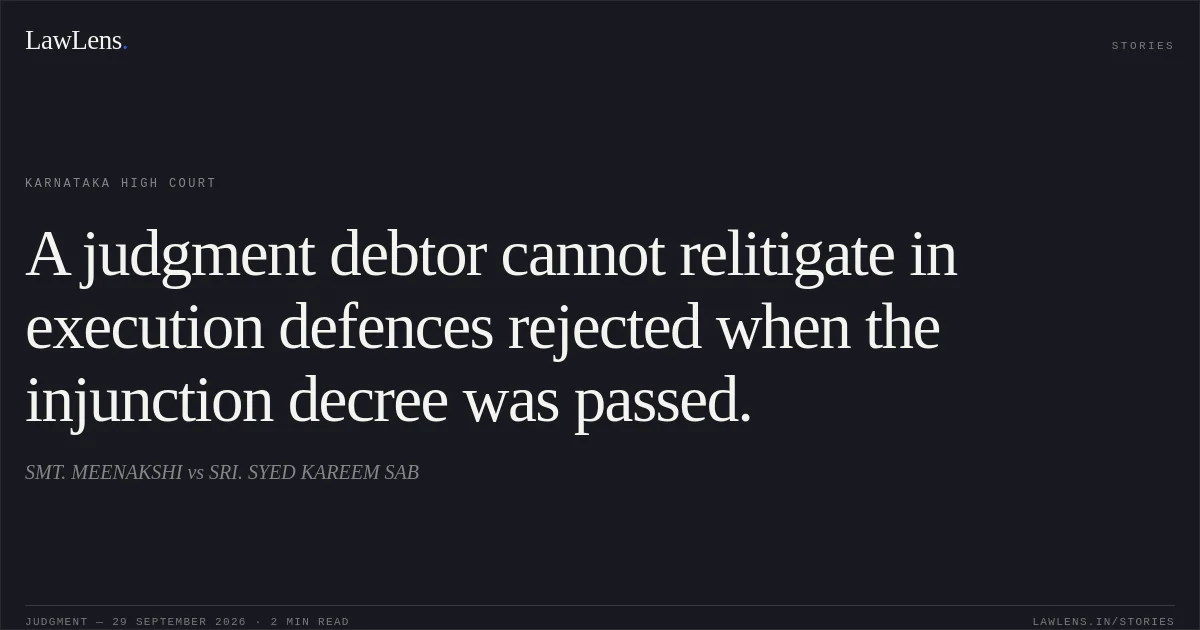
The Court applied the principle that issues determined in the original suit and embodied in a decree cannot be re-opened by a judgment debtor in execution proceedings; the decree must be obeyed unless set aside through appropriate proceedings.
Source reference: para. 3; para. 5It also treated the petitioner’s clear and categorical undertaking to the Court as binding and required her to abide by the perpetual injunction decree.
Source reference: para. 7; para. 8Reasoning
The Court noted that the petitioner’s objections to the suit property’s location, identity and boundaries had already been considered and rejected in O.S. No. 56/1994, and found that she was attempting to raise the same defence in execution.
Source reference: para. 3; para. 5The Executing Court had relied on that conduct in finding disobedience and directing attachment.
Source reference: para. 5However, in the writ proceedings the petitioner admitted the decree holder’s ownership, the property’s boundaries and possession, and undertook not to interfere. The Court accepted the undertaking and concluded that the impugned order need not survive, while preserving the petitioner’s obligation to comply with the injunction decree.
Source reference: para. 6; para. 8Holding
The writ petition was disposed of. The Executing Court’s order dated 4 June 2018 in E.P. No. 41/2012 was quashed and set aside; the petitioner’s affidavit was made part of the order.
The petitioner was directed not to interfere with the decree holders’ peaceful possession and enjoyment of the specified property, and her undertaking was declared binding as an undertaking to the Court.
Source reference: para. 9Original Court PDF
SMT. MEENAKSHIvsSRI. SYED KAREEM SAB
Click to open original judgment
Original judgment, available to read, download and summarize on LawLens.in