Facts
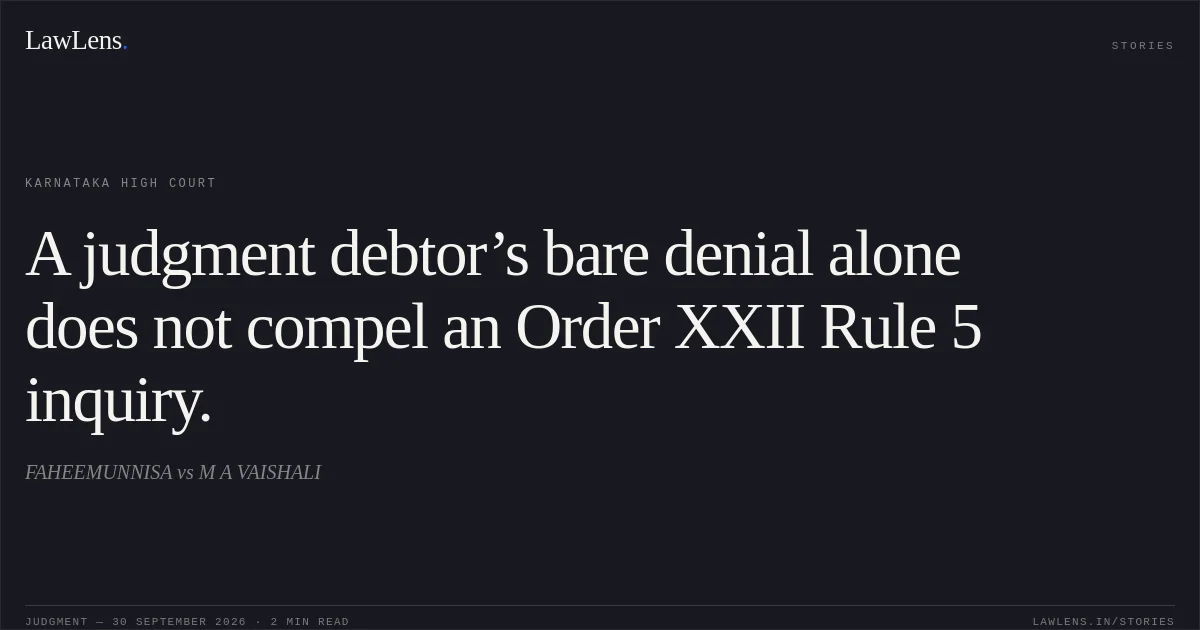
The petitioners, judgment-debtors in Execution Petition No. 769/2023, challenged the executing court’s order dated 11 March 2026 rejecting their application under Order XXII Rule 5 CPC.
Source reference: pp. 4–6They sought an inquiry into whether the persons claiming to be the deceased decree-holder’s legal representatives were entitled to continue the execution.
Source reference: pp. 4–6The executing court relied on the family tree and death certificate produced, the absence of rival claimants or contrary material, and the petitioners’ earlier acknowledgment of the claimed representative relationship; it considered a separate inquiry unnecessary
Source reference: pp. 4–6Issues
Whether the executing court was required to conduct an inquiry under the principles of Order XXII Rule 5 CPC before allowing the alleged legal representatives of the deceased decree-holder to continue execution
Source reference: pp. 11–13Whether the judgment-debtors’ denial, without material raising a genuine doubt about the claim, justified such an inquiry
Source reference: pp. 12–14Law Applied
Order XXII Rules 3, 4 and 8 CPC do not apply to execution proceedings by virtue of Rule 12; nevertheless, an executing court may determine a dispute concerning the legal representative of a deceased decree-holder on the principles underlying Order XXII Rule 5 CPC
Source reference: pp. 11–12Under Rule 5, the determination is summary and for the limited purpose of representation in the proceedings; it does not finally decide succession or title to the deceased’s estate.
Source reference: p. 12The Court relied on Varadarajan v. Kanakavalli, (2012) 11 SCC 598, for the availability of such a determination in execution proceedings
Source reference: p. 12Reasoning
The Court accepted that an executing court can determine who represents a deceased decree-holder, but held that this does not require a full inquiry whenever a judgment-debtor merely disputes the claimed relationship
Source reference: pp. 11–13Here, the application was vague; the petitioners produced no material creating a genuine doubt about the claim, and there was no competing claimant to the decree-holder’s estate.
Source reference: pp. 13–14The family tree and death certificate supported the claim, while the executing court had also noted the petitioners’ earlier acknowledgment of the representative relationship.
Source reference: pp. 5–6In those circumstances, requiring a separate inquiry would risk delaying execution without a sufficient factual basis
Source reference: pp. 13–14Holding
The Court held that the executing court was justified in declining to conduct an inquiry under the circumstances.
Finding no reason to interfere with the order rejecting I.A. No. 6, it dismissed the writ petition and closed all pending interlocutory applications
Source reference: p. 14Original Court PDF
FAHEEMUNNISAvsM A VAISHALI
Click to open original judgment
Original judgment, available to read, download and summarize on LawLens.in