Facts
The petitioner challenged the Commercial Court’s order referring Com.O.S. No. 1/2022 to arbitration, directing return of the plaint and refund of the court fee.
Source reference: p. 3–4, p. 10–11It contended that the parties’ contracts dated 17 and 24 January 2017 contained no arbitration agreement and that the respondents had not produced the original agreement or a duly certified copy when seeking reference under Section 8 of the Arbitration and Conciliation Act, 1996 (“A&C Act”).
Source reference: p. 3–4, p. 10–11The respondents relied on clauses in both contracts as arbitration clauses, while acknowledging that the originals had not been filed.
Source reference: p. 4Issues
1. Whether the clauses in the contracts dated 17 and 24 January 2017 constituted an arbitration agreement between the parties.
Source reference: p. 5–92. Whether the Commercial Court could entertain the Section 8 application without the original arbitration agreement or a duly certified copy.
Source reference: p. 10–11Law Applied
Section 7 of the A&C Act defines an arbitration agreement as an agreement to submit disputes arising from a defined legal relationship to arbitration; it may be a clause in a contract or a separate agreement, must be in writing, and may be evidenced in the ways set out in subsections (3)–(5).
Source reference: p. 7–8Under Section 8(1), a judicial authority must refer the parties to arbitration where a timely application is made in a matter covered by an arbitration agreement, unless it finds prima facie that no valid arbitration agreement exists.
Source reference: p. 9–10Section 8(2) requires the application to be accompanied by the original arbitration agreement or a duly certified copy, subject to the statutory proviso where the agreement is retained by the other party.
Source reference: p. 9–10Reasoning
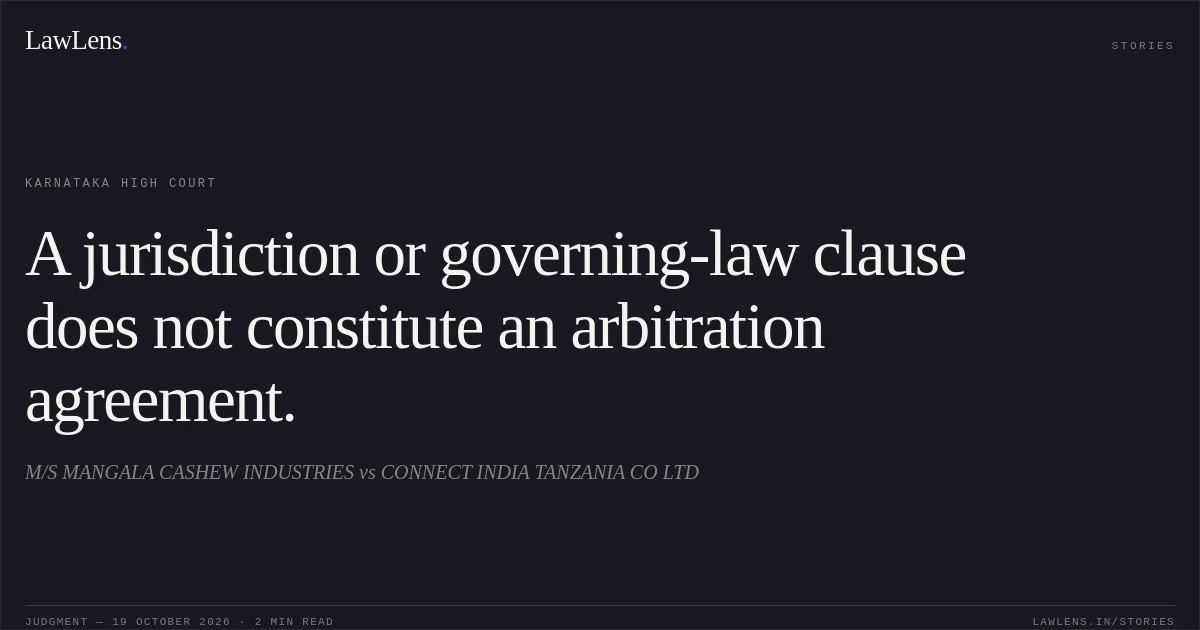
The Court found that the 17 January contract’s reference to amicable settlement and “Mangalore court jurisdiction only” was, at most, a jurisdiction clause; it did not provide for arbitration.
Source reference: p. 5–9The 24 January contract’s statement that it was governed and construed under existing UAE law addressed governing law, not arbitration.
Source reference: p. 5–9Neither document therefore established an arbitration agreement under Section 7.
Source reference: p. 5–9Further, the original agreement was not produced before the Commercial Court, and the record did not satisfy Section 8(2)’s requirement.
Source reference: p. 10–11The Commercial Court had therefore erred in referring the suit to arbitration.
Source reference: p. 10–11Holding
The Court held that no arbitration agreement existed between the parties and that the Section 8 application could not, in any event, be allowed without compliance with Section 8(2).
It allowed the writ petition and set aside the Commercial Court’s order dated 1 April 2023; pending applications, if any, were closed.
Source reference: p. 12Acts & Sections Cited
2 provisions across 1 statute referred to in this judgment. Each provision opens on LawLens.
Original Court PDF
M/S MANGALA CASHEW INDUSTRIESvsCONNECT INDIA TANZANIA CO LTD
Click to open original judgment
Original judgment, available to read, download and summarize on LawLens.in