Facts
The petitioner challenged the Commercial Court’s order allowing Respondent No. 1’s application under Section 8 of the Arbitration and Conciliation Act, 1996, and referring the parties to arbitration
Source reference: p. 2, para. 1The petitioner contended that the arbitration agreement was inadequately stamped and that its original had remained with the respondent; he also relied on the respondent’s alleged non-compliance with the agreement
Source reference: p. 3, paras. 2–3The respondent disputed that the original was unavailable to the petitioner and submitted that the original agreement had been produced before the Commercial Court
Source reference: p. 4, para. 4The Commercial Court recorded that the Section 8 application was filed before the written statement and that the original agreement was subsequently produced
Source reference: p. 5, para. 6Issues
Whether an objection that the arbitration agreement was inadequately stamped could prevent a court from referring the parties to arbitration under Section 8 of the Arbitration and Conciliation Act, 1996
Source reference: pp. 3, 7–9, paras. 2, 8Whether the requirements of Section 8 were met where the original arbitration agreement was produced before the Commercial Court after the application was filed but before the written statement
Source reference: pp. 4–6, paras. 4–6Law Applied
Section 8(1) of the Arbitration and Conciliation Act, 1996 requires a judicial authority to refer parties to arbitration, on a timely application, unless it finds prima facie that no valid arbitration agreement exists; under Section 8(2), the application must ordinarily be accompanied by the original agreement or a duly certified copy, subject to the proviso where the document is retained by the other party
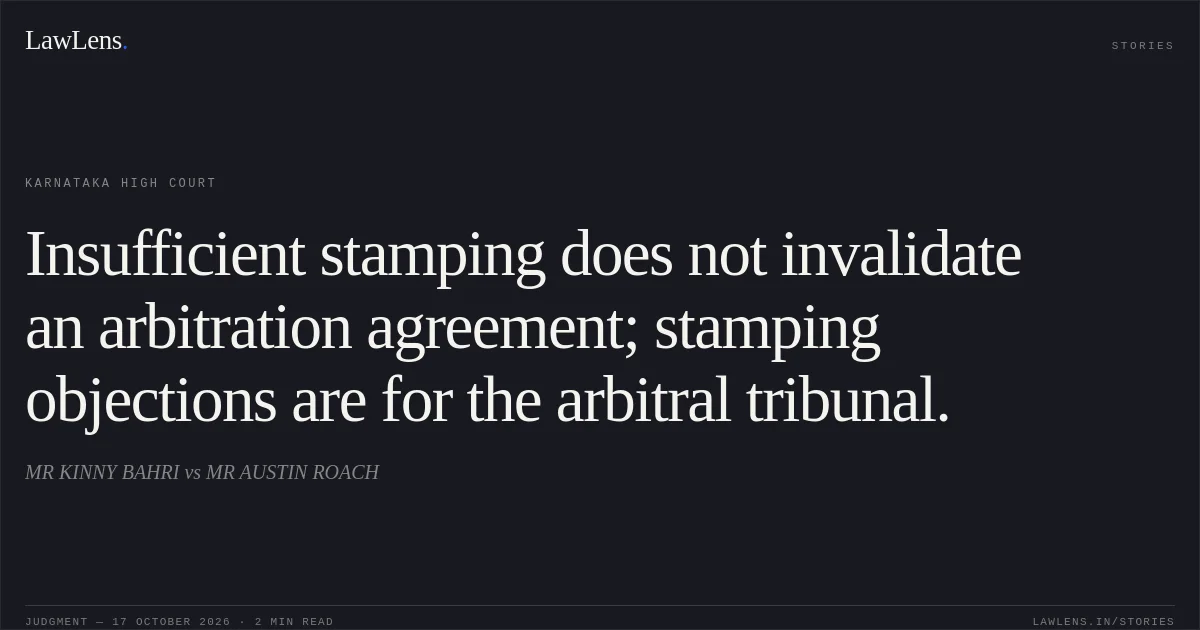
Source reference: p. 5, para. 5In *Interplay Between Arbitration Agreements under Arbitration Act, 1996 & Stamp Act, 1899, In re*, (2024) 6 SCC 1, the Supreme Court held that non-stamping or inadequate stamping does not render an agreement void or nonexistent, is a curable defect, and does not fall for determination under Sections 8 or 11; stamping objections fall within the Arbitral Tribunal’s remit
Source reference: pp. 7–9, para. 8The judgment also records the Commercial Court’s reliance on *Cox and Kings Ltd. v. SAP India Pvt. Ltd.*, (2024) 2 SCC 1, and *N.N. Global Mercantile v. Indo Unique Flame*, (2023) 7 SCC 1
Source reference: p. 6, para. 7Reasoning
The High Court found that the Commercial Court had recorded the existence of an arbitration agreement dated 19 June 2014 and that the respondent’s Section 8 application preceded the filing of the written statement
Source reference: p. 5, para. 6The original agreement was placed before the Commercial Court, and the petitioner’s contention that it had remained with the respondent did not establish a basis to disturb the referral
Source reference: pp. 4–5, paras. 4, 6Applying *Interplay*, the Court held that the alleged stamping defect was for the Arbitral Tribunal to consider and did not defeat referral under Section 8
Source reference: pp. 7–9, para. 8It therefore found no ground to interfere with the Commercial Court’s order
Source reference: p. 9, para. 9Holding
The High Court rejected the challenge and dismissed the writ petition, leaving in force the Commercial Court’s order referring the parties to arbitration
Pending applications, if any, were closed
Source reference: p. 9, para. 9Acts & Sections Cited
3 provisions across 2 statutes referred to in this judgment. Each provision opens on LawLens.
Arbitration and Conciliation Act, 19962
Indian Stamp Act, 18991
Original Court PDF
MR KINNY BAHRIvsMR AUSTIN ROACH
Click to open original judgment
Original judgment, available to read, download and summarize on LawLens.in