Facts
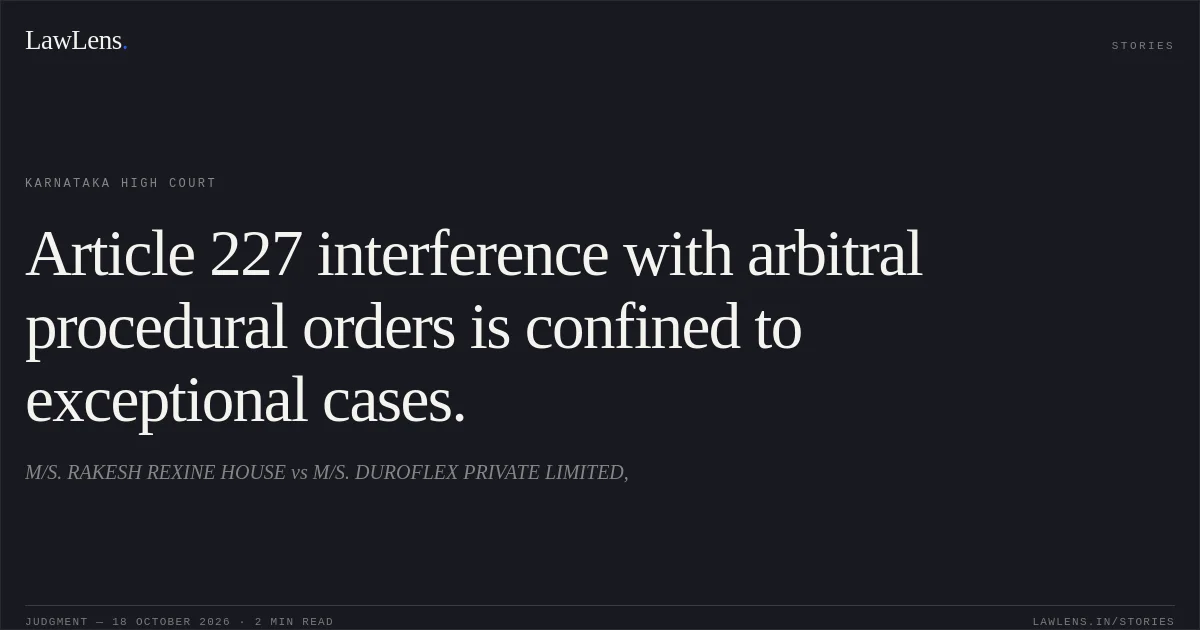
The claimant challenged the Arbitral Tribunal’s order rejecting its application under Section 19 of the Arbitration and Conciliation Act, 1996, to summon 11 persons as witnesses in the arbitration.
Source reference: p. 2–3The claimant said their evidence was needed to confront them with invoices and other documents already marked as Exs. P1–P16.
Source reference: p. 2–3The Tribunal noted that the claimant had previously sought to implead the 11 persons, that request had been rejected, and the claimant’s father—not the firm’s proprietor—had testified as PW1. It rejected the witness application and treated the claimant as having no further evidence.
Source reference: p. 3–6The claimant then invoked Articles 226 and 227 of the Constitution to challenge that order.
Source reference: p. 2Issues
1. Whether the High Court should exercise its supervisory jurisdiction under Article 227 to interfere with the Tribunal’s rejection of the application to summon the 11 witnesses.
Source reference: p. 6–112. Whether the Tribunal’s refusal to summon the witnesses warranted intervention in light of the statutory scheme governing arbitration and the limited scope for judicial interference.
Source reference: p. 7–11Law Applied
Section 19 of the Arbitration and Conciliation Act, 1996 provides that an arbitral tribunal is not bound by the Code of Civil Procedure, 1908 or the Indian Evidence Act, 1872 in conducting proceedings.
Source reference: p. 6The Tribunal observed that a party seeking the Tribunal’s assistance to secure witnesses should apply under Section 27, and noted that no such application had been filed.
Source reference: p. 3The Court relied on Nivedita Sharma v. COAI, (2011) 14 SCC 337, for the principle that writ jurisdiction should not ordinarily bypass a statutory forum.
Source reference: p. 7Deep Industries v. ONGC, (2020) 15 SCC 706, for the principle that Article 227 interference in arbitration matters must be exercised with extreme circumspection and confined to cases of patent lack of inherent jurisdiction.
Source reference: p. 7–8Bhaven Construction v. Executive Engineer, Sardar Sarovar Narmada Nigam Ltd., (2022) 1 SCC 75, for the principle that intervention beyond the Arbitration Act’s procedure is reserved for exceptional cases, such as where a party is left remediless or bad faith is shown.
Source reference: p. 8–10Reasoning
The Court noted that the Tribunal had considered the application and relied on the prior refusal to implead the proposed witnesses, the purpose for which they were sought to be examined, and the fact that the relevant documents had already been marked through PW1.
Source reference: p. 3–6Although the petitioner argued that the witnesses were necessary, the Court found no basis to treat the Tribunal’s decision as a patent jurisdictional defect or as an exceptional case justifying supervisory intervention.
Source reference: p. 6–11Applying the restrained approach required by the Arbitration Act and the cited precedents, the Court declined to reassess the Tribunal’s evidentiary decision under Article 227.
Source reference: p. 7–11Holding
The High Court held that the petition was not a fit case for interference under Article 227 and dismissed it.
The Tribunal’s rejection of the application to summon the 11 witnesses therefore remained undisturbed.
Source reference: p. 11Acts & Sections Cited
7 provisions across 2 statutes referred to in this judgment. Each provision opens on LawLens.
Arbitration and Conciliation Act, 19966
Limitation Act, 19631
Original Court PDF
M/S. RAKESH REXINE HOUSEvsM/S. DUROFLEX PRIVATE LIMITED,
Click to open original judgment
Original judgment, available to read, download and summarize on LawLens.in