Facts
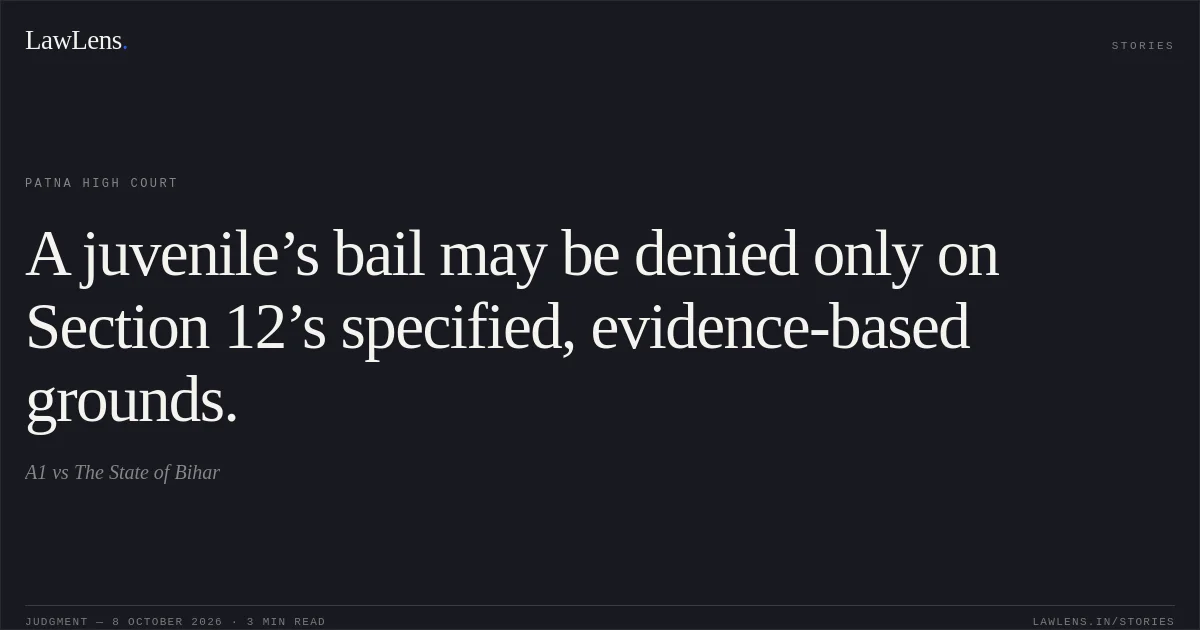
The four appellants, children in conflict with law (CICLs), appealed against separate orders dated 17 February 2026 of the Children Court, Siwan, refusing them bail under Section 12 of the Juvenile Justice (Care and Protection of Children) Act, 2015, in connection with Basantpur P.S. Case No. 485 of 2025.
Source reference: p. 2–4The prosecution alleged that the appellants and a co-accused killed the informant’s 18-year-old son and attempted to burn his body to destroy evidence; the case was based on circumstantial evidence, with no alleged eyewitness.
Source reference: p. 2–4The Children Court refused bail on the view that release could expose the appellants to danger and defeat the ends of justice, relying on the Social Investigation Report.
Source reference: p. 22–23Issues
1. Whether the Children Court’s refusal of bail was sustainable under Section 12 of the Juvenile Justice Act, 2015, in the absence of material supporting any of the statutory grounds for refusal.
Source reference: p. 7–8, 22–242. Whether the seriousness of the alleged offence or the appellants’ age could, by itself, justify refusing bail to a juvenile in conflict with law.
Source reference: p. 10–14, 23–24Law Applied
Section 12(1) of the Juvenile Justice Act, 2015, provides that a child alleged to be in conflict with law is to be released on bail, with or without surety, or placed under supervision or the care of a fit person.
Source reference: p. 7–8Bail may be refused only where there are reasonable grounds to believe that release would bring the child into association with a known criminal, expose the child to moral, physical or psychological danger, or defeat the ends of justice; the reasons and supporting circumstances must be recorded.
Source reference: p. 7–8The Court relied on Juvenile in Conflict with Law v. State of Rajasthan, Re: Exploitation of Children in Orphanages in the State of T.N. v. Union of India, and decisions of various High Courts for the principles that the statutory exceptions must be specifically supported by material and that the offence’s gravity is not, by itself, a ground to deny bail.
Source reference: p. 8–14It further considered Sections 3 and 15(2) of the Act, including the principles of the child’s best interests, family responsibility, institutionalisation as a last resort, and the relevance of the Social Investigation Report.
Source reference: p. 15–21Reasoning
The High Court examined the Children Court’s orders and the Social Investigation Reports.
Source reference: p. 22–23Although the Children Court had inferred that the appellants’ release might expose them to danger and defeat the ends of justice, the reports did not show that they had been in contact with known criminals, had been neglected by their parents, or would face moral, physical or psychological danger if released.
Source reference: p. 22–23The Court held that the Children Court’s conclusion on the ends of justice was misconceived: under the Act, that ground must be assessed in light of the child’s welfare, development and rehabilitation, and cannot rest solely on the heinous nature of the alleged offence.
Source reference: p. 23–24As the statutory grounds for refusing bail were not established by the material, the refusal was unsustainable.
Source reference: p. 23–24Holding
The Court allowed all four appeals and set aside the impugned bail orders.
It directed the appellants’ release on bail on bonds of ₹10,000 each, subject to undertakings by their respective fathers to supervise their habits, prevent contact with criminal persons, attend to their developmental needs, ensure that they continue their studies, and secure their attendance before the Court when required.
Source reference: p. 24–25Acts & Sections Cited
8 provisions across 2 statutes referred to in this judgment. Each provision opens on LawLens.
Bharatiya Nyaya Sanhita, 20233
Juvenile Justice (Care and Protection of Children) Act, 2015.5
Original Court PDF
A1vsThe State of Bihar
Click to open original judgment
Original judgment, available to read, download and summarize on LawLens.in