Facts
The appellants claimed succession to and possession of lands bearing R.S. No. 259/1 measuring 10 acres 34 guntas and R.S. No. 259/2 measuring 11 acres at Devagiri village, Haveri Taluk.
Source reference: para. 2Respondents 3 and 4 filed applications in Form No. 7 claiming occupancy rights as tenants of the respective lands.
Source reference: para. 3Their claims were initially rejected, but their writ petitions were allowed and the matters were remanded to the Land Tribunal for fresh consideration.
Source reference: paras. 3–4On 30 January 2013, the Land Tribunal granted occupancy rights in favour of respondents 3 and 4.
Source reference: para. 5The appellants challenged that order in W.P. No. 79389 of 2013.
Source reference: para. 6The learned Single Judge dismissed the writ petition on 23 November 2022, holding, inter alia, that the presence of all five Tribunal members was sufficient and that the non-signature of one member did not invalidate the order.
Source reference: paras. 6, 28In the writ appeal, the appellants contended that the Tribunal’s order was invalid because one member who had heard the matter had not signed it, contrary to Rule 17(8) of the Karnataka Land Reforms Rules, 1974.
Source reference: paras. 9–12Issues
Whether an order of a multi-member Land Tribunal is legally valid when it is not signed by one of the members who heard the case, despite the presence of the prescribed quorum?
Source reference: paras. 14–18, 20–21Whether the learned Single Judge erred in upholding the Land Tribunal’s order on the ground that the presence of all members at the hearing and pronouncement was sufficient compliance with Rule 17(8)?
Source reference: para. 28Law Applied
The Court applied Rule 16 of the Karnataka Land Reforms Rules, 1974, which prescribes a quorum of three members, including the Chairman, for a Tribunal meeting.
Source reference: para. 16It separately applied Rule 17(8), which mandates that an order be signed by the Chairman and all other members of the Tribunal who heard the case; the Court treated this as a mandatory procedural requirement distinct from the quorum requirement.
Source reference: paras. 15, 17–18Rule 17(9), requiring Tribunal orders to be speaking orders, was also noted.
Source reference: para. 15Relying principally on Vijaya Bank Founders Branch v. Secretary to Government of Karnataka, Revenue Department, ILR 2008 KAR 1481, the Court held that failure of all adjudicating members to sign the order is not a mere technical defect but goes to the root of the adjudication and renders the order a nullity.
Source reference: para. 23The Court also relied on Vishwanath v. State of Karnataka, W.P. No. 46938 of 2004, and Pundalik S/o Dattatraya Havaldhar v. State of Karnataka, W.P. No. 12383 of 2007, which treated non-compliance with Rule 17(8) as requiring the Tribunal’s order to be set aside.
Source reference: paras. 24–25Reasoning
The Tribunal’s order dated 30 January 2013 showed that the Chairman and three members had signed it, but Member No. 1, Sri Chandru Iliger, whose name appeared in the order as a member of the Tribunal, had not signed.
Source reference: paras. 19–20The Court distinguished the existence of quorum under Rule 16 from the obligation under Rule 17(8) to obtain the signatures of all members who heard the matter.
Source reference: para. 18Thus, even if the Tribunal was competent to conduct the proceedings because the quorum was present, the final adjudication was incomplete and legally defective unless every member who heard the case signed the order.
Source reference: para. 18Applying the binding principle in Vijaya Bank Founders Branch, the Court held that the omission affected the validity of the adjudication itself and was not curable as a technical lapse.
Source reference: paras. 23, 26–27The learned Single Judge’s reasoning that a member might have been absent when the order was pronounced, and that mere non-signature therefore did not invalidate the order, was rejected because Rule 17(8) expressly requires the signatures of all members who heard the case.
Source reference: para. 28Since the defect was dispositive, the Court did not examine the appellants’ remaining objections concerning possession, mutation entries, merits of the tenancy claims, or the Tribunal’s reasons.
Source reference: paras. 12, 29Holding
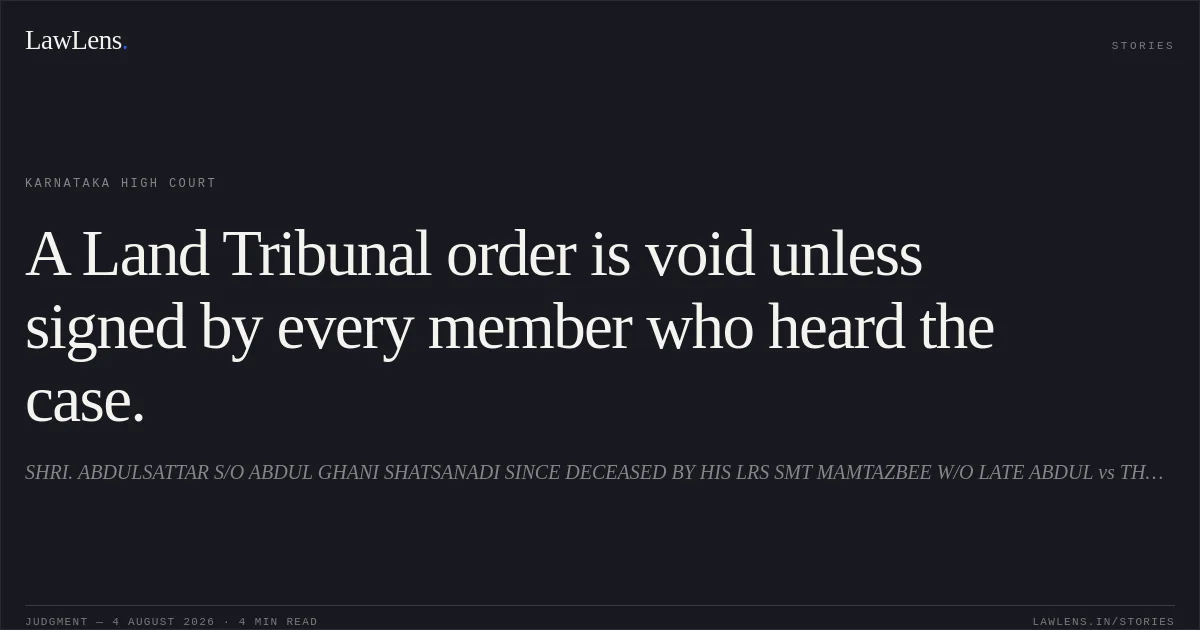
The Court answered the issues in favour of the appellants and held that the Land Tribunal’s order was void ab initio for non-compliance with Rule 17(8) of the Karnataka Land Reforms Rules, 1974.
The writ appeal was allowed; the learned Single Judge’s order dated 23 November 2022 was set aside, and the matter was remanded to the Land Tribunal for fresh determination in accordance with law, after considering all contentions of the parties.
Source reference: Order, clauses (i)–(iii)The Tribunal was directed to dispose of the matter expeditiously, within six months from the date of its constitution.
Source reference: Order, clause (iv)Original Court PDF
SHRI. ABDULSATTAR S/O ABDUL GHANI SHATSANADI SINCE DECEASED BY HIS LRS SMT MAMTAZBEE W/O LATE ABDULvsTHE STATE OF KARNATAKA
Click to open original judgment
Original judgment, available to read, download and summarize on LawLens.in