Facts
The Plaintiff, a freight-forwarding company, claimed that Hapag-Lloyd AG quoted and confirmed bookings for 510 containers in February 2022, but cancelled them the next day.
Source reference: paras. 2–4It sued Hapag-Lloyd (India) Private Limited, the Indian subsidiary and alleged agent of Hapag-Lloyd AG, for damages including loss of profits, business opportunities and reputation, and sought interim asset-disclosure, attachment and security reliefs.
Source reference: paras. 2–4, 14–15The Defendant applied to reject the plaint under Order VII Rule 11 CPC, principally alleging failure to comply with Section 12A of the Commercial Courts Act, 2015 and that the suit could not be maintained against an agent of a disclosed foreign principal under Section 230 of the Contract Act.
Source reference: paras. 5–9, 16The Plaintiff applied to amend the plaint after the rejection application had been filed; the Court decided the rejection application first because the objections went to the root of maintainability.
Source reference: paras. 17–22Issues
Whether the Plaintiff exhausted the pre-institution mediation remedy required by Section 12A before instituting the suit, and whether the suit contemplated urgent interim relief.
Source reference: paras. 23–45Whether the suit could be maintained against the Defendant as the Indian agent of a disclosed foreign principal, having regard to Section 230 of the Contract Act.
Source reference: paras. 46–58Whether the plaint should be rejected or returned on the ground that the parties had agreed to the exclusive jurisdiction of the Courts at Hamburg.
Source reference: paras. 59–60Law Applied
Section 12A(1) of the Commercial Courts Act requires a plaintiff in a commercial suit that does not contemplate urgent interim relief to exhaust, not merely initiate, pre-institution mediation.
Source reference: paras. 24–25, 32Under Order VII Rule 11 CPC, a suit instituted without that mandatory compliance is liable to have its plaint rejected; Patil Automation Private Limited v. Rakheja Engineers Private Limited and Dhanbad Fuels Pvt. Ltd. v. Union of India establish the mandatory nature of Section 12A and the test that urgency is assessed from the standpoint of the plaintiff, while guarding against a merely pretextual claim of urgency.
Source reference: paras. 24–25, 32Rule 3 of the Commercial Courts (Pre-Institution Mediation and Settlement) Rules, 2018 sets out the mediation process, which concludes upon settlement, a non-settlement report or a non-starter report.
Source reference: paras. 29–31Section 230 of the Contract Act provides that, absent a contract to the contrary, an agent is not personally bound by or entitled to enforce a contract made on behalf of a principal; its statutory exceptions include a contract made by an agent for the sale or purchase of goods for a merchant resident abroad, a principal whose name is undisclosed, or a disclosed principal who cannot be sued.
Source reference: paras. 47–48The Court applied Midland Overseas v. M.V. “CMBT Tana” and M.V. X-Press Annapurna v. Gitanjali Woolens Pvt. Ltd., and distinguished Cochin Frozen Foods Exports (P) Ltd. v. Vanchinad Agencies, which concerned the statutory sale-or-purchase-of-goods exception.
Source reference: paras. 49–57Reasoning
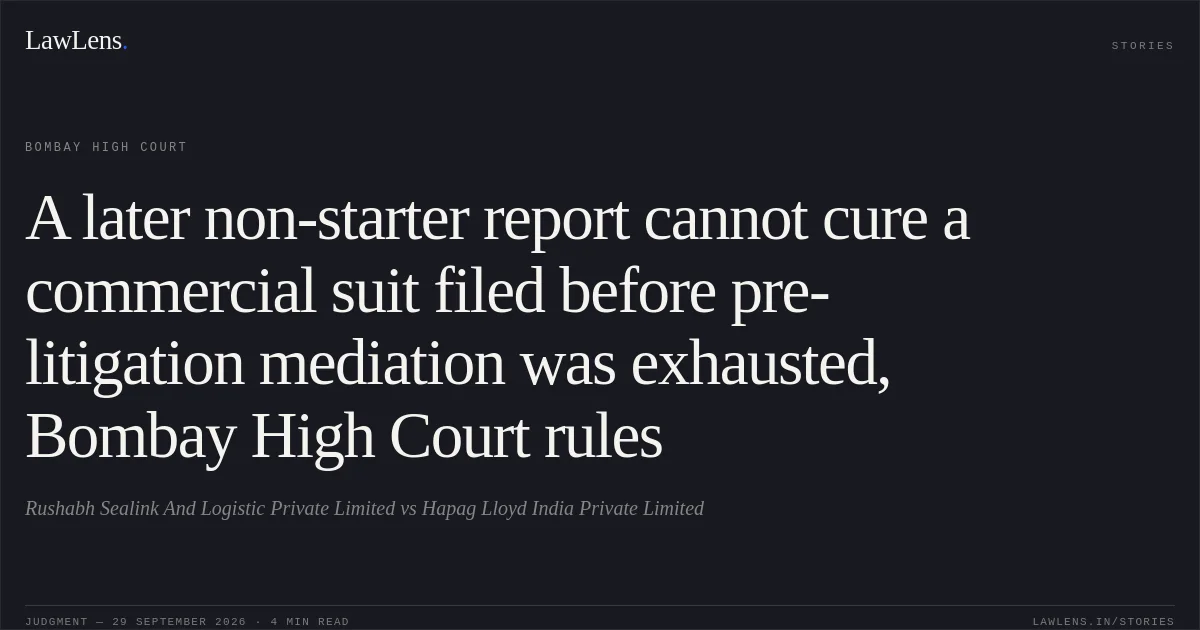
The Plaintiff applied for mediation on 21 February 2025 but instituted the suit on 26 February 2025, before the mediation centre had issued its first notice; the non-starter report followed on 9 May 2025.
Source reference: paras. 27–35The Court held that the later report could not cure non-compliance existing when the suit was filed.
Source reference: paras. 27–35Although a suit may be filed before mediation concludes if urgency arises after mediation begins, no such intervening urgency was pleaded or shown; the Plaintiff had also chosen to initiate mediation, and the suit concerned monetary damages arising from events in 2022, with no genuine urgent interim relief demonstrated.
Source reference: paras. 36–43Separately, the plaint and booking documents showed that Hapag-Lloyd AG was the contracting principal and the Defendant was identified as its agent or booking contact.
Source reference: paras. 46–48, 58The claim arose from carriage arrangements, not a sale or purchase of goods; the principal was disclosed, and the plaint did not plead a contract making the agent personally liable or that the principal could not be sued.
Source reference: paras. 46–48, 58The Court therefore found no applicable Section 230 exception.
Source reference: paras. 46–48, 58Because the suit was not maintainable against the Defendant, the Court left the Hamburg-jurisdiction issue open for any suit brought against Hapag-Lloyd AG.
Source reference: para. 59Holding
The Court held that the Plaintiff had not complied with Section 12A and that the suit against the Defendant was barred by Section 230 of the Contract Act.
It rejected the plaint under Order VII Rule 11 CPC and consequently dismissed Commercial Suit No. 59 of 2025; Interim Application No. 2847 of 2026 was allowed, with no order as to costs.
Source reference: paras. 60–62The Court did not decide the alleged Hamburg exclusive-jurisdiction clause, leaving that question open.
Source reference: para. 59Acts & Sections Cited
5 provisions across 3 statutes referred to in this judgment. Each provision opens on LawLens.
Indian Contract Act, 18721
Code of Civil Procedure, 19081
Mediation Act, 20233
Original Court PDF
Rushabh Sealink And Logistic Private LimitedvsHapag Lloyd India Private Limited
Click to open original judgment
Original judgment, available to read, download and summarize on LawLens.in