Facts
The petitioners, a company and its two directors/co-borrowers, obtained a business loan of ₹35,24,981 from the respondent, an NBFC, under a Business Loan–Sanction Cum Facility Agreement dated 30 April 2025.
Source reference: p.1–2, paras 2–3Clause 10.5 provided that disputes would be referred to a sole arbitrator appointed by the lender, with New Delhi as the seat of arbitration.
Source reference: p.2, para 5Following alleged default and a loan recall notice dated 14 November 2025, the respondent purported to confer its appointing power upon CNICA without the petitioners’ concurrence.
Source reference: p.2–3, paras 4, 7CNICA thereafter appointed Mr. Nishant S. Diwan as sole arbitrator at the respondent’s request.
Source reference: p.3, para 8The petitioners were not consulted regarding the constitution of the tribunal and did not consent to the appointment.
Source reference: p.3, para 9During the proceedings, interim directions were allegedly issued resulting in liens being marked over the petitioners’ bank accounts.
Source reference: p.3–4, para 10The petitioners consequently sought termination of the arbitrator’s mandate under Sections 14 and 15 of the Arbitration and Conciliation Act, 1996 (“A&C Act”), and a stay of the arbitral proceedings and interim directions.
Source reference: p.4, para 11During the hearing, both parties consented to termination of the mandate of the unilaterally appointed arbitrator.
Source reference: p.4, para 14Issues
1. Whether the appointment of a sole arbitrator under a clause conferring exclusive appointing power upon the lender is impermissible under the A&C Act and renders the arbitrator de jure unable to perform his functions under Section 14(1)(a).
Source reference: p.4–6, paras 15–202. Whether the respondent could cure the invalid unilateral appointment by unilaterally transferring its appointing power to CNICA after disputes had arisen, without the petitioners’ consent.
Source reference: p.8–9, paras 24–263. Whether the proceedings and interim directions, including the orders resulting in liens over the petitioners’ bank accounts, were legally operative despite the invalid constitution of the tribunal.
Source reference: p.9–10, paras 27–304. Whether, upon termination of the arbitrator’s mandate, a substitute arbitrator should be appointed under Section 15(2) of the A&C Act.
Source reference: p.10–11, paras 31–36Law Applied
Section 12(5) read with the Seventh Schedule of the A&C Act renders a person having a prohibited relationship with a party or the dispute ineligible to act as arbitrator; such ineligibility makes the arbitrator de jure unable to perform his functions under Section 14(1)(a), as held in TRF Ltd. v. Energo Engineering Projects Ltd., (2017) 8 SCC 377, and HRD Corporation v. GAIL (India) Ltd., (2018) 12 SCC 471.
Source reference: p.5, paras 16–17Under Perkins Eastman Architects DPC v. HSCC (India) Ltd., (2020) 20 SCC 760, an interested party cannot possess the exclusive power to appoint a sole arbitrator.
Source reference: p.6, para 18The Constitution Bench decision in Central Organisation for Railway Electrification v. ECI-SPIC-SMO-MCML (JV), (2025) 4 SCC 641, and Bhadra International (India) Pvt. Ltd. v. Airports Authority of India, 2026 SCC OnLine SC 7, establish that Section 18’s equal-treatment principle applies to the constitution of the tribunal, that unilateral appointment by an interested party is invalid, and that the mandate of an ineligible arbitrator terminates automatically.
Source reference: p.6–7, paras 19–20The same rule applies to lender-borrower arbitrations, as recognised in Kotak Mahindra Bank Ltd. v. Narendra Kumar Prajapat, 2023 SCC OnLine Del 3148, and M/s Upper India Trading Co. Pvt. Ltd. v. M/s Hero Fincorp Ltd., 2024 SCC OnLine Del 1477.
Source reference: p.8, para 23A post-dispute waiver of Section 12(5) requires an express written agreement; mere participation or implication is insufficient.
Source reference: p.7, para 20; p.9, para 26Upon termination, a substitute arbitrator may be appointed under Section 15(2).
Source reference: p.10, para 31Reasoning
Clause 10.5 vested the exclusive power to appoint the sole arbitrator in the respondent/lender, an interested party with a direct stake in the outcome of the loan dispute; the petitioners had no corresponding role in constituting the tribunal.
Source reference: p.8–9, para 24This appointment procedure was therefore inconsistent with the equal-treatment requirement and the prohibition against unilateral appointment under Sections 12(5) and 18 of the A&C Act.
Source reference: p.8–9, para 24The respondent’s purported transfer of its appointing power to CNICA did not alter the substance of the arrangement because CNICA was neither designated as the arbitral institution under the Facility Agreement nor jointly selected by the parties.
Source reference: p.3, 8–9, paras 7–8, 25Its appointment was made solely at the respondent’s request and resulted from the respondent’s unilateral post-dispute act.
Source reference: p.3, 8–9, paras 7–8, 25The indirect appointment mechanism could not achieve what the respondent was prohibited from doing directly.
Source reference: p.8–9, paras 24–25There was also no express written post-dispute agreement waiving Section 12(5), and the petitioners had challenged the tribunal’s constitution at the earliest opportunity.
Source reference: p.9, para 26Accordingly, the arbitrator was de jure unable to act, and the proceedings conducted by the invalidly constituted tribunal, including the interim directions concerning bank-account liens, were non est in law.
Source reference: p.9–10, paras 27–28Since the reference itself survived termination of the mandate, the Court appointed a substitute arbitrator under Section 15(2).
Source reference: p.10–11, paras 31–36Holding
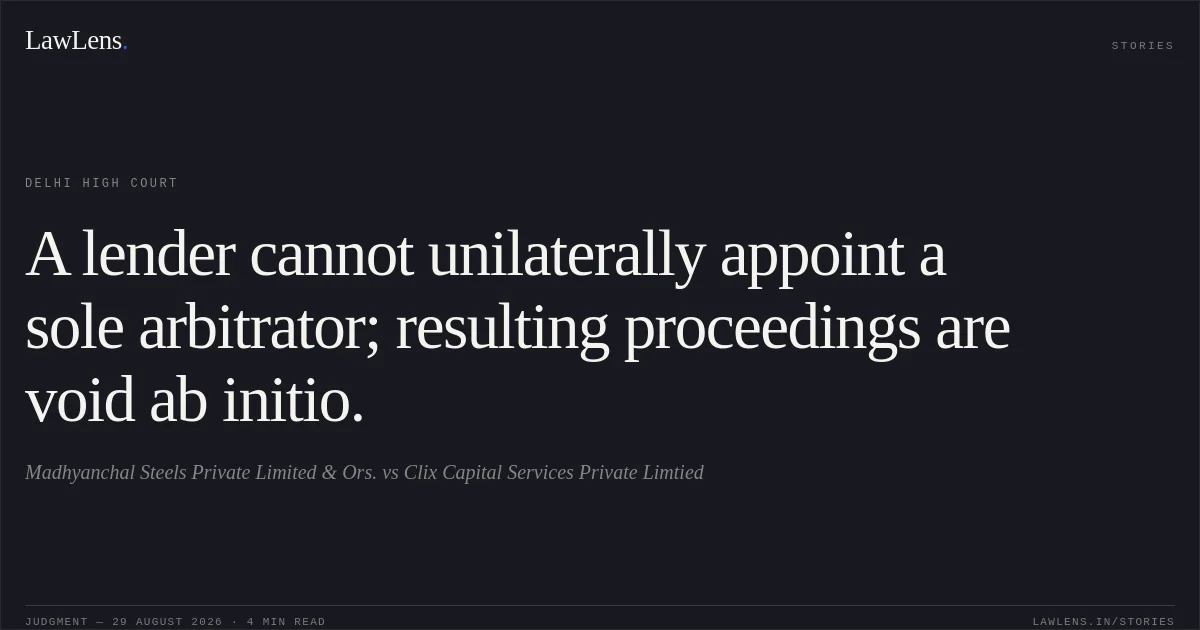
The Court terminated the mandate of Mr. Nishant S. Diwan under Section 14(1)(a), holding that his appointment pursuant to the lender-controlled appointment mechanism was void ab initio and that the subsequent CNICA appointment did not cure the defect.
The arbitral proceedings in Arbitration Case No. CC/NSD/CNICA/58/2026 and all orders passed therein, including the orders dated 13 February 2026 and 11 April 2026, were declared non est and were directed not to be acted upon.
Source reference: p.10, para 29(i)The liens over the petitioners’ accounts with Kotak Mahindra Bank and HDFC Bank were held inoperative, and the petitioners were permitted to communicate the order to the concerned banks.
Source reference: p.10, para 29(ii)–(iii)The Court appointed Dr. Abhimanyu Chopra, Advocate, as the independent sole arbitrator, directed that the arbitration proceed afresh under the aegis and rules of the Delhi International Arbitration Centre, and kept all claims, counterclaims, rights and contentions open on the merits.
Source reference: p.10–11, paras 34–38The petition and connected application were disposed of accordingly.
Source reference: p.10–11, paras 30, 39Acts & Sections Cited
6 provisions across 1 statute referred to in this judgment. Each provision opens on LawLens.
Arbitration and Conciliation Act, 19966
Original Court PDF
Madhyanchal Steels Private Limited & Ors.vsClix Capital Services Private Limtied
Click to open original judgment
Original judgment, available to read, download and summarize on LawLens.in
![A police constable cannot be removed for unauthorized absence without a Rule 359-compliant inquiry.. Mohammad Sidiq Khan vs D/o Home Ut Of Jammu & Kashmir. CAT - ['Srinagar']. LawLens](/stories/thumbnails/a-police-constable-cannot-be-removed-for-unauthorized-absence-without-a-rule-359-compliant-7b43fc316bd94f22a62676153bbc9d54.webp)
![A Review DPC lacks authority to determine or alter inter se seniority.. SAURABH KUMAR vs REVENUE. CAT - ['Patna']. LawLens](/stories/thumbnails/a-review-dpc-lacks-authority-to-determine-or-alter-inter-se-seniority-4b21640f20af46fcabdfc8273d2ce959.webp)