Facts
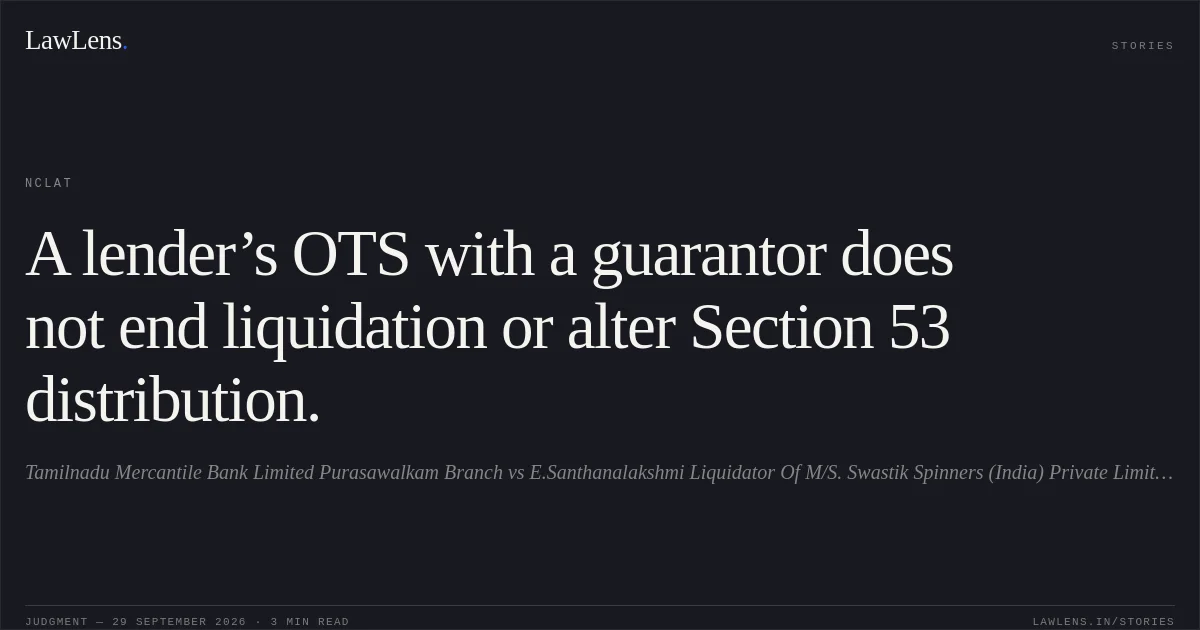
Swastik Spinners (India) Private Limited entered liquidation after its resolution plan was rejected.
Source reference: p. 6Its promoter and personal guarantor, S.V. Ramasamy, later paid Tamil Nadu Mercantile Bank (TMB) ₹9.50 crore under a one-time settlement (OTS), and the Bank issued an account-closure certificate.
Source reference: p. 6–9, 20An earlier NCLT order rejecting Ramasamy’s application to withdraw the company from liquidation and directing the liquidator to continue the process had attained finality.
Source reference: p. 6–9, 20In the liquidation, ₹54.31 lakh deposited as earnest money by an unsuccessful auction bidder, Sivajothi Spinning Mills, had been forfeited; ₹2,03,664 was taken as the liquidator’s fees and the balance was distributed to TMB.
Source reference: p. 7The NCLT subsequently permitted transfer of the corporate debtor’s assets to Ramasamy, directed repayment of the forfeited amount to the liquidation estate, and ordered payment of ₹20 lakh to the erstwhile liquidator, ₹4.5 lakh to the present liquidator, and the balance to an operational creditor under Section 53 of the Insolvency and Bankruptcy Code, 2016 (IBC).
Source reference: p. 4–5, 23–24TMB and Ramasamy appealed aspects of that order; the asset-transfer direction itself was not challenged.
Source reference: p. 5, 21–22Issues
1. Whether the OTS between TMB and Ramasamy affected the ongoing liquidation or entitled TMB to retain the forfeited earnest money.
Source reference: p. 20–232. Whether the forfeited amount could be applied toward the liquidators’ fees and the operational creditor’s admitted claim, and whether the erstwhile liquidator was entitled to ₹20 lakh.
Source reference: p. 23–253. Whether Ramasamy, by paying TMB’s debt, became a financial creditor entitled to claim the liquidation-estate proceeds ahead of the operational creditor.
Source reference: p. 25–26Law Applied
Under Section 53 of the IBC, liquidation-estate proceeds are distributed according to the statutory waterfall.
Source reference: p. 20The NCLAT treated the earlier, final NCLT order as establishing that the liquidation could not be withdrawn in the circumstances; it could proceed only through a scheme under Section 230 of the Companies Act, 2013, or a sale as a going concern.
Source reference: p. 20It also considered Regulations 33 and 37 of the IBBI (Liquidation Process) Regulations in relation to the NCLT’s treatment of the asset transfer as a private sale.
Source reference: p. 21A guarantor’s payment of a creditor’s debt does not, without assignment or substitution in the liquidation proceedings, make the guarantor a financial creditor entitled to the creditor’s former priority.
Source reference: p. 25–26Reasoning
The NCLAT held that the OTS between Ramasamy and TMB could not alter the liquidation process because the earlier order directing liquidation to continue had attained finality.
Source reference: p. 20It left the asset transfer undisturbed because that part of the NCLT’s order had not been appealed, while noting that the procedure was not strictly in accordance with the Code and Regulations.
Source reference: p. 22Once TMB had accepted ₹9.50 crore and issued an account-closure certificate, it could not retain the ₹52.27 lakh it had received from the forfeited deposit; that amount had to return to the liquidation estate for distribution.
Source reference: p. 22–23The NCLAT upheld the erstwhile liquidator’s ₹20 lakh remuneration, noting his work, the prior fixing of his fee, and the reduction of his claim, and accepted the liquidators’ confirmation that the operational creditor’s claim had been submitted and admitted.
Source reference: p. 24–25Ramasamy had not obtained an assignment of TMB’s debt or sought substitution as a creditor; the NCLAT therefore treated him as a purchaser and promoter, not a financial creditor entitled to the liquidation proceeds ahead of other stakeholders.
Source reference: p. 25–26Holding
The NCLAT dismissed all four appeals and declined to interfere with the NCLT’s order.
TMB could not retain the forfeited amount; the liquidation-estate funds were to be applied toward the liquidators’ fees and distributed to stakeholders, including the operational creditor, in accordance with Section 53.
Source reference: p. 26–27Ramasamy acquired no creditor priority merely by settling TMB’s debt.
Source reference: p. 26–27Acts & Sections Cited
3 provisions across 2 statutes referred to in this judgment. Each provision opens on LawLens.
Insolvency and Bankruptcy Code, 2016.2
Companies Act, 20131
Original Court PDF
Tamilnadu Mercantile Bank Limited Purasawalkam BranchvsE.Santhanalakshmi Liquidator Of M/S. Swastik Spinners (India) Private Limited & Ors.
Click to open original judgment
Original judgment, available to read, download and summarize on LawLens.in