Facts
The deceased was travelling in a tractor carrying Nilgiri wood logs when the tractor went into a roadside ditch and he was fatally trapped beneath the logs.
Source reference: p.1–2, para. 2The claimants sought compensation under Section 166 of the Motor Vehicles Act, 1988. The Tribunal awarded Rs. 9,85,328 with interest at 9% per annum and fastened liability on the relevant opponents.
Source reference: p.1–2, paras. 1, 2.2–2.3The insurer appealed under Section 173, contending that use of the tractor and attached trailer to carry logs breached the policy conditions.
Source reference: p.1, 4, paras. 1, 6The policy was a Miscellaneous and Special Type of Vehicle Package Policy; its premium included third-party cover, trailer cover, and Workmen’s Compensation risk for five employees.
Source reference: p.3–4, paras. 4–5Issues
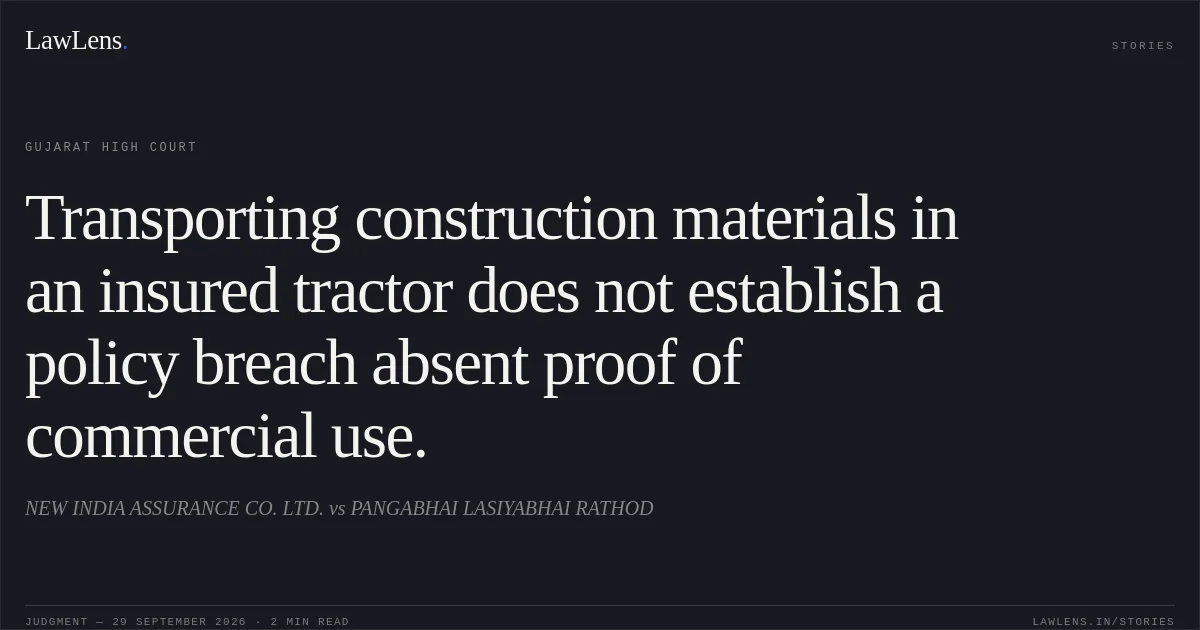
Whether carrying wooden logs in the insured tractor and trailer established a breach of the policy conditions that relieved the insurer of liability to satisfy the award.
Source reference: p.4, para. 6; p.6, para. 8Whether the Tribunal erred in fastening liability on the opponents despite the insurer’s asserted breach of policy conditions.
Source reference: p.6, paras. 8–9Law Applied
Section 149(2)(a)(i)(a) of the Motor Vehicles Act permits an insurer to rely on specified policy breaches, including unauthorised use of a vehicle, but the breach must be pleaded and proved; it cannot be presumed merely from the nature of the goods carried.
Source reference: p.4–6, para. 7Relying on Fahim Ahmad v. United India Insurance Co. Ltd., (2014) 14 SCC 148, the Court applied the rule that the insurer must substantiate an alleged breach with positive evidence, and that carrying goods does not by itself establish commercial use or use for a purpose other than agriculture.
Source reference: p.4–6, para. 7The cited decision also refers to National Insurance Co. Ltd. v. V. Chinnamma, JT 2004 (7) SC 167, concerning the distinction between agricultural carriage and commercial use.
Source reference: p.5, para. 7Reasoning
The insurer argued that carrying logs for house construction amounted to use outside the policy’s permitted purpose.
Source reference: p.4, para. 6Applying Fahim Ahmad, the Court held that the nature of the load alone did not establish commercial or otherwise unauthorised use.
Source reference: p.4–6, para. 7The policy particulars, including the premiums for third-party cover, the trailer, and Workmen’s Compensation risk, did not support the insurer’s contention that liability could be avoided.
Source reference: p.3–4, paras. 4–5, 8The Court therefore found no basis to displace the Tribunal’s liability finding.
Source reference: p.6, para. 8Holding
The Court answered the insurer’s challenge in the negative, holding that the appeal lacked merit.
It dismissed the appeal and confirmed the Tribunal’s judgment and award; any interim relief was vacated, and any amount deposited with the Registry or Tribunal was to be disbursed to the claimants in accordance with law.
Source reference: p.6, para. 10Acts & Sections Cited
4 provisions across 1 statute referred to in this judgment. Each provision opens on LawLens.
Motor Vehicles Act, 19884
Original Court PDF
NEW INDIA ASSURANCE CO. LTD.vsPANGABHAI LASIYABHAI RATHOD
Click to open original judgment
Original judgment, available to read, download and summarize on LawLens.in