Facts
The plaintiff brought a claim for compensation for injuries suffered during his employment with defendant no. 2.
Source reference: no citationDefendant no. 1, initially deleted from the suit, was re-impleaded pursuant to a Division Bench order that also directed framing an issue on its liability. The Supreme Court declined to interfere with that order but permitted defendant no. 1 to file an additional written statement, directed that additional issues be framed on its basis, and left open whether it was a necessary or proper party.
Source reference: pp. 2–5, paras. 3–7Defendant no. 1 then applied under Order XIV Rule 5 CPC to frame issues concerning its status as a party, an Ohio court’s stay order, res judicata, and the effect of a 2021 equity transfer.
Source reference: p. 5, para. 8Issues
1. Whether an issue should be framed on whether defendant no. 1 is a necessary or proper party to the suit
Source reference: p. 6, paras. 10–112. Whether additional issues should be framed concerning the Ohio court’s stay order and the alleged dismissal of the plaintiff’s claims there on res judicata grounds
Source reference: pp. 6–7, paras. 12–133. Whether an issue should be framed on the maintainability of the claim against defendant no. 1 after the equity transfer dated 1 February 2021, conditional on the relevant prior issues being decided for the plaintiff
Source reference: p. 7, para. 13Law Applied
Order XIV Rule 5 CPC empowers the court to frame or amend issues where necessary for determining the matters in controversy.
Source reference: no citationThe Supreme Court’s order dated 4 December 2024 expressly permitted defendant no. 1 to raise, through an additional written statement, contentions including that it was not a necessary or proper party and that the claim was barred by limitation; it directed the trial court to frame additional issues based on that pleading and left the party-status question open.
Source reference: p. 4, para. 7The Division Bench had earlier directed an issue on whether defendant no. 1 was liable to pay damages, while clarifying that re-impleadment did not determine liability.
Source reference: p. 3, para. 6Reasoning
The Court treated the Supreme Court’s express reservation of the party-status question as requiring a corresponding issue to be framed.
Source reference: p. 6, para. 11It also found that the existing issue on defendant no. 1’s liability did not address the distinct questions raised by the Ohio stay order or the alleged rejection of the plaintiff’s claims in Ohio; those matters therefore required separate issues.
Source reference: pp. 6–7, paras. 12–13The proposed issue concerning the equity transfer was consequential on the determination of the stay and res judicata issues and was also necessary for the trial.
Source reference: pp. 6–7, paras. 12–13The Court framed the issues for trial without deciding their merits.
Source reference: no citationHolding
The application under Order XIV Rule 5 CPC was allowed.
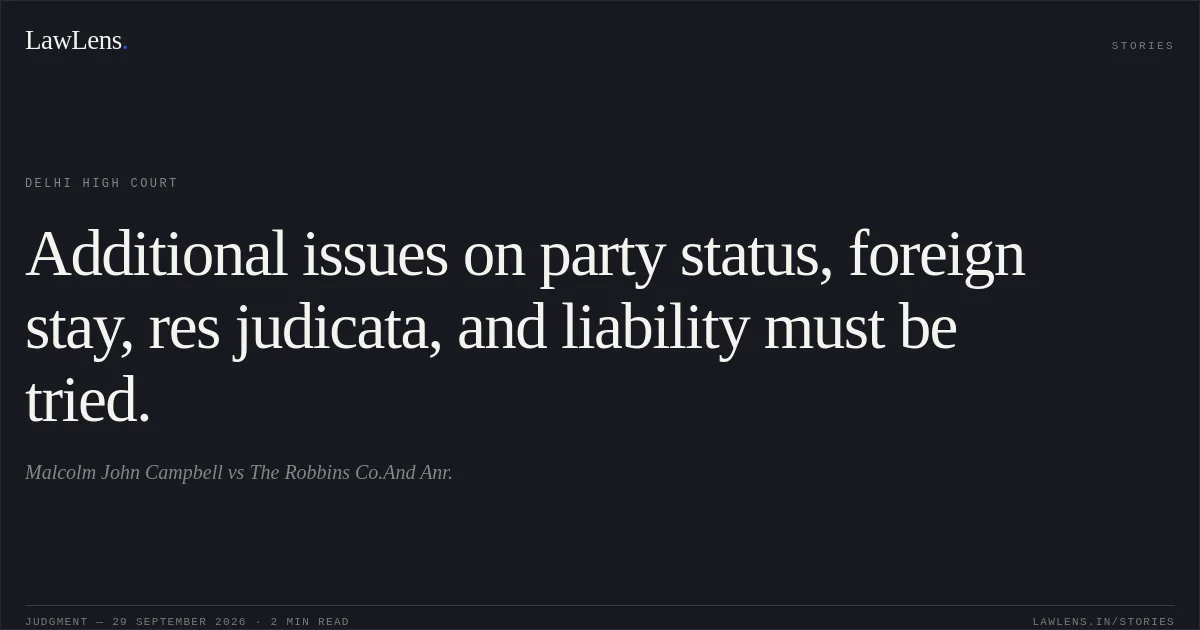
The Court added issues concerning defendant no. 1’s status as a party, the Ohio stay order, res judicata, and the effect of the equity transfer, alongside the previously framed issues, including defendant no. 1’s liability.
Source reference: pp. 7–9, paras. 14–17The plaintiff was given liberty to rely on the existing evidence affidavit or file a fresh one, and the matter was listed before the Joint Registrar for recording evidence on 1 October 2026.
Source reference: p. 10, paras. 18–19Original Court PDF
Malcolm John CampbellvsThe Robbins Co.And Anr.
Click to open original judgment
Original judgment, available to read, download and summarize on LawLens.in