Facts
Lalita Sadhukhan held a lease of the suit property from the Calcutta Port Trust, now the Kolkata Port Trust (“KoPT”). She granted a sub-lease to Panchkari Paramanick on 13 December 1965, and Panchkari granted a further sub-lease to the appellants on 16 December 1965. Both sub-leases were coextensive and expired on 8 February 1975 by efflux of time under Section 111(a) of the Transfer of Property Act, 1882 (“TPA”).
Source reference: para. 37–39The plaintiffs instituted Ejectment Suit No. 84 of 1977 on 18 December 1977 for eviction of the appellants, despite the expiry of their own leasehold interest and that of their immediate lessor.
Source reference: para. 40, 45–46Before institution of the suit, KoPT had issued an eviction notice to Lalita and had instituted Ejectment Suit No. 1444 of 1974 against her. That suit was decreed on 20 December 1979, and execution proceedings were initiated in 1991. KoPT subsequently attempted to obtain possession, leading to proceedings under Order XXI Rule 97 of the Code of Civil Procedure, 1908 (“CPC”).
Source reference: para. 40–44The learned Single Judge decreed eviction in favour of the plaintiffs on 6 May 2014 and subsequently awarded mesne profits. The appellants challenged both decrees in APD Nos. 56 and 183 of 2015. They also sought admission of documents relating to the KoPT proceedings as additional evidence under Order XLI Rule 27 CPC.
Source reference: para. 1–3, 27Issues
Whether the documents relating to KoPT’s eviction and execution proceedings should be admitted as additional evidence under Order XLI Rule 27 CPC?
Source reference: paras. 27–34Whether the plaintiffs had any subsisting leasehold right, title, possession, or locus standi to institute and maintain the eviction suit against the appellants after expiry of the relevant leases by efflux of time?
Source reference: paras. 35–46, 66–67Whether the appellants were barred by Section 116 of the Indian Evidence Act, 1872 from disputing the title of their lessor, particularly in light of KoPT’s eviction decree against the superior lessor?
Source reference: paras. 47–65Whether the decree for mesne profits could survive after the eviction decree was set aside?
Source reference: paras. 70–71Law Applied
The Court applied Order XLI Rule 27(1)(b) and Rule 27(2) CPC, which permit an appellate court to admit additional evidence when it requires the evidence to pronounce judgment or for any other substantial cause, provided reasons are recorded.
Source reference: paras. 27–32Section 111(a) TPA provides that a lease is determined by efflux of the time limited by the lease, while Section 108(q) requires the lessee to put the lessor into possession upon determination of the lease.
Source reference: paras. 5, 39Section 116 of the Indian Evidence Act embodies the tenant’s estoppel against denying that the landlord had title at the commencement of the tenancy; however, the Court relied on Vashu Deo v. Balkishan, (2002) 2 SCC 50, for the principle that eviction by paramount title may permit repudiation of the immediate landlord’s title where the paramount title-holder has a legally enforceable process for eviction.
Source reference: paras. 47–65It also relied on Kewal Chand Mimani v. S.K. Sen, (2001) 6 SCC 512, concerning loss of possessory and leasehold rights where the lessee is deprived of possession and the lease is terminated.
Source reference: paras. 47–65The Court distinguished In Re: Ganesh Trading Co. Pvt. Ltd., AIR 1985 Cal 37, and considered Vithalbhai Pvt. Ltd. v. Union Bank of India, 1992 SCC OnLine Cal 34, as well as Vithalbhai (P) Ltd. v. Union Bank of India, (2005) 4 SCC 315.
Source reference: paras. 29–32, 47–65It further relied on Charu Diesels LLP v. E.L. Properties (P) Ltd., 2025 SCC OnLine Cal 4255, which applied the relevant Supreme Court principles.
Source reference: paras. 29–32, 47–65Reasoning
The Court allowed the application under Order XLI Rule 27 because the KoPT proceedings were directly relevant to the plaintiffs’ title and locus, and their non-production was attributable to the plaintiffs’ suppression rather than any laches by the appellants; both parties had also addressed the issue on appeal.
Source reference: paras. 27–34On the merits, the Court held that the appellants’ sub-lease and the plaintiffs’ derivative leasehold interest had both expired on 8 February 1975, nearly two years before institution of the eviction suit.
Source reference: paras. 37–46Since the plaintiffs had already parted with possession by granting the sub-lease, they could not claim that they remained in physical possession when their leasehold interest expired.
Source reference: paras. 48–49, 63–64The Court further held that KoPT, as paramount title-holder, had obtained an eviction decree against Lalita and had initiated execution proceedings, thereby establishing a legal process for eviction that could not lawfully be resisted by Lalita or those claiming through her.
Source reference: paras. 56–61The fact that the appellants continued in possession, and that KoPT’s execution application was later dismissed for default, did not restore the plaintiffs’ expired leasehold rights or confer upon them a right to recover possession.
Source reference: paras. 62–67Accordingly, the case concerned not merely the evidentiary estoppel under Section 116 but the plaintiffs’ fundamental lack of locus standi and maintainable title on the date of suit.
Source reference: paras. 62–67The Court concluded that the principle in Ganesh Trading had been implicitly displaced by the later Supreme Court authorities relied upon in the judgment.
Source reference: paras. 54–65Holding
The Court allowed GA No. 4 of 2019 and admitted the additional documents under Order XLI Rule 27 CPC.
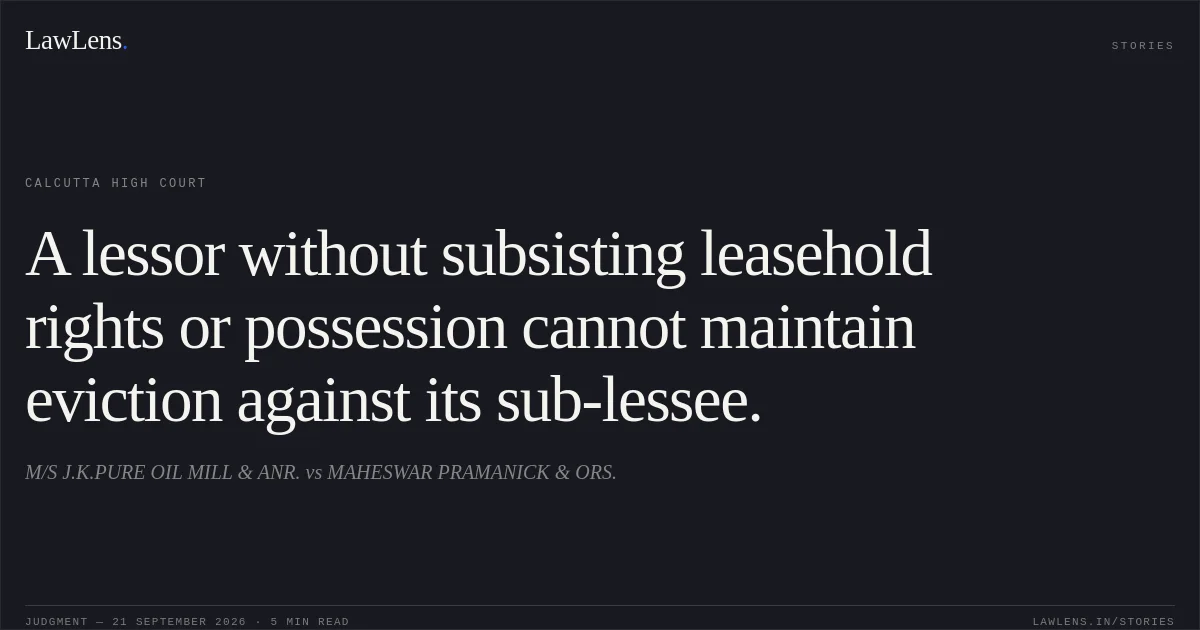
It held that the plaintiffs had no subsisting leasehold right, title, possession, or locus standi to maintain the eviction suit when it was instituted on 18 December 1977.
Source reference: paras. 66–69APD No. 56 of 2015 was therefore allowed, and the eviction judgment and decree dated 6 May 2014 in CS No. 84 of 1977 were set aside.
Source reference: paras. 66–69Since the eviction decree was set aside, the appellants’ possession could not be treated as unlawful for the purposes of mesne profits.
Source reference: paras. 70–71APD No. 183 of 2015 was consequently allowed and the decree for mesne profits was also set aside.
Source reference: paras. 70–71All steps taken pursuant to the impugned decrees were annulled, with no order as to costs.
Source reference: paras. 72–74Acts & Sections Cited
2 provisions across 1 statute referred to in this judgment. Each provision opens on LawLens.
Transfer of Property Act, 18822
Original Court PDF
M/S J.K.PURE OIL MILL & ANR.vsMAHESWAR PRAMANICK & ORS.
Click to open original judgment
Original judgment, available to read, download and summarize on LawLens.in