Facts
Second Appeal No. 660 of 2006 was dismissed for want of prosecution on 5 February 2025 because the appellant’s arguing counsel was engaged before another Bench.
Source reference: para. 7The applicant thereafter filed MCC No. 897 of 2025 for restoration of the second appeal, but that MCC was dismissed on 14 May 2025 for non-compliance with a conditional/peremptory order. A subsequent MCC No. 3361 of 2025 met the same fate on 25 November 2025 for non-compliance with another peremptory order.
Source reference: para. 7The applicant filed the present MCC seeking restoration of both earlier MCCs and, ultimately, restoration of the second appeal.
Source reference: para. 8The application under Section 5 of the Limitation Act was itself delayed by 81 days.
Source reference: paras. 2–4, 10–11Issues
Whether the 81-day delay in filing the present restoration application should be condoned under Section 5 of the Limitation Act?
Source reference: paras. 1–5Whether the dismissal of MCC Nos. 897 of 2025 and 3361 of 2025 for non-compliance with peremptory orders justified restoration of the underlying Second Appeal No. 660 of 2006?
Source reference: paras. 6–14Whether the applicant could be granted restoration of the second appeal directly, subject to payment of costs, instead of first restoring the earlier MCCs?
Source reference: paras. 16–18Law Applied
The Court applied Section 5 of the Limitation Act, 1963, under which delay may be condoned where sufficient cause is shown and the interests of justice so require.
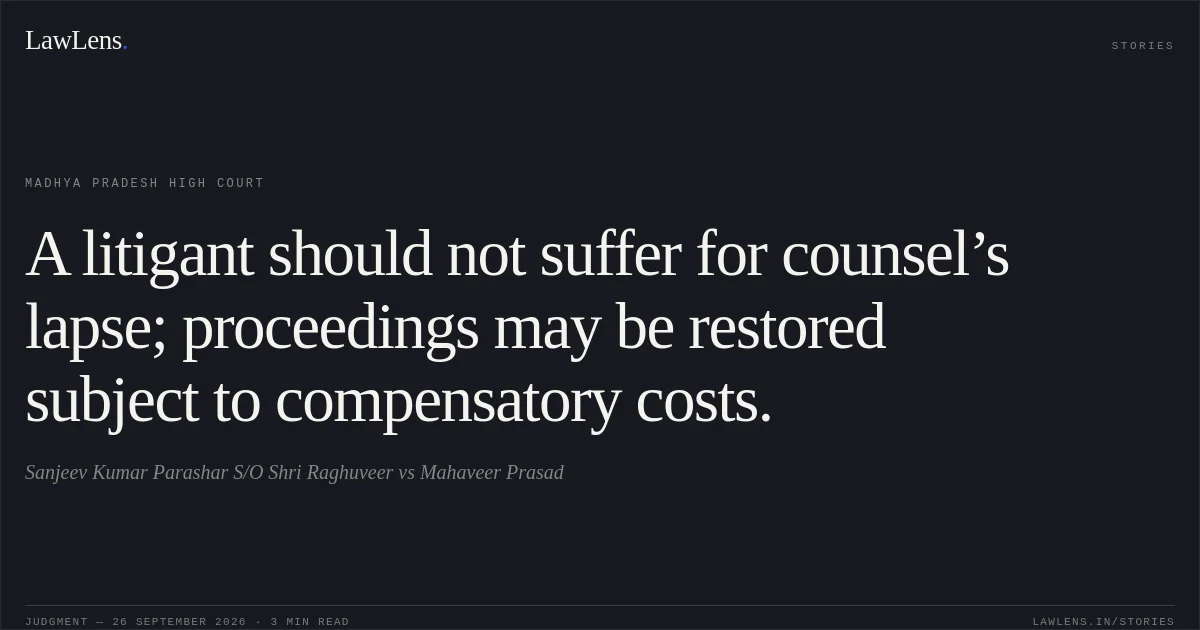
Source reference: paras. 1–5It also applied the principle that a litigant should not ordinarily suffer for the bona fide mistake or lapse of counsel, relying on Rafiq & Anr. v. Munshilal & Anr., AIR 1981 SC 1400, which holds that a party should not be penalised for the fault of his advocate.
Source reference: para. 15At the same time, the Court recognised that restoration may be granted on terms that compensate the opposing party and ensure compliance with the Court’s process.
Source reference: paras. 16–18Reasoning
The Court found the explanation for the non-appearance in Second Appeal No. 660 of 2006 bona fide because the arguing counsel was engaged before another Bench, and this factual assertion had not been disputed by the respondent.
Source reference: para. 13Although the applicant’s explanation for failing to cure defects in the two earlier MCCs was not satisfactory—particularly because other assisting counsel were reflected in the cause list—the Court treated the dismissals as attributable to counsel’s lapse rather than a deliberate abandonment by the applicant.
Source reference: para. 14Applying the principle in Rafiq, the Court held that refusing restoration would cause the applicant to suffer for his counsel’s default.
Source reference: para. 15Since all the earlier MCCs ultimately sought restoration of the same second appeal, the Court considered it unnecessary to revive each MCC sequentially. The respondent’s inconvenience was addressed by imposing compensatory costs, and the objection regarding court fee was rejected because court fee had already been paid for each MCC.
Source reference: para. 16Holding
The Court allowed the application under Section 5 of the Limitation Act and condoned the 81-day delay.
It allowed the present MCC and directed that Second Appeal No. 660 of 2006 be restored to its original number, subject to payment of ₹25,000 as costs to non-applicant No. 1 within fifteen days.
Source reference: para. 17Payment of the costs within that period was made a condition precedent to restoration; upon compliance, the Registry was directed to restore the appeal and list it for final hearing at the motion stage on 16 October 2026.
Source reference: para. 18The applicant’s counsel also undertook to argue the appeal on the date fixed.
Source reference: para. 19Acts & Sections Cited
1 provisions across 1 statute referred to in this judgment. Each provision opens on LawLens.
Limitation Act, 19631
Original Court PDF
Sanjeev Kumar Parashar S/O Shri RaghuveervsMahaveer Prasad
Click to open original judgment
Original judgment, available to read, download and summarize on LawLens.in