Facts
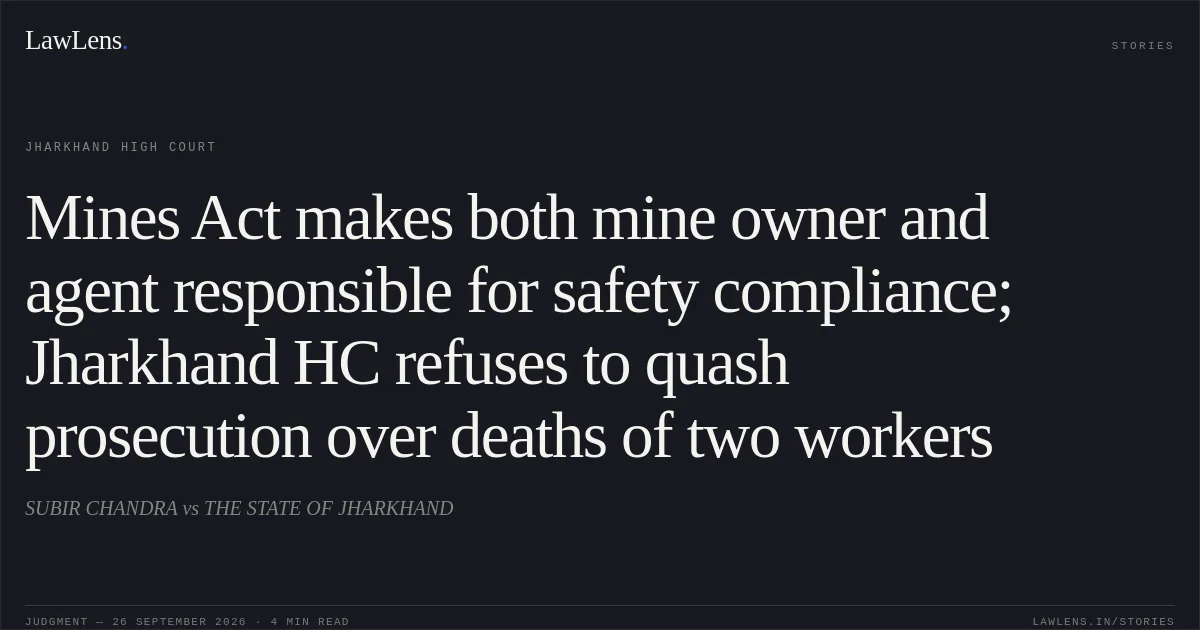
The petitioners—Subir Chandra, the then Director (Technical/Operation) and nominated owner of Sayal “D” Mine, and Prakash Chanda @ Prakash Chandra, the General Manager and Agent of the mine—invoked Section 482 of the Code of Criminal Procedure seeking quashing of the criminal proceedings and the order dated 08.02.2018 by which the Judicial Magistrate, Ramgarh, took cognizance in G (DGMS) Case No. 13 of 2018 for offences under Sections 70, 72A and 72C(1)(a) of the Mines Act, 1952.
Source reference: paras. 2–5The prosecution alleged that the petitioners failed to construct a proper retaining wall or convert the existing brick wall into a standard water dam, failed to adopt statutory safety precautions, and deployed workers in prohibited areas beneath and within 60 metres of water-logged workings.
Source reference: paras. 3–4The wall subsequently failed, causing a sudden rush of water into the underground mine, resulting in the deaths by drowning of two pump khalasis, Pravesh Nonia and Ashok Kumar.
Source reference: paras. 3–4The petitioners contended that Regulations 127(1), 127(3) and 129(1) of the Coal Mines Regulations, 1957, read with the relevant DGMS circular, were not attracted; that the nominated owner was primarily responsible for financial provisions while the agent was responsible for operational compliance; and that the water flow had existed for several years before their relevant tenure.
Source reference: para. 6The State and the Deputy Director of Mines Safety opposed quashing, asserting that the complaint contained direct and specific allegations against both petitioners and that their defences required evidence at trial.
Source reference: paras. 7–8Issues
Whether the criminal proceedings and the order taking cognizance dated 08.02.2018 were liable to be quashed under Section 482 CrPC on the ground that the alleged statutory provisions were not applicable to the petitioners?
Source reference: paras. 2, 6, 11–12Whether, under Section 18(1) of the Mines Act, 1952, the owner and the agent each bear responsibility for making financial and other provisions and taking necessary steps to ensure compliance with the Act, regulations, rules, bye-laws and orders?
Source reference: paras. 9–10Whether the petitioners’ assertions regarding their respective roles, tenure and alleged inapplicability of the regulations constituted grounds for quashing, or were matters of defence to be determined at trial?
Source reference: paras. 6–8, 11Law Applied
The Court applied Section 18(1) of the Mines Act, 1952, which provides that the owner and agent of every mine shall each be responsible for making financial and other provisions and taking necessary steps for compliance with the Act and the subordinate statutory instruments.
Source reference: para. 9It also considered the alleged contraventions of Regulations 127(1), 127(3) and 129(1) of the Coal Mines Regulations, 1957, read with DGMS Circular No. 7 of 1976, and the offences alleged under Sections 70, 72A and 72C(1)(a) of the Mines Act.
Source reference: paras. 2–5In exercising jurisdiction under Section 482 CrPC, the Court held that disputed questions requiring evidentiary adjudication cannot ordinarily be decided at the quashing stage.
Source reference: para. 11The Court distinguished the petitioners’ reliance on D.K. Basu @ Dilip Kumar Basu v. State of Jharkhand and relied on the principle reflected in Nageshwar Sharma v. State of Jharkhand, (2016) 4 JLJR 526, and A.K. Mishra @ Awadh Kishore Mishra v. State of Jharkhand, that specific allegations concerning statutory responsibility and compliance justify continuation of the criminal proceedings.
Source reference: paras. 7–8Reasoning
The Court interpreted the word “each” in Section 18(1) as imposing an independent and concurrent responsibility on both the owner and the agent.
Source reference: paras. 9–10It therefore rejected the petitioners’ argument that the owner’s duty was confined to making financial provisions while the agent alone was responsible for operational compliance.
Source reference: paras. 9–10The complaint contained direct and specific allegations that both petitioners failed to ensure compliance with the applicable mining regulations and safety requirements, resulting in the failure of the wall and the deaths of two workers.
Source reference: paras. 3–5, 11Whether the regulations applied to the mine, whether the petitioners had assumed responsibility during the relevant period, and whether their individual roles exonerated them were factual and legal defences requiring evidence.
Source reference: paras. 6, 11–12Such matters could not be conclusively determined in proceedings under Section 482 CrPC at the pre-trial stage.
Source reference: paras. 6, 11–12Holding
The Court held that both the owner and the agent may be proceeded against under Section 18(1) of the Mines Act, 1952, and that the petitioners’ objections regarding the applicability of the regulations, their tenure and their respective responsibilities were matters for trial rather than grounds for quashing.
Finding no exceptional ground for interference under Section 482 CrPC, the Court dismissed both Criminal Miscellaneous Petitions and declined to quash the criminal proceedings or the cognizance order dated 08.02.2018.
Source reference: para. 13Acts & Sections Cited
1 provisions across 1 statute referred to in this judgment. Each provision opens on LawLens.
Code of Criminal Procedure, 19731
Original Court PDF
SUBIR CHANDRAvsTHE STATE OF JHARKHAND
Click to open original judgment
Original judgment, available to read, download and summarize on LawLens.in