Facts
The three writ appeals arose from the same factual background and were heard and disposed of by a common order. Writ Appeal No. 42/2026 challenged the order dated 11 November 2025 in W.P. No. 6260/2021; W.A. No. 3225/2025 challenged the order dated 7 October 2025 in W.P. No. 59/2022; and W.A. No. 221/2026 challenged the order dated 17 December 2025 in W.P. No. 5329/2022.
Source reference: para. 1–2The appellants sought, inter alia, quashing of the rejection orders and absorption of their services in the respondent school.
Source reference: para. 3–4The appellants claimed that similarly situated persons had earlier been directed to submit representations, and that although their own representation remained pending, contempt proceedings were initiated. They contended that the pendency of those proceedings explained the delay in approaching the Court.
Source reference: para. 4The State opposed the appeals, contending that the appellants had not worked since 1995, had acquiesced in the situation, and could not seek absorption after nearly thirty years.
Source reference: para. 5The Division Bench found that the appellants had been out of service since 1995 and had been aware of the rejection of their representation at least since 2015. The rejection order dated 8 June 2015 had been placed on record in contempt proceedings filed on 7 July 2015. Despite this knowledge, the appellants did not challenge the order for several years, whereas similarly situated persons had challenged comparable orders in 2016.
Source reference: para. 7Issues
Whether the writ petitions and consequential appeals were liable to be dismissed on the ground of delay and laches, when the appellants had knowledge of the rejection order since 2015 but approached the Court belatedly?
Source reference: para. 7–8Whether the appellants could claim absorption in service after not having worked since 1995 and after a lapse of approximately thirty years?
Source reference: para. 5, 9Whether the orders of the learned Single Judge dismissing the writ petitions disclosed any ground for interference in writ appeal?
Source reference: para. 9Law Applied
The Court applied the discretionary and equitable jurisdiction under Article 226 of the Constitution, under which relief may be refused where a petitioner approaches the Court after unreasonable delay and laches.
Source reference: para. 8Relying on State of Orissa v. Mamata Mohanty, (2011) 3 SCC 436, particularly paragraph 54, the Court reiterated that a litigant cannot awaken from prolonged inaction and claim the benefit of relief obtained by diligent litigants in similar cases; subsequent knowledge of favourable judgments does not adequately explain delay.
Source reference: para. 8The Court also relied on Rup Diamonds v. Union of India, (1989) 2 SCC 356; State of Karnataka v. S.M. Kotrayya, (1996) 6 SCC 267; and Jagdish Lal v. State of Haryana, (1997) 6 SCC 538, which reject stale claims based on belated reliance on relief granted to others.
Source reference: para. 8Further, relying on BSNL v. Ghanshyam Dass, (2011) 4 SCC 374, the Court accepted the principle that absorption cannot ordinarily be ordered after an extremely long period when the claimant has not remained in service.
Source reference: para. 9Reasoning
The Court held that the appellants’ explanation based on the pending contempt proceedings did not cure the delay. The record showed that they knew of the adverse order dated 8 June 2015 by July 2015, yet failed to challenge it for several years, while similarly situated persons had approached the Court in 2016.
Source reference: para. 7Applying the rule against stale claims under Article 226 and the principle in Mamata Mohanty, the Court refused to permit the appellants to obtain belated relief merely by relying on litigation pursued by more diligent persons.
Source reference: para. 8Independently, the claim for absorption was found untenable because the appellants had not been in service since 1995 and had not worked for approximately thirty years. In light of this factual finding and the principle recognised in BSNL v. Ghanshyam Dass, the learned Single Judge’s refusal to direct absorption disclosed no error warranting appellate interference.
Source reference: para. 9Holding
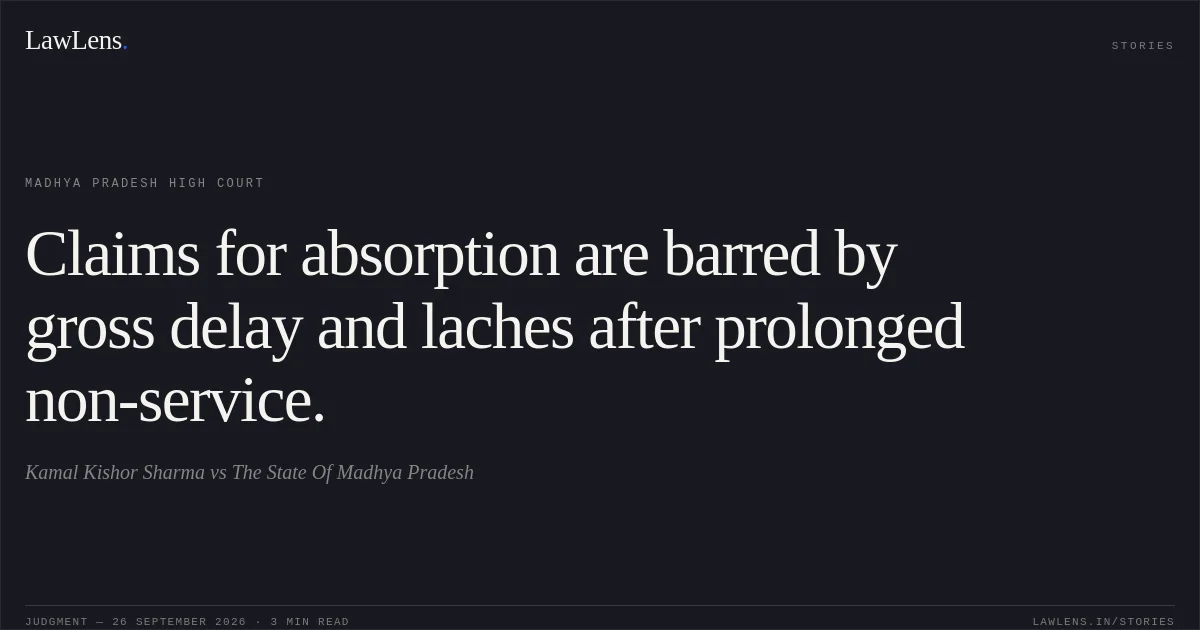
The Division Bench answered the issues against the appellants. It held that the claims were barred by substantial delay and laches and that no case for absorption could be made after the appellants had remained out of service since 1995.
Finding no ground to interfere with the orders of the learned Single Judge, the Court dismissed Writ Appeal Nos. 42/2026, 3225/2025, and 221/2026.
Source reference: para. 9Original Court PDF
Kamal Kishor SharmavsThe State Of Madhya Pradesh
Click to open original judgment
Original judgment, available to read, download and summarize on LawLens.in