Facts
The appellants, parents of deceased Chandra Kumar Shriwas, filed a claim under Section 163-A of the Motor Vehicles Act, 1988, alleging that on 23 January 2019 the deceased was riding motorcycle No. CG 13-AB/8732 when an animal suddenly came in front of the vehicle, causing him to lose control and collide with a Mahua tree; he subsequently died from his injuries.
Source reference: para. 2The motorcycle was registered in the name of respondent No. 1 and insured with respondent No. 2. The appellants claimed that the deceased was a paid driver of the motorcycle and sought compensation of ₹50,56,000.
Source reference: para. 2The vehicle owner denied authorising the deceased to drive it and stated that he had taken the motorcycle without permission. The insurer contended that the deceased, having borrowed or driven the vehicle, was not a third party and that no liability arose under Section 163-A.
Source reference: paras. 3–4The Motor Accident Claims Tribunal, Korba, rejected the claim by award dated 21 January 2020, leading to the present appeal.
Source reference: para. 1Issues
Whether the deceased could be treated as an owner, or as a person stepping into the shoes of the owner, for the purpose of maintaining a claim under Section 163-A of the Motor Vehicles Act?
Source reference: para. 9Whether the appellants established that the deceased was an authorised and paid driver of the insured motorcycle so as to claim compensation against its owner and insurer?
Source reference: paras. 11, 15Law Applied
Section 2(30) of the Motor Vehicles Act defines “owner” as the person in whose name the motor vehicle is registered, including a person in possession under a hire-purchase, lease, or hypothecation agreement.
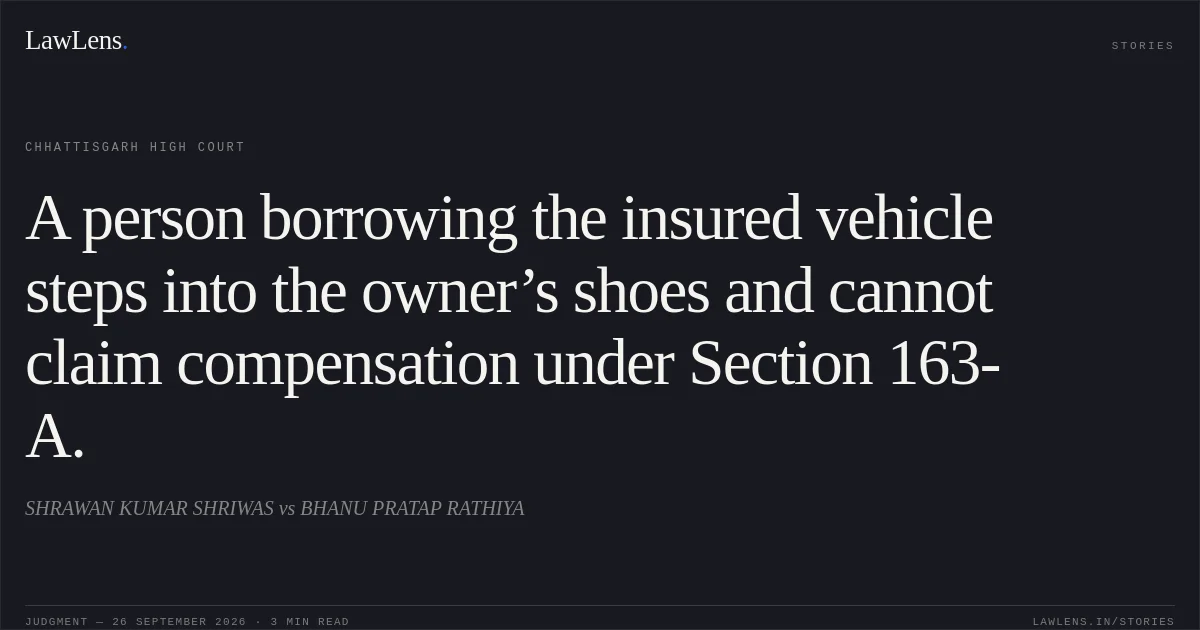
Source reference: para. 10Section 163-A provides for compensation on a no-fault basis, but the claimant must nevertheless be a “third party”; a person who borrows or drives the vehicle and thereby steps into the shoes of the owner cannot maintain a claim under Section 163-A against the owner or insurer of that vehicle.
Source reference: no citationThe Court relied on Ningamma v. United India Insurance Co. Ltd., (2009) 13 SCC 710, holding that a person who borrows the vehicle is not an employee or third party and steps into the shoes of the owner.
Source reference: para. 12Ram Khiladi v. United India Insurance Co., (2020) 2 SCC 550, reiterating that the borrower or driver of the vehicle cannot claim compensation under Section 163-A from its owner or insurer.
Source reference: para. 13Reasoning
The appellants asserted that the deceased had been appointed as a paid driver, but they failed to establish this contention through cogent evidence.
Source reference: para. 11The Tribunal had also found that the deceased did not possess a valid and effective driving licence, a finding supported by the admission of his father, appellant No. 1.
Source reference: para. 11The High Court held that, in these circumstances, the deceased could not be treated as an authorised driver appointed by the owner.
Source reference: no citationApplying Ningamma and Ram Khiladi, the Court reasoned that a person driving or borrowing the insured vehicle occupies the position of the owner rather than that of a third party.
Source reference: paras. 12–14Consequently, the deceased could not maintain a claim under Section 163-A against the owner or insurer of the motorcycle.
Source reference: paras. 12–14Holding
The High Court held that the deceased was not proved to be an authorised paid driver and, for the purposes of Section 163-A, could not claim the status of a third party against the owner or insurer of the motorcycle.
The Tribunal’s dismissal of the claim petition was found to be justified and was affirmed. Accordingly, the appeal was dismissed as devoid of merit.
Source reference: paras. 15–16Acts & Sections Cited
2 provisions across 1 statute referred to in this judgment. Each provision opens on LawLens.
Motor Vehicles Act, 19882
Original Court PDF
SHRAWAN KUMAR SHRIWASvsBHANU PRATAP RATHIYA
Click to open original judgment
Original judgment, available to read, download and summarize on LawLens.in