Facts
The respondent-plaintiff, Manju Rani, filed a suit for mandatory injunction seeking the petitioner’s eviction from a portion of House No. 60, Street No. 3, Sunil Nagar, Ludhiana, alleging that the petitioner was merely a licensee.
Source reference: para. 2The petitioner, who was the plaintiff’s daughter-in-law, claimed that after the death of her husband she was harassed by her in-laws and faced financial hardship.
Source reference: para. 2.1After receiving summons, she engaged counsel but asserted that the counsel assured her that her personal presence was unnecessary and subsequently failed to respond to her calls and messages.
Source reference: paras. 2.2–2.3The Trial Court struck off her defence for non-filing of the written statement on 1 July 2024.
Source reference: para. 2.4When the plaintiff’s evidence was recorded, no one appeared for the petitioner to cross-examine the plaintiff, and the cross-examination was consequently recorded as “Nil” on 28 April 2026.
Source reference: para. 2.5The petitioner was thereafter proceeded against ex parte on 20 May 2026.
Source reference: para. 2.6She subsequently engaged a new counsel and filed an application under Order IX Rule 7 CPC on 15 July 2026 to join the proceedings.
Source reference: para. 2.7The present revision petition under Article 227 of the Constitution challenged the orders dated 1 July 2024 and 28 April 2026.
Source reference: para. 1Issues
Whether the High Court should exercise its supervisory jurisdiction under Article 227 of the Constitution to interfere with the Trial Court’s orders striking off the petitioner’s defence and treating the plaintiff’s cross-examination as “Nil”.
Source reference: paras. 1, 3, 9Whether the petitioner’s alleged counsel negligence constituted sufficient justification for condoning her prolonged inaction and reopening the proceedings.
Source reference: paras. 6–8Whether the petitioner, having knowledge of the pending suit, could avoid the consequences of her failure to remain vigilant by attributing the entire responsibility to her counsel.
Source reference: paras. 7.1–7.2Law Applied
The Court applied Article 227 of the Constitution, under which the High Court exercises limited supervisory jurisdiction over subordinate courts and does not ordinarily reopen proceedings absent a legally sustainable ground for interference.
Source reference: paras. 1, 3, 9It applied the procedural consequences arising from non-filing of a written statement and non-appearance for cross-examination, including striking off the defence and treating cross-examination as “Nil”.
Source reference: paras. 2.4–2.5The Court further applied the principle that a litigant who has knowledge of proceedings is bound to remain vigilant and cannot ordinarily shift the entire blame to counsel for the consequences of the litigant’s own prolonged inaction.
Source reference: paras. 7.1–8The petitioner’s application under Order IX Rule 7 CPC was noted, but the Court found no sufficient basis to reopen the matter at that stage.
Source reference: paras. 2.7, 9Reasoning
The Court found that the petitioner had been aware of the suit and had engaged counsel, yet remained inactive for approximately two years after her defence was struck off.
Source reference: paras. 5, 7.1During that period, she neither ensured the filing of a written statement nor appeared when the plaintiff’s evidence was recorded, resulting in the plaintiff’s cross-examination being treated as “Nil” and the petitioner subsequently being proceeded against ex parte.
Source reference: paras. 5, 7.1The Court held that the plea of counsel negligence was unsupported by any cogent explanation for the petitioner’s failure to independently inquire into the status of the case.
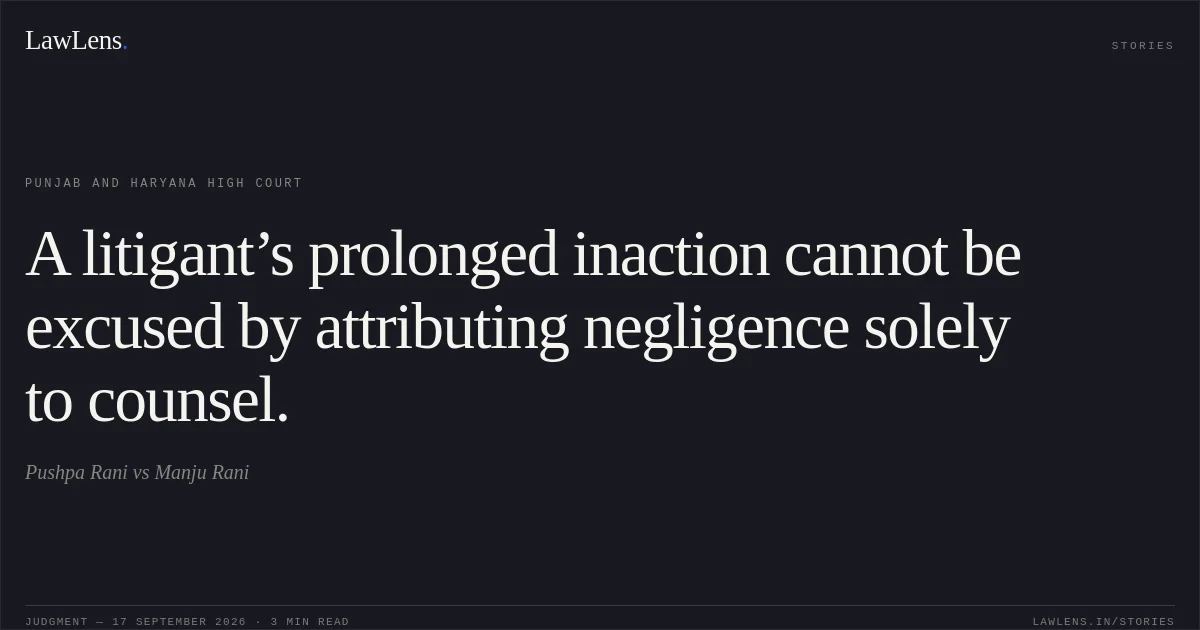
Source reference: paras. 7–8Since the petitioner had knowledge of the proceedings, she was required to remain vigilant and could not use alleged negligence of counsel as a device to overcome the consequences of her own persistent lack of diligence.
Source reference: paras. 7.1–7.2Accordingly, the Court found no ground for exercising Article 227 jurisdiction or reopening the proceedings.
Source reference: para. 9Holding
The Court answered the issues against the petitioner.
It held that the petitioner’s prolonged and unexplained inaction, despite knowledge of the suit, was sufficient to disentitle her from relief, and that the alleged negligence of counsel did not justify reopening the proceedings.
Source reference: paras. 7.1–8The civil revision petition was dismissed, and the Trial Court’s orders dated 1 July 2024 and 28 April 2026 were not interfered with.
Source reference: para. 9All pending applications, if any, were ordered to stand closed.
Source reference: para. 10Original Court PDF
Pushpa RanivsManju Rani
Click to open original judgment
Original judgment, available to read, download and summarize on LawLens.in