Facts
The petitioner registered under the DDA’s Special Housing Registration Scheme for Scheduled Castes/Scheduled Tribes, known as the Ambedkar Awas Yojana, for allotment of an MIG flat and paid the requisite registration deposit.
Source reference: p.2His registration form contained his address at 21E-DB Block, DDA LIG Flat, G-8 Hari Nagar, New Delhi. He claimed that, after shifting to Mumbai on 24 December 1993, he informed the DDA in writing of his changed address.
Source reference: p.5The petitioner also had a permanent address at House No. 1273, Sector 8, Chandigarh available in the DDA’s records.
Source reference: p.6In 2002, the DDA issued a demand-cum-allotment letter, but the record showed that it was dispatched to House No. 1845, Basti Ram Dass, Kotla Mubarakpur, New Delhi—an address that was neither mentioned in the registration form nor otherwise furnished by the petitioner.
Source reference: p.6–7The allotment was subsequently cancelled.
Source reference: p.7In 2012, the petitioner became aware through a public notice that the DDA considered allotments under the relevant schemes complete and that no allotment remained pending. He learned of the cancellation on 6 December 2012 and filed the writ petition on 11 December 2012.
Source reference: p.7–8He challenged the cancellation and sought alternative allotment at the old rate with consequential reliefs.
Source reference: p.1–2Issues
1. Whether the DDA could validly cancel the petitioner’s allotment when the demand-cum-allotment letter was not served at all the addresses available in its records, particularly when it was sent to an address never furnished by the petitioner.
Source reference: p.6–8 / paras. 7–112. Whether publication of notices in newspapers constituted sufficient service of the allotment and cancellation notices in place of individual notice.
Source reference: p.7 / paras. 9–103. Whether the writ petition was barred by delay and laches, having regard to the time elapsed between the allotment/cancellation and the filing of the petition.
Source reference: p.8 / para. 124. Whether the petitioner was entitled to alternative allotment at rates prevailing in 2012, with consequential directions for possession and execution of the lease deed.
Source reference: p.8–9 / paras. 13–15Law Applied
The Court exercised its jurisdiction under Article 226 of the Constitution of India to review the legality and fairness of the DDA’s cancellation action.
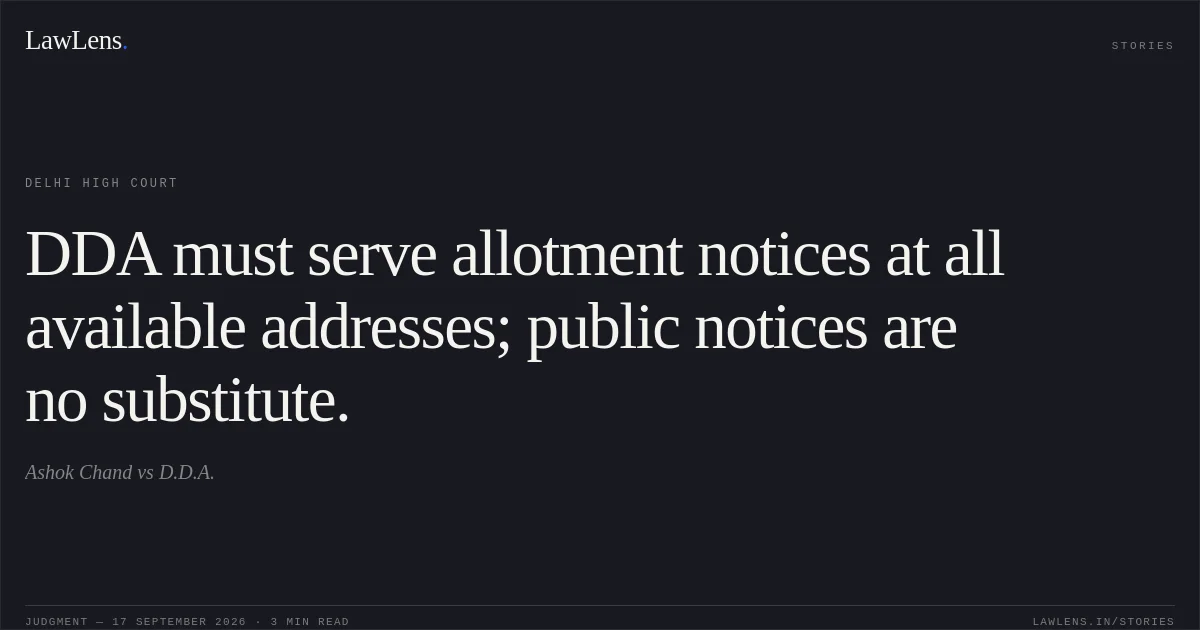
Source reference: p.1It applied the principle that, where a public authority has more than one address of an allottee available on its records, it must serve the allotment communication at all such addresses; a public notice in newspapers cannot substitute individual notice where valuable rights are at stake.
Source reference: p.7–8 / para. 10This principle was drawn from Delhi Development Authority v. Mahinder Pal Sikri, 2013 SCC OnLine Del 4803, and reaffirmed in Kiran Bhatia v. DDA, W.P.(C) 403/2011.
Source reference: p.7–8 / para. 10The Court further applied the rule that delay and laches are assessed from the date on which the petitioner acquired knowledge of the adverse action, particularly where the public authority failed to provide proper individual notice.
Source reference: p.7–8 / paras. 10 and 12Reasoning
The DDA had the petitioner’s Chandigarh address and other addresses in its records, yet the demand-cum-allotment letter was dispatched to an address that did not appear in the registration form or in any document submitted by him.
Source reference: p.6–7 / paras. 7–8The DDA therefore failed to discharge its obligation to communicate the allotment at all available addresses.
Source reference: p.6–7 / paras. 7–8Applying Mahinder Pal Sikri and Kiran Bhatia, the Court held that newspaper advertisements could not cure this failure because individual notice was required before cancellation of the petitioner’s valuable allotment rights.
Source reference: p.7–8 / paras. 10–11The petition was not barred by delay or laches because the petitioner became aware of the completion of allotments through the public notice dated 22 November 2012 and of the cancellation on 6 December 2012, following which he approached the Court on 11 December 2012.
Source reference: p.8 / para. 12Since the cancellation resulted from defective service attributable to the DDA, the petitioner was entitled to an alternative flat corresponding to his original entitlement at rates prevailing in 2012.
Source reference: p.8 / paras. 13–14Holding
The petition was allowed.
The DDA was directed to allot the petitioner a flat according to his entitlement at the rates prevailing in 2012, i.e., the rates applicable on the date of filing of the writ petition.
Source reference: p.8 / para. 13If flats at those rates were unavailable, the DDA was directed to proportionately adjust the value so as to correspond with the 2012 rates.
Source reference: p.8 / para. 14The DDA was required to complete the allotment within 12 weeks and take consequential steps within a further 12 weeks.
Source reference: p.9 / para. 15The Court declined to further address or precipitate the CBI inquiry and disposed of the petition and pending applications accordingly.
Source reference: p.9 / paras. 16–17Original Court PDF
Ashok ChandvsD.D.A.
Click to open original judgment
Original judgment, available to read, download and summarize on LawLens.in