Facts
The petitioner, an Executive Engineer, faced two separate departmental proceedings.
Source reference: paras. 3–12The first concerned alleged excess expenditure and non-functional tube wells; the second concerned alleged delay in verifying and auctioning scrap material.
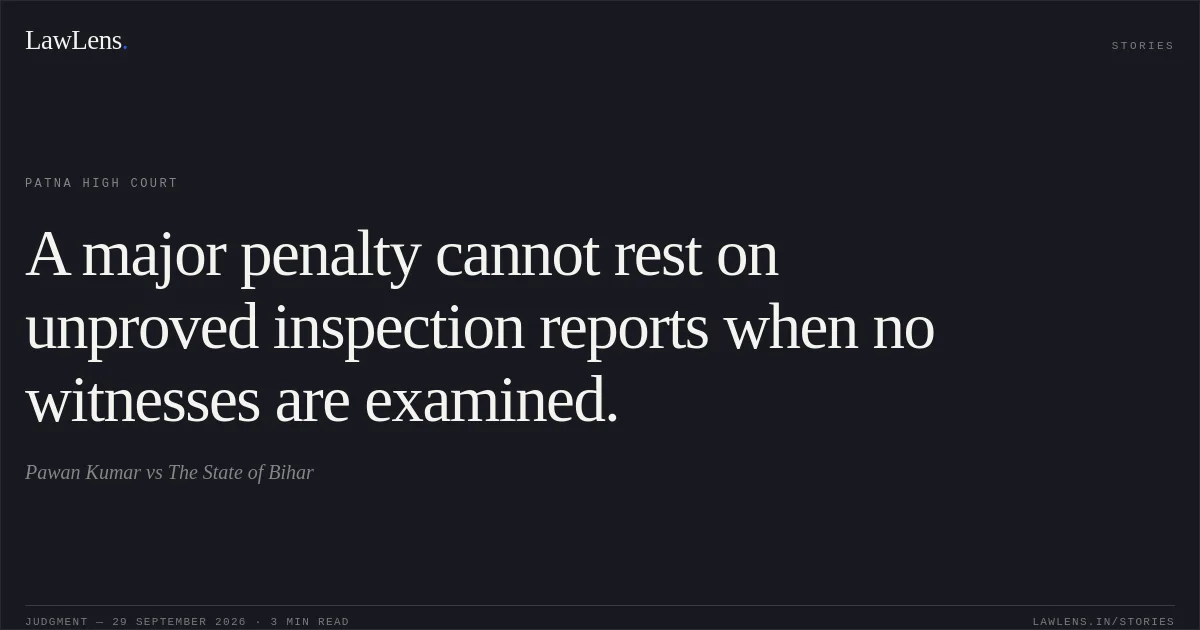
Source reference: paras. 3–12The Enquiry Officer found the charges proved in both proceedings, although no witnesses were examined.
Source reference: paras. 3–12The Department imposed a composite punishment of censure and reversion to the post of Assistant Engineer, and rejected the petitioner’s review petition.
Source reference: paras. 3–12The petitioner challenged both orders, alleging procedural violations, denial of cross-examination, failure to consider exculpatory material, and impermissible consolidation of penalties from separate proceedings.
Source reference: paras. 13–17Issues
1. Whether the two departmental enquiries complied with the mandatory procedure under Rule 17 of the Bihar Government Servants (Classification, Control and Appeal) Rules, 2005, including the requirements concerning charge particulars, evidence, and witnesses
Source reference: para. 18(a)2. Whether findings of guilt, and a major penalty, could be sustained when no witnesses were examined and the petitioner had no opportunity to cross-examine the authors of the reports relied upon
Source reference: para. 18(b)3. Whether the Enquiry Officer’s failure to consider the Vigilance Technical Examiner Cell’s exculpatory report vitiated the first enquiry report
Source reference: para. 18(c)4. Whether a composite punishment could be imposed on the basis of two independent proceedings without an order for common proceedings under Rule 22
Source reference: para. 18(d)5. Whether the impugned punishment and review orders were otherwise sustainable
Source reference: para. 18(e)Law Applied
Rule 17(3)(ii)(a)–(b) of the CCA Rules, 2005 requires the charge materials to state relevant facts and identify the documents and witnesses proposed to prove the charges; Rule 17(4) requires those materials to be supplied to the charged employee, and Rule 17(14) contemplates the production and examination of evidence, subject to cross-examination.
Source reference: paras. 19–20, 24, 32–35Rule 22 governs common proceedings.
Source reference: paras. 19–20, 24, 32–35The Court applied State of U.P. v. Saroj Kumar Sinha, (2010) 2 SCC 772, for the principles that an enquiry officer is an independent adjudicator and that documentary material relied upon must be proved through evidence in the enquiry.
Source reference: paras. 19–20, 24, 32–35It also relied on Uma Nath Pandey v. State of U.P., (2009) 12 SCC 40, and D.K. Yadav v. J.M.A. Industries Ltd., (1993) 3 SCC 259, for the requirements of fair hearing and non-arbitrary procedure.
Source reference: paras. 19–20, 24, 32–35On whether to remit the matter, the Court applied State of Uttar Pradesh v. Ram Prakash Singh, 2025 (2) PLJR (SC) 331, which recognises that a further opportunity to conduct an enquiry need not be granted where delay and the circumstances make a fresh enquiry unfair and unjust.
Source reference: paras. 38Reasoning
The charge materials did not include the required lists of documents and witnesses, and the records showed that no witnesses were examined in either enquiry.
Source reference: paras. 21–30The inspection reports forming the basis of the charges were therefore not tested through examination of their authors or cross-examination by the petitioner.
Source reference: paras. 21–30The Court held that the reports could not, in those circumstances, sustain findings of guilt.
Source reference: paras. 21–30It further found that the first enquiry report did not address the Vigilance Technical Examiner Cell’s report, which contradicted the allegations of excess payment and financial irregularity; that omission rendered the finding unreasoned and perverse.
Source reference: paras. 21–30Finally, the two proceedings concerned distinct matters and had been initiated and conducted separately; absent an order under Rule 22, their findings could not be combined to impose a single composite punishment.
Source reference: paras. 21–30Given the lapse of time and the absence of witnesses in the original enquiries, the Court considered a remand unfair and unjust.
Source reference: paras. 38–39Holding
The Court held that both enquiry reports were vitiated by non-compliance with Rule 17 and the principles of natural justice, and that the composite punishment was not sustainable.
It quashed the punishment order dated 9 May 2018 and the review order dated 6 August 2018.
Source reference: para. 39–42The competent authority was left to determine, in accordance with law, the treatment of the intervening period and consequential monetary benefits, including subsistence allowance.
Source reference: para. 39–42The writ petition was allowed to that extent.
Source reference: para. 39–42Original Court PDF
Pawan KumarvsThe State of Bihar
Click to open original judgment
Original judgment, available to read, download and summarize on LawLens.in