Facts
The Drug Inspector drew samples of “Theruptor Hand Rub” on 26 May 2020 and sent them for analysis. The samples were reported to be of standard quality, but the prosecution alleged misbranding and manufacture without a valid licence, under Section 18(c) of the Drugs and Cosmetics Act, 1940, read with Rule 74 and Condition 3 of Form 25.
Source reference: p.2, paras. 1–2; p.3, para. 3The petitioners stated that the manufacturer had obtained a licence on 23 April 2020 and that the product’s composition matched the licence. The alleged labelling defect was the statement “each 100g”.
Source reference: p.3, para. 4; p.4, para. 5They sought to quash C.C. No. 42 of 2026 pending before the Chief Judicial Magistrate, Kancheepuram.
Source reference: p.2, para. 1Issues
1. Whether the prosecution for manufacture without a valid licence could proceed when a manufacturing licence had been issued before the relevant sampling.
Source reference: p.4, para. 62. Whether describing the product’s contents as “each 100g” rendered the drug misbranded under Section 17(c) of the Act.
Source reference: pp. 5–6, paras. 7–9Law Applied
Section 18(c) of the Drugs and Cosmetics Act, 1940, read with Rule 74 and Condition 3 of Form 25, governs manufacture of drugs without the required licence.
Source reference: p.4, para. 6Under Section 17(c), a drug is misbranded if its label or accompanying material contains a statement that is false or misleading in any particular.
Source reference: p.5, para. 8The Court also referred to guidelines framed under Section 33(P), which identify labelling errors among minor defects and support resolving minor variations by administrative measures rather than criminal prosecution.
Source reference: pp. 6–7, paras. 10–11Reasoning
The Court found that the existence of a manufacturing licence was undisputed; accordingly, the allegation of manufacture without a valid licence could not be sustained.
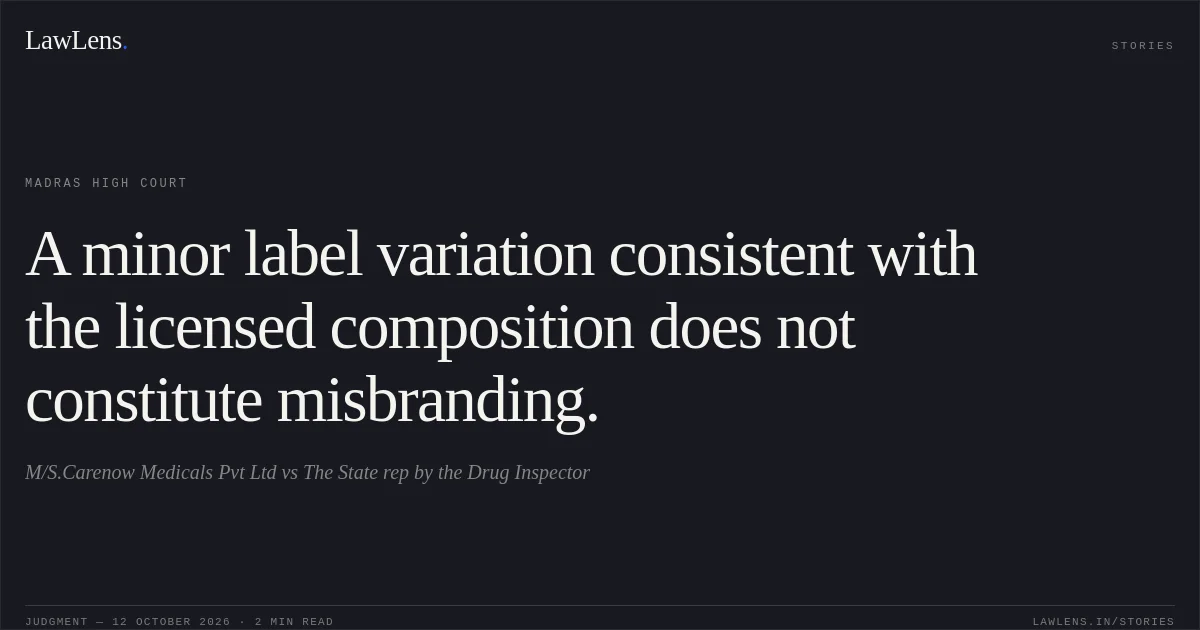
Source reference: p.4, para. 6As to misbranding, the analyst found the drug to be of standard quality, and the prosecution did not dispute that its composition, weight, or volume differed from the licence. The only alleged defect was the “each 100g” wording, which the Court found did not make the label false or misleading; the word had also been removed after the show-cause notice.
Source reference: pp. 5–6, paras. 7–9In light of the minor nature of the labelling variation and the cited guidelines, the Court held that it did not warrant prosecution for misbranding.
Source reference: pp. 6–8, paras. 10–11Holding
The Court held that neither the charge of manufacture without a valid licence nor the alleged misbranding could be sustained on the facts.
It allowed the Criminal Original Petition and quashed the proceedings in C.C. No. 42 of 2026 before the Chief Judicial Magistrate, Kancheepuram; the connected miscellaneous petitions were closed.
Source reference: p.8, para. 12Acts & Sections Cited
4 provisions across 2 statutes referred to in this judgment. Each provision opens on LawLens.
Bharatiya Nagarik Suraksha Sanhita, 20231
Drugs and Cosmetics Act, 19403
Original Court PDF
M/S.Carenow Medicals Pvt LtdvsThe State rep by the Drug Inspector
Click to open original judgment
Original judgment, available to read, download and summarize on LawLens.in