Facts
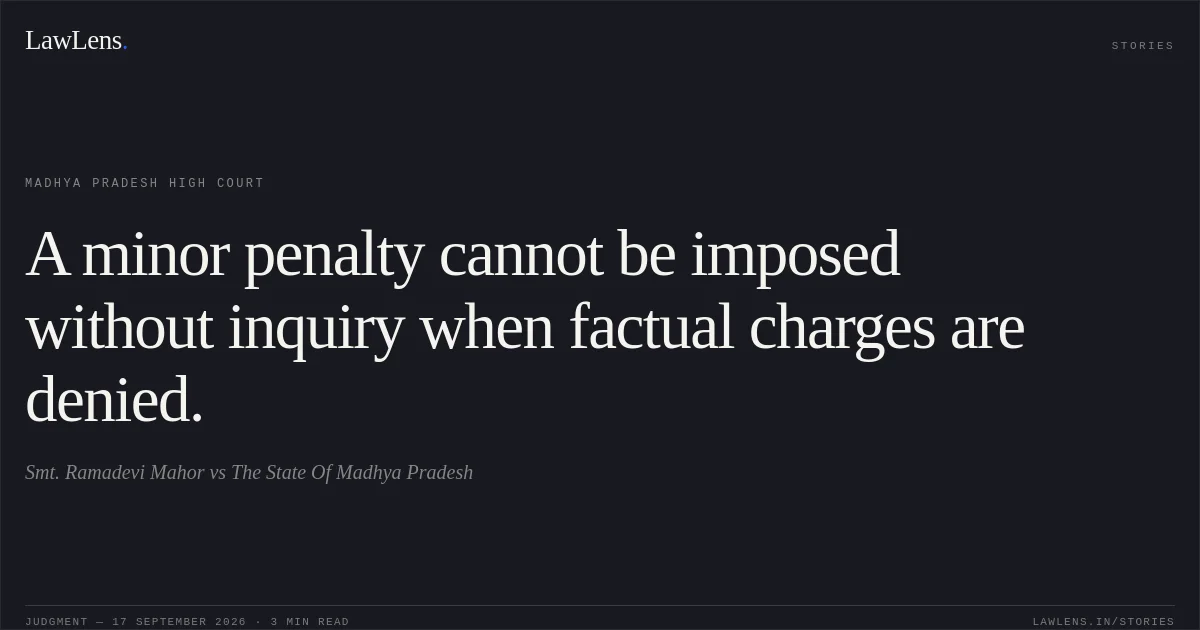
The petitioner, substantively appointed as an Anganwadi Supervisor and working as In-charge Project Officer, Women and Child Development, Vijaypur-1, District Sheopur, was served a show-cause notice dated 18 December 2025 alleging irregularities.
Source reference: para. 2She submitted a detailed reply on 20 December 2025 denying the allegations.
Source reference: para. 2Without adequately addressing the reply, the disciplinary authority suspended her on 26 December 2025 and subsequently passed an order dated 9 July 2026 treating the suspension period as duty and imposing the penalty of withholding two annual increments without cumulative effect, while reinstating her.
Source reference: para. 2No regular departmental enquiry was conducted despite the petitioner’s factual denial of the charges.
Source reference: para. 14Issues
Whether the disciplinary authority’s order imposing the minor penalty was invalid for being non-speaking, unreasoned, and reflective of non-application of mind.
Source reference: paras. 6–10, 15Whether, where factual charges are denied by the delinquent employee, a departmental enquiry is mandatory even before imposing a minor penalty of withholding increments.
Source reference: paras. 13–14Whether the availability of an alternative statutory appeal barred the High Court from exercising jurisdiction under Article 226 of the Constitution in the circumstances of the case.
Source reference: para. 15Law Applied
The Court applied the principle that an administrative or quasi-judicial order adversely affecting an employee must be reasoned, self-contained, and speaking.
Source reference: paras. 8–11Relying on State of Punjab v. Bandip Singh, (2016) 1 SCC 724, and Kranti Associates Pvt. Ltd. v. Masood Ahmed Khan, (2010) 9 SCC 496, the Court held that reasons ensure fairness, restrain arbitrary exercise of power, demonstrate consideration of relevant factors, and facilitate judicial review.
Source reference: paras. 8–11The Court also relied on Oryx Fisheries Pvt. Ltd. v. Union of India, (2010) 13 SCC 427, for the proposition that reasons absent from the original order cannot be supplied or cured through an appellate order.
Source reference: para. 12Under O.K. Bhardwaj v. Union of India, (2001) 9 SCC 180, even where withholding increments constitutes a minor penalty, the employee must be given an opportunity to respond; where factual charges are denied, a departmental enquiry is the minimum requirement of natural justice.
Source reference: para. 13Although an alternative remedy ordinarily warrants restraint under Article 226, it is not an absolute bar where the impugned order suffers from non-application of mind, breach of natural justice, or absence of reasons.
Source reference: para. 15Reasoning
The disciplinary authority’s conclusion that the petitioner’s reply was “not satisfactory” did not disclose which allegations were established, why her specific defence was rejected, or what material justified the penalty.
Source reference: paras. 5–12The order therefore failed to satisfy the requirement of a reasoned quasi-judicial decision and prevented meaningful appellate or judicial review.
Source reference: paras. 5–12Further, because the petitioner had denied the factual allegations, O.K. Bhardwaj required the authority to conduct a departmental enquiry before imposing even a minor penalty.
Source reference: para. 14The absence of such an enquiry constituted a violation of natural justice.
Source reference: para. 14In these circumstances, the existence of an appellate remedy did not preclude writ jurisdiction, since the defect lay in the decision-making process itself and not merely in the correctness of the penalty.
Source reference: para. 15Holding
The High Court held that the order dated 9 July 2026 was non-speaking, unreasoned, passed without proper consideration of the petitioner’s reply, and imposed in breach of the requirement of a departmental enquiry where factual charges were denied.
The order was accordingly quashed.
Source reference: para. 16The respondents were directed to grant all consequential benefits to the petitioner within three months of receiving the certified copy of the judgment.
Source reference: para. 16The Court granted liberty to the respondents to initiate fresh proceedings in accordance with law, if so advised.
Source reference: para. 16The writ petition was allowed and disposed of, and pending interlocutory applications, if any, were also disposed of.
Source reference: paras. 17–18Original Court PDF
Smt. Ramadevi MahorvsThe State Of Madhya Pradesh
Click to open original judgment
Original judgment, available to read, download and summarize on LawLens.in