Facts
The appellant was prosecuted in Special Criminal (POCSO) Case No. 57/2024 for allegedly taking the minor prosecutrix from Chhattisgarh to Hyderabad, where he sexually assaulted and molested her.
Source reference: paras. 1–2The prosecutrix was recovered from the appellant at Hyderabad and brought back to Police Station Simga; the recovery was documented through Ex. P/4, and the FIR had initially been lodged by her father against an unknown person.
Source reference: paras. 1–2The prosecution examined 11 witnesses and relied on 28 documents, including the prosecutrix’s original birth certificate issued by the Gram Panchayat, which recorded her date of birth as 26 October 2011.
Source reference: para. 4; p. 6The Trial Court convicted the appellant under Sections 137(2), 87 and 351(3) of the Bharatiya Nyaya Sanhita, 2023 (“BNS”) and Section 8 of the Protection of Children from Sexual Offences Act, 2012 (“POCSO Act”), sentencing him to concurrent terms of imprisonment, including five years under Sections 87 BNS and 8 POCSO.
Source reference: para. 1The appellant challenged the conviction and sentence under Section 415(2) BNS, contending that the prosecutrix was above 16 years, had voluntarily accompanied him, and that the birth certificate was unreliable.
Source reference: paras. 1, 6Issues
Whether the prosecutrix was below 18 years of age on the date of the incident, so as to attract the statutory protection of the POCSO Act and negate the legal relevance of her consent?
Source reference: paras. 9–12Whether the prosecution proved beyond reasonable doubt that the appellant abducted/took the minor prosecutrix to Hyderabad and subjected her to sexual assault and molestation, thereby establishing offences under Sections 137(2), 87 and 351(3) BNS and Section 8 POCSO?
Source reference: paras. 13–15Whether the sentence imposed by the Trial Court required interference, particularly in view of the appellant’s age and the period of incarceration already undergone?
Source reference: paras. 16–18Law Applied
The Court applied Section 94 of the Juvenile Justice (Care and Protection of Children) Act, 2015, which prescribes the hierarchy for determining age: the school or matriculation certificate, followed by a birth certificate issued by a municipal authority, corporation or panchayat, and only in their absence, medical age determination.
Source reference: para. 11; pp. 5–6The Court further applied Sections 137(2), 87 and 351(3) BNS concerning taking or abducting a child, inducement or related sexual exploitation, and criminal intimidation, respectively, together with Section 8 of the POCSO Act concerning sexual assault on a child.
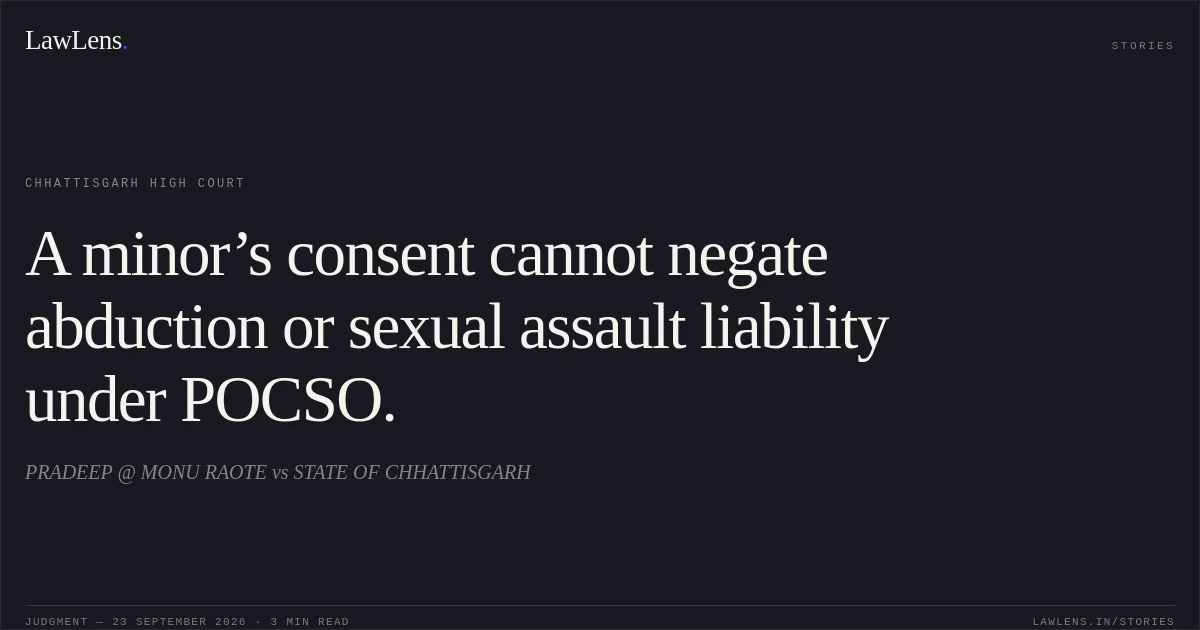
Source reference: paras. 1–3, 15The governing principle applied was that a child’s consent has no legal validity for conduct criminalised under the POCSO Act; consequently, a minor’s voluntary accompaniment with the accused does not exonerate him.
Source reference: para. 13Reasoning
The Court accepted the original birth certificate issued by the Gram Panchayat on 7 November 2011, recording the prosecutrix’s date of birth as 26 October 2011.
Source reference: paras. 9–12Since the incident occurred on 10 August 2024, she was 12 years, 9 months and 16 days old, and the defence evidence regarding her being in Class IX and having repeated Class VI did not displace the documentary proof of age.
Source reference: paras. 9–12Although the prosecutrix admitted that she and the appellant were acquainted, had planned the journey, and travelled together to Hyderabad, the Court held that her consent was legally immaterial because she was a minor.
Source reference: para. 13Her testimony that the appellant had lured her, taken her to Hyderabad, pressed her chest and molested her was not materially discredited in cross-examination.
Source reference: paras. 13–15Her evidence was corroborated by the depositions of her relatives and the recovery panchnama showing that she was found with the appellant at Hyderabad.
Source reference: paras. 13–15The Court therefore affirmed the findings of guilt.
Source reference: paras. 13–15However, considering that the appellant was approximately 20 years old and had been in custody since 13 August 2024, it exercised sentencing discretion and reduced the imprisonment under Sections 87 BNS and 8 POCSO from five years to three years, the minimum sentence, while retaining the convictions, fines and concurrency of sentences.
Source reference: paras. 16–18Holding
The appeal was partly allowed.
The convictions under Sections 137(2), 87 and 351(3) BNS and Section 8 POCSO were affirmed, as were the sentences under Sections 137(2) and 351(3) BNS.
Source reference: paras. 17–18The sentences under Section 87 BNS and Section 8 POCSO were reduced from five years’ rigorous imprisonment to three years’ rigorous imprisonment.
Source reference: paras. 17–18The fines and default sentences remained unchanged, all substantive sentences were directed to run concurrently, and the appellant was entitled to set-off for the period already undergone in custody.
Source reference: paras. 17–18Acts & Sections Cited
13 provisions across 4 statutes referred to in this judgment. Each provision opens on LawLens.
Bharatiya Nyaya Sanhita, 20236
Bharatiya Nagarik Suraksha Sanhita, 20231
Juvenile Justice (Care and Protection of Children) Act, 2015.3
Original Court PDF
PRADEEP @ MONU RAOTEvsSTATE OF CHHATTISGARH
Click to open original judgment
Original judgment, available to read, download and summarize on LawLens.in