Facts
The appellant-husband and respondent-wife were married according to Muslim rites on 7 April 1999.
Source reference: p.1, para. 2(i)The husband alleged that the wife treated him cruelly and deserted him by permanently leaving the matrimonial home on 14 October 2008; she allegedly refused repeated requests to return and sought dissolution of the marriage.
Source reference: p.1, para. 2(ii)The husband thereafter pronounced talaq successively and instituted M.M. Case No. 53 of 2021 seeking a decree of divorce.
Source reference: p.1, para. 2(ii)The wife, despite service of summons, did not appear, and the matter proceeded ex parte.
Source reference: p.2, para. 2(iii)Evidence indicated that both parties had subsequently contracted second marriages.
Source reference: p.2, para. 2(iv)The Principal Judge, Family Court, Madhubani dismissed the case, relying on Shayara Bano v. Union of India, which declared talaq-i-biddat or triple talaq unconstitutional.
Source reference: p.2, paras. 2(v)–(vi)The husband preferred the present appeal; the wife again did not appear despite service of notice.
Source reference: p.3, para. 3Issues
Whether the appellant’s successive pronouncements of talaq constituted a legally valid and irrevocable dissolution of the Muslim marriage?
Source reference: pp. 2–5, paras. 2(v)–(vi), 8–11Whether the husband could obtain a decree of divorce on the grounds of cruelty and desertion notwithstanding the alleged pronouncement of talaq?
Source reference: p.3, paras. 4–7; p.5, paras. 12–13Law Applied
The Court applied the principles relating to dissolution of a Muslim marriage stated in Chapter XVI of Mulla’s Principles of Mahomedan Law (19th ed., reprint 2021), under which a Muslim marriage may be dissolved by the husband at his will without court intervention, by mutual consent, or by judicial decree.
Source reference: p.3, paras. 5–7It further recognised that, under Muslim law, no specific ground is ordinarily necessary for a husband to effect talaq, which may be pronounced orally or recorded in a talaqnama.
Source reference: p.4, para. 7Talaq was classified as talak ahsan, talak hasan, and talak-ul-biddat or triple talaq.
Source reference: p.4, para. 8Relying on Shayara Bano v. Union of India, (2017) 9 SCC 2, the Court held that talaq-i-biddat is unconstitutional.
Source reference: p.4, para. 9Ahsan talaq becomes irrevocable upon expiry of the iddat period, while hasan talaq becomes irrevocable upon the third pronouncement in accordance with its requirements.
Source reference: p.4, para. 11The Court also referred to Section 2 of the Dissolution of Muslim Marriages Act, 1939, which sets out the grounds on which a Muslim woman may seek dissolution by judicial decree.
Source reference: p.3, paras. 6–7Reasoning
The Court found that the appellant’s case was based on successive pronouncements of talaq and did not assert that the divorce had been effected by the ahsan or hasan form.
Source reference: p.4, para. 10Since talaq-i-biddat had been declared unconstitutional in Shayara Bano, the successive pronouncements could not operate as an irrevocable dissolution of the marriage.
Source reference: p.4, paras. 9–10Although the appellant argued that the wife’s alleged desertion since 2008 and cruelty entitled him to a decree of divorce, the Court held that the argument was misconceived because, under the principles of Muslim law relied upon by the Court, a Muslim husband ordinarily requires no specific ground to effect talaq and cannot seek a judicial divorce decree on cruelty or desertion in the manner asserted.
Source reference: p.5, paras. 12–13Accordingly, the Family Court’s dismissal was not legally erroneous.
Source reference: p.5, para. 14Holding
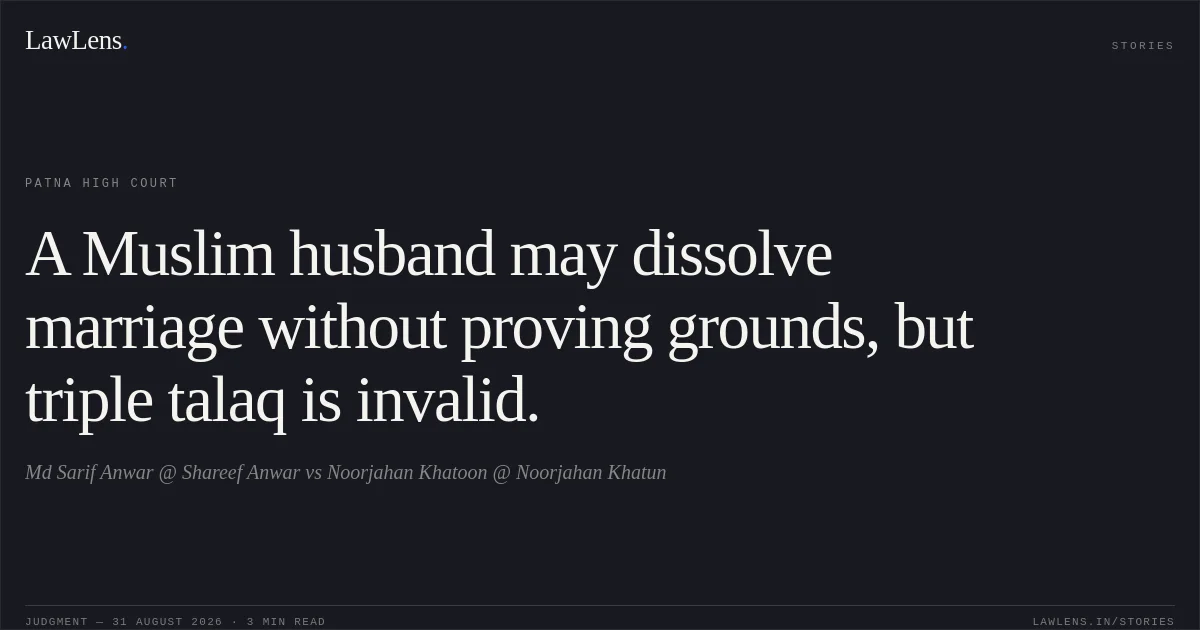
The Court held that the appellant’s successive pronouncements of talaq did not constitute a valid and irrevocable divorce because they amounted to the constitutionally invalid form of talaq-i-biddat and were not shown to comply with talaq ahsan or talaq hasan.
It further held that the appellant’s claim for a decree of divorce on cruelty and desertion was misconceived.
Source reference: p.5, para. 13The appeal was dismissed, and the judgment and decree of dismissal passed by the Principal Judge, Family Court, Madhubani in M.M. Case No. 53 of 2021 were affirmed.
Source reference: p.5, paras. 14–15Acts & Sections Cited
1 provisions across 1 statute referred to in this judgment. Each provision opens on LawLens.
Dissolution of Muslim Marriages Act, 19391
Original Court PDF
Md Sarif Anwar @ Shareef AnwarvsNoorjahan Khatoon @ Noorjahan Khatun
Click to open original judgment
Original judgment, available to read, download and summarize on LawLens.in