Facts
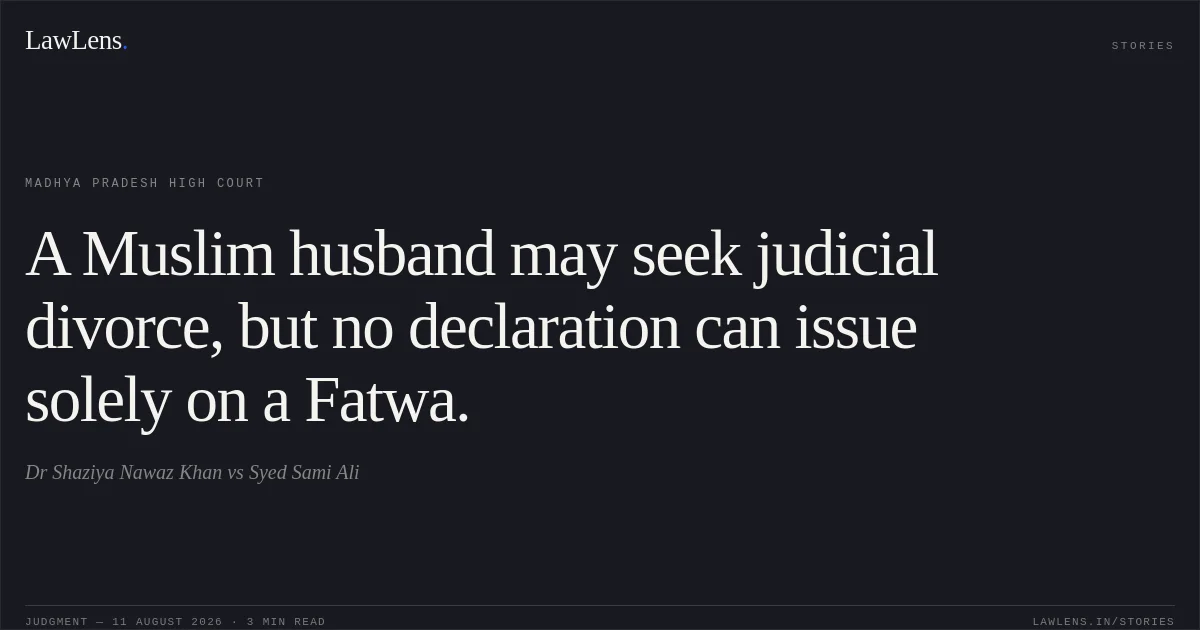
The respondent-husband instituted proceedings before the Family Court seeking a declaration of divorce on the basis of a Fatwa issued by the Darul-Ifta Masajid Committee, Bhopal.
Source reference: para. 2The petitioner-wife filed an application under Order VII Rule 11 CPC, contending that the Committee lacked authority to grant a divorce and that, under the Dissolution of Muslim Marriages Act, 1939, only a Muslim woman could seek dissolution of marriage.
Source reference: para. 5The Family Court rejected the application on 11 April 2026, leading to the present civil revision.
Source reference: para. 1The High Court examined the plaint and the Fatwa, noting that the Fatwa merely referred to Islamic scriptural principles concerning marital cruelty and did not itself grant a divorce.
Source reference: paras. 6–7Issues
Whether a suit seeking a declaration of divorce on the basis of the Fatwa issued by the Darul-Ifta Masajid Committee, Bhopal disclosed a valid and legally enforceable cause of action?
Source reference: paras. 6–10Whether a Muslim husband can institute divorce proceedings before the Family Court, notwithstanding the petitioner-wife’s reliance on the Dissolution of Muslim Marriages Act, 1939?
Source reference: paras. 5, 8Whether the plaint was liable to be rejected under Order VII Rule 11 CPC?
Source reference: paras. 1, 10–12Law Applied
The Court applied Order VII Rule 11 CPC, under which a plaint may be rejected where it does not disclose a cause of action.
Source reference: no citationIt relied on Section 7(1), Explanation (d), of the Family Courts Act, 1984, which confers jurisdiction over suits or proceedings concerning orders or injunctions arising out of a marital relationship, without distinguishing between communities.
Source reference: para. 8Rule 9(2)(vii) of the Madhya Pradesh Family Court Rules, 1988 recognises suits or proceedings arising from Muslim personal law, including proceedings under the Muslim Personal Law (Shariat) Application Act, 1937 and the Dissolution of Muslim Marriages Act, 1939.
Source reference: para. 8Relying on the Division Bench decision in F.A. No. 1199 of 2022, as well as Aqeel Ahmed (Khan) v. Smt. Farzana Khatun, F.A. No. 1017 of 2022, the Court held that a Muslim husband is not barred from instituting divorce proceedings before the Family Court and that the Dissolution of Muslim Marriages Act does not render such proceedings non-maintainable.
Source reference: para. 8However, a religious seminary or committee has no legal authority to grant a divorce or issue a decree capable of being judicially declared; a Fatwa merely expressing religious guidance cannot, by itself, constitute a legally enforceable divorce.
Source reference: para. 7Reasoning
The Court distinguished between the maintainability of a properly constituted divorce proceeding and the respondent’s specific claim for a declaration based on the Fatwa.
Source reference: paras. 5–6, 8–9Although the petitioner was incorrect in asserting that a Muslim husband could not file divorce proceedings, the plaint as framed did not seek adjudication of legally recognised grounds for divorce; it sought a declaration founded solely on the Fatwa.
Source reference: paras. 5–6, 8–9On examination, the Fatwa did not purport to dissolve the marriage and merely stated the relevant principles from Islamic scriptures concerning cruelty by a wife.
Source reference: para. 7Since the issuing Committee lacked authority to grant a divorce, no valid legal consequence could flow from the Fatwa and the Family Court could not grant a declaration of divorce on that basis.
Source reference: paras. 7, 9Consequently, the plaint disclosed no valid or legal cause of action and attracted rejection under Order VII Rule 11 CPC.
Source reference: para. 10Holding
The High Court allowed the civil revision and rejected the respondent-husband’s plaint under Order VII Rule 11 CPC because it sought a declaration of divorce based on a Fatwa that neither granted a divorce nor created an enforceable legal right.
The Court clarified that the respondent was not barred from filing a properly constituted divorce petition before the Family Court in accordance with law, and expressly preserved that liberty.
Source reference: para. 11Acts & Sections Cited
3 provisions across 2 statutes referred to in this judgment. Each provision opens on LawLens.
Family Courts Act, 19841
Parsi Marriage and Divorce Act, 1936.2
Original Court PDF
Dr Shaziya Nawaz KhanvsSyed Sami Ali
Click to open original judgment
Original judgment, available to read, download and summarize on LawLens.in