Facts
The petitioner, Smt. Shibani Dutta, claimed to be the legally wedded wife of late Sankar Dutta, a former Deputy Director of Economics and Statistics, who retired on 28 February 2002 and died on 4 January 2021.
Source reference: pp. 3–4; paras. 2–3He had received his retiral benefits except DCRG and continued to draw pension until his death.
Source reference: pp. 3–4; paras. 2–3The parties were married in June 1970 and had two daughters.
Source reference: p. 4; para. 5Although Sankar Dutta instituted divorce proceedings against the petitioner, the proceeding was dismissed for default and non-prosecution on 2 June 2010; no decree of divorce was ever passed.
Source reference: pp. 4–5; paras. 5, 10The petitioner asserted that she had originally been nominated as the wife and beneficiary under the service records and the State Government Employees Group Insurance Scheme, 1982.
Source reference: p. 10; para. 16However, while processing the pension papers, the deceased employee nominated Smt. Gayatri Dutta by describing her as his wife.
Source reference: pp. 5–7, 10–11; paras. 6, 9, 17On that basis, the PPO and GPO reflected Gayatri Dutta as the family pensioner.
Source reference: pp. 5–7, 10–11; paras. 6, 9, 17The petitioner sought family pension, arrears, DCRG and interest for delayed payment under Article 226 of the Constitution.
Source reference: p. 3; para. 2Issues
1. Whether a person nominated by a deceased Government employee as his wife can claim family pension despite not falling within the statutory definition of “family” under Rule 143 of the Assam Services (Pension) Rules, 1969?
Source reference: pp. 7–10; paras. 12–142. Whether the nomination of Smt. Gayatri Dutta could override the petitioner’s statutory entitlement as the legally wedded wife of the deceased employee?
Source reference: pp. 10–14; paras. 17–263. Whether the petitioner was entitled to consideration and release of family pension, arrears and DCRG, subject to verification by the competent authorities?
Source reference: pp. 14–16; paras. 27–30Law Applied
The Court applied Rule 143 of the Assam Services (Pension) Rules, 1969, which defines “family” for family-pension purposes and includes the wife of a male Government servant as the primary beneficiary, with pension thereafter devolving upon eligible children in the prescribed circumstances.
Source reference: pp. 8–10; para. 13Family pension is a statutory entitlement governed by the Pension Rules and does not arise merely from nomination.
Source reference: p. 10; para. 14A nomination is generally an administrative mechanism facilitating payment and does not confer beneficial ownership or override the rights of the person legally entitled under the governing statute, as recognised in Sarbati Devi v. Usha Devi, (1984) 1 SCC 424, and Shipra Sengupta v. Mridul Sengupta, (2009) 10 SCC 680.
Source reference: pp. 11–12; para. 19Under the Hindu Marriage Act, 1955, a subsequent marriage during the subsistence of a valid earlier marriage is void; therefore, a person described as a second wife cannot acquire the legal status of a wife for claiming family pension where the first marriage remained undissolved.
Source reference: pp. 7–8, 12; paras. 11, 21The Court also followed Tinku Das v. State of Assam, WP(C) No. 6073 of 2019, which held that a woman claiming to be the second wife of a Hindu Government employee is not entitled to family pension where the first marriage subsisted.
Source reference: pp. 12–13; paras. 22–23Reasoning
The Court found that the petitioner’s marriage with the deceased employee was never dissolved by a competent court because the divorce proceeding had been dismissed for non-prosecution.
Source reference: pp. 7–8; paras. 10–11Consequently, she continued to be his legally wedded wife at the time of his death and fell within the definition of “family” under Rule 143.
Source reference: pp. 13–14; paras. 24–25The later nomination of Gayatri Dutta, even accompanied by a description of her as the deceased’s wife, could not create a substantive entitlement contrary to the Pension Rules.
Source reference: pp. 10–14; paras. 17–26The Court also relied on the earlier service and insurance records, which identified the petitioner as the wife and beneficiary, as corroborating her marital status.
Source reference: p. 10; para. 16Although the PPO and GPO had been issued in favour of Gayatri Dutta, those administrative documents could not validate an otherwise ineligible claim or defeat the petitioner’s statutory entitlement.
Source reference: pp. 10–14; paras. 17–26However, because the authorities had not independently determined all questions of eligibility and entitlement, the Court directed fresh verification before actual payment.
Source reference: pp. 14–15; para. 27Holding
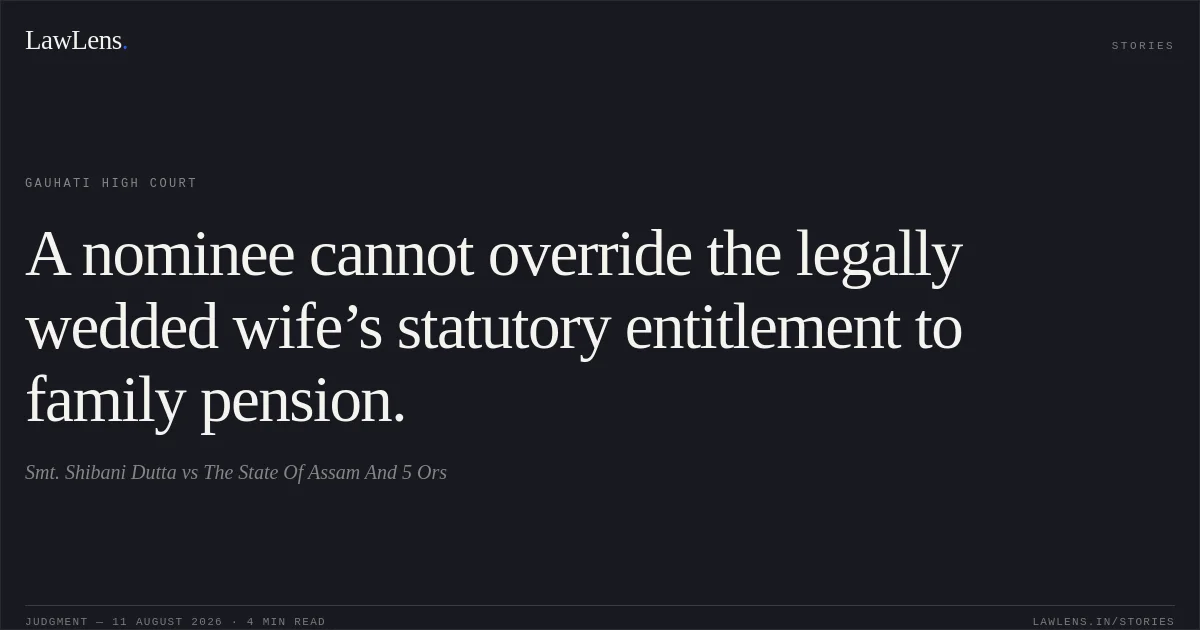
The Court held that the petitioner continued to be the legally wedded wife of late Sankar Dutta and that the nomination of Smt. Gayatri Dutta could not override the petitioner’s statutory entitlement to family pension under Rule 143 of the Assam Services (Pension) Rules, 1969.
The writ petition was disposed of with directions to the competent authorities to verify the petitioner’s claim, recognise her as the lawful beneficiary if found eligible, correct the PPO and GPO where necessary, and release the family pension, consequential arrears, and admissible DCRG and other retiral benefits.
Source reference: pp. 14–16; paras. 28–29The entire exercise was directed to be completed within two months from receipt of a certified copy of the order.
Source reference: p. 16; para. 30No order as to costs was made.
Source reference: p. 16; para. 31Original Court PDF
Smt. Shibani DuttavsThe State Of Assam And 5 Ors
Click to open original judgment
Original judgment, available to read, download and summarize on LawLens.in