Facts
Manipur State Power Company Limited (MSPCL) issued a tender for construction of a 132 kV transmission line.
Source reference: pp. 1–2The tender required bidders to have completed at least 5 km of qualifying work under a single turnkey work order, submit a mandatory site-visit certificate, and attend the scheduled site visit and pre-bid meeting.
Source reference: pp. 1–2, 9–10; paras. 12–13The petitioner did not attend either event and had not completed similar work, although it claimed to have completed 95% of a previous project.
Source reference: pp. 2, 10–11; paras. 12–13It submitted representations seeking recognition of that work and a further opportunity to visit the site and attend a pre-bid meeting.
Source reference: pp. 2, 10–11; paras. 12–13After MSPCL did not respond, the petitioner sought writ relief, including permission to participate and relaxation of the tender requirements.
Source reference: pp. 2–5The High Court heard the matter urgently and dismissed the writ petition, also disposing of the connected miscellaneous application.
Source reference: pp. 5, 12; paras. 6, 18Issues
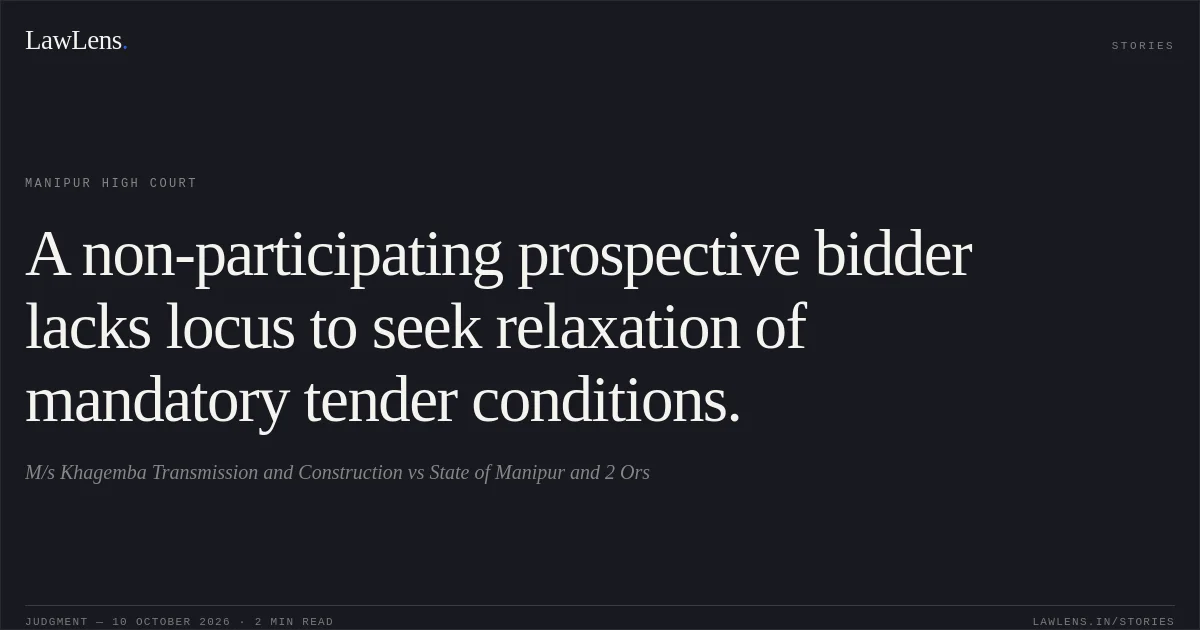
Whether a prospective bidder that had not submitted a bid and had not complied with mandatory tender requirements had locus to seek writ relief for relaxation of those requirements
Source reference: pp. 5–6, 11; paras. 8, 14–15Whether the Court should direct MSPCL to permit a further site visit and pre-bid participation, and to consider the petitioner’s 95% completed work as satisfying the technical-experience requirement
Source reference: pp. 2–5, 9–11; paras. 12–13Law Applied
Under Article 226, a stranger with no legally cognisable right cannot ordinarily seek mandamus or certiorari concerning another’s affairs; the Court relied on Ayaaubkhan Noorkhan Pathan v. State of Maharashtra, (2013) 4 SCC 465, for that principle.
Source reference: p. 11; para. 14Judicial review of tender decisions is limited to illegality, irrationality, or procedural impropriety; courts review the decision-making process rather than the merits of the decision, and the tendering authority is best placed to interpret its tender terms. The Court relied on Tata Cellular and the Supreme Court’s statement of these principles in Micky Traders v. L.R.Y. Labour Contractor & Ors., 2026 INSC 1025.
Source reference: pp. 11–12; para. 16Reasoning
The petitioner had neither submitted a bid nor attended the mandatory site visit and pre-bid meeting, and its requests for relaxation and a fresh opportunity were made after the pre-bid meeting had concluded.
Source reference: pp. 10–11; para. 13The Court treated the petitioner as a stranger to the tender and held that granting the requested relief would alter essential tender conditions, including mandatory participation requirements.
Source reference: p. 11; para. 15Further, the petitioner alleged no illegality or impropriety in the tender process that would justify judicial intervention; applying the limited standard of tender review, the Court declined to interfere.
Source reference: p. 12; para. 17Holding
The Court held that the petitioner lacked standing to obtain the requested relaxation and further participation opportunities, and found no basis to exercise its writ jurisdiction to interfere with the tender process.
The writ petition was dismissed, the connected miscellaneous application was disposed of, and no costs were ordered.
Source reference: p. 12; para. 18Acts & Sections Cited
5 provisions across 3 statutes referred to in this judgment. Linked provisions open on LawLens.
Commercial Documents Evidence Act, 19391
Instruction to Bidders (ITB)1
Annexure-A (BDS)3
Original Court PDF
M/s Khagemba Transmission and ConstructionvsState of Manipur and 2 Ors
Click to open original judgment
Original judgment, available to read, download and summarize on LawLens.in