Facts
The petitioner was convicted under Section 376 IPC and sentenced to seven years’ rigorous imprisonment and a fine of ₹5,000.
Source reference: pp. 2–5, paras. 1–5The conviction arose from the victim’s allegation that the petitioner, her nephew, had forcibly had sexual intercourse with her while she was sleeping at home.
Source reference: pp. 2–5, paras. 1–5The Sessions Court dismissed his appeal and affirmed the conviction and sentence.
Source reference: pp. 2–5, paras. 1–5He challenged both decisions in revision, alleging that the evidence had been perversely assessed
Source reference: pp. 2–5, paras. 1–5Issues
1. Whether the evidence, assessed in revision, could sustain the concurrent findings of guilt under Section 376 IPC
Source reference: pp. 5–6, paras. 5–72. Whether the prosecution had established the petitioner’s guilt beyond reasonable doubt in light of the alleged contradictions and infirmities in the evidence
Source reference: pp. 7–8, paras. 9–12Law Applied
Section 376 IPC governs the offence of rape.
Source reference: p. 6, para. 6The Court referred to Amit Kapoor v. Ramesh Chander, (2012) 9 SCC 460, as outlining the limits of revisional jurisdiction
Source reference: p. 6, para. 6It nevertheless stated that it could scrutinize the evidence to determine whether, taken at face value, it could support the conclusions reached by the lower courts
Source reference: p. 6, para. 7The prosecution was required to establish guilt beyond reasonable doubt
Source reference: p. 8, para. 12Reasoning
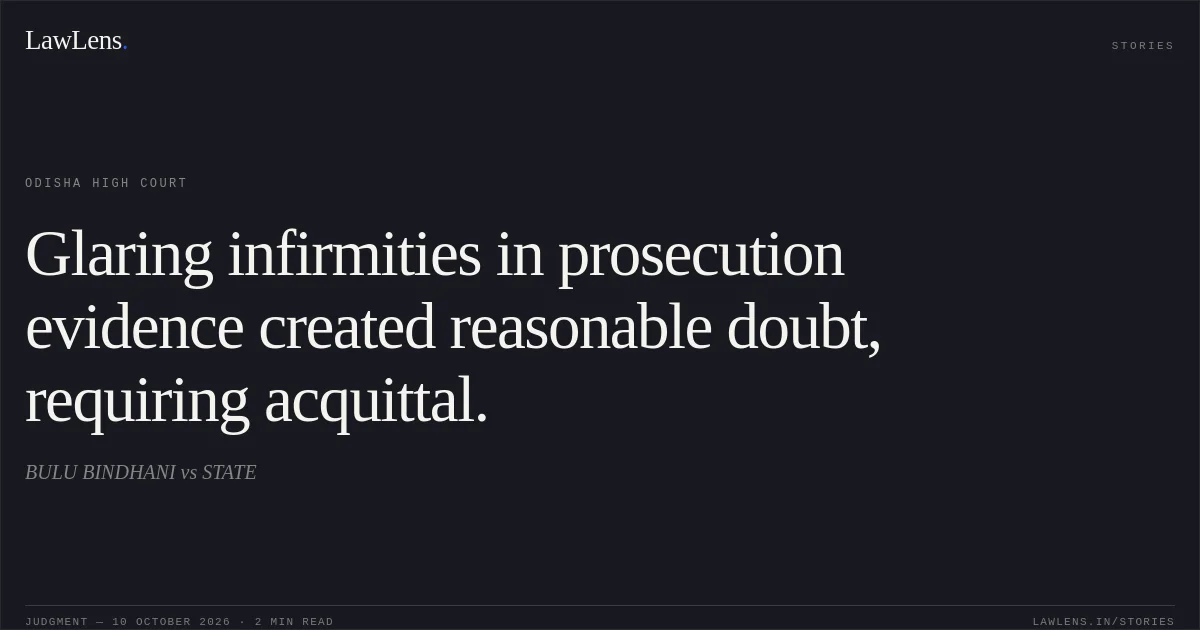
The Court found material weaknesses in the evidence: the mother-in-law’s testimony did not identify the alleged offender; the victim’s son, who was nearby, did not hear her cries; and the victim stated that she did not wish to proceed with the case.
Source reference: pp. 7–8, paras. 9–11The victim also testified that she was illiterate and that the FIR had neither been read over nor explained to her, while the Court identified material contradictions and glaring infirmities in the prosecution evidence.
Source reference: pp. 7–8, paras. 9–11It concluded that the lower courts had failed to account for these matters and that the evidence did not reliably establish the petitioner’s guilt
Source reference: pp. 7–8, paras. 9–11Holding
The Court held that the prosecution had not proved the petitioner’s guilt beyond reasonable doubt.
It acquitted him of the charge under Section 376 IPC, allowed the criminal revision, and disposed of the pending interlocutory applications.
Source reference: p. 8, para. 12; p. 9, para. 13Acts & Sections Cited
4 provisions across 2 statutes referred to in this judgment. Each provision opens on LawLens.
Code of Criminal Procedure, 19733
Indian Penal Code, 18601
Original Court PDF
BULU BINDHANIvsSTATE
Click to open original judgment
Original judgment, available to read, download and summarize on LawLens.in