Facts
The husband instituted C.P. No. 147 of 2022 before the Family Court, Nayagarh, seeking dissolution of the marriage under Section 13(1) of the Hindu Marriage Act, 1955.
Source reference: no citationThe wife sought rejection of the petition under Order VII Rule 11 read with Section 151 CPC, contending that the petition had been filed before completion of the two-year desertion period required by Section 13(1)(ib), and that it did not specifically plead when the cause of action arose.
Source reference: p. 2, para. 2The petition alleged that the wife left the husband’s company in 2020 and, on 6 November 2020, left the rented house where she was residing with their son; it also referred to a legal notice dated 21 July 2022 asking her to rejoin the husband.
Source reference: pp. 4–5, paras. 6–6.1The Family Court rejected the wife’s application, holding that the petition disclosed a cause of action and that the issues raised required adjudication at trial.
Source reference: pp. 3–4, para. 4The wife challenged that order in this writ petition.
Source reference: no citationIssues
Whether the husband’s divorce petition was liable to be rejected under Order VII Rule 11 CPC because its pleadings showed that the statutory two-year period of desertion had not been satisfied, or because it did not specifically state when the cause of action arose.
Source reference: p. 2, para. 2; pp. 4–5, paras. 6–7Whether the Family Court erred in rejecting the wife’s application under Order VII Rule 11 read with Section 151 CPC.
Source reference: pp. 3–4, paras. 4–5Law Applied
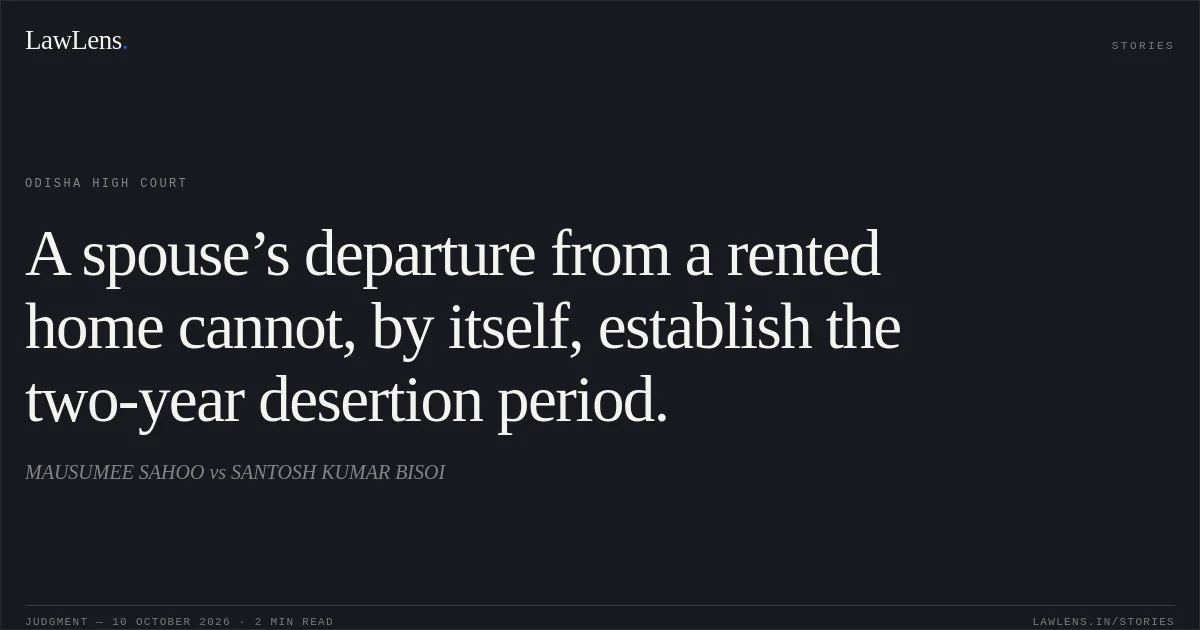
Section 13(1)(ib) of the Hindu Marriage Act, 1955 requires desertion for a continuous period of at least two years immediately preceding the presentation of a divorce petition on that ground.
Source reference: p. 2, para. 2Under Order VII Rule 11 CPC, the court considers the plaint and documents filed with it; it does not determine the truth of the allegations by relying on the defendant’s written statement or defence.
Source reference: p. 4, para. 5The court may reject a plaint at the threshold where the plaint itself does not disclose a cause of action or shows that the claim is barred by law; disputes requiring factual adjudication are not ordinarily resolved at that stage.
Source reference: pp. 3–4, para. 4Reasoning
The High Court applied the limited scope of Order VII Rule 11 by examining the divorce petition’s pleadings rather than the wife’s defence.
Source reference: p. 4, paras. 5–6Although the petition referred to the wife leaving the husband’s company in 2020 and leaving the rented house on 6 November 2020, the Court held that the latter date could not be taken as the date from which to calculate the desertion period for the purpose of rejecting the petition at the threshold.
Source reference: pp. 4–5, paras. 6–7It therefore found no basis to conclude at that stage that the petition was barred by law or failed to disclose a cause of action, while leaving the maintainability issue for determination during the final trial.
Source reference: pp. 3–4, para. 4; p. 6, para. 9Holding
The Court held that the Family Court committed no infirmity in rejecting the wife’s Order VII Rule 11 application and dismissed the writ petition.
It observed that the Family Court should decide all issues, including maintainability, during the final trial; the accompanying I.A. was also disposed of, and a copy of the judgment was directed to be communicated to the Family Court.
Source reference: p. 6, paras. 9–11Acts & Sections Cited
3 provisions across 3 statutes referred to in this judgment. Each provision opens on LawLens.
Code of Civil Procedure, 19081
Hindu Marriage Act, 19551
Code of Criminal Procedure, 19731
Original Court PDF
MAUSUMEE SAHOOvsSANTOSH KUMAR BISOI
Click to open original judgment
Original judgment, available to read, download and summarize on LawLens.in