Facts
Manoj Tewari instituted Title Suit No. 241 of 2013 against the petitioner, who filed a counterclaim seeking recovery of possession.
Source reference: para. 12–16The suit was dismissed for non-compliance with a court order, but the counterclaim proceeded and was decreed ex parte against the plaintiff, directing him to vacate and deliver the scheduled property.
Source reference: para. 12–16A proforma defendant, who had unsuccessfully applied to be transposed as a plaintiff in the counterclaim, filed Title Appeal No. 60 of 2025.
Source reference: para. 3–4, 14The First Appellate Court condoned the delay in filing the appeal and stayed the counterclaim decree.
Source reference: para. 3–4, 14The petitioner challenged both orders in revision, contending that the appellant was not a party to the counterclaim, had obtained no leave to appeal, and had shown no prejudice from the decree.
Source reference: para. 8–11Issues
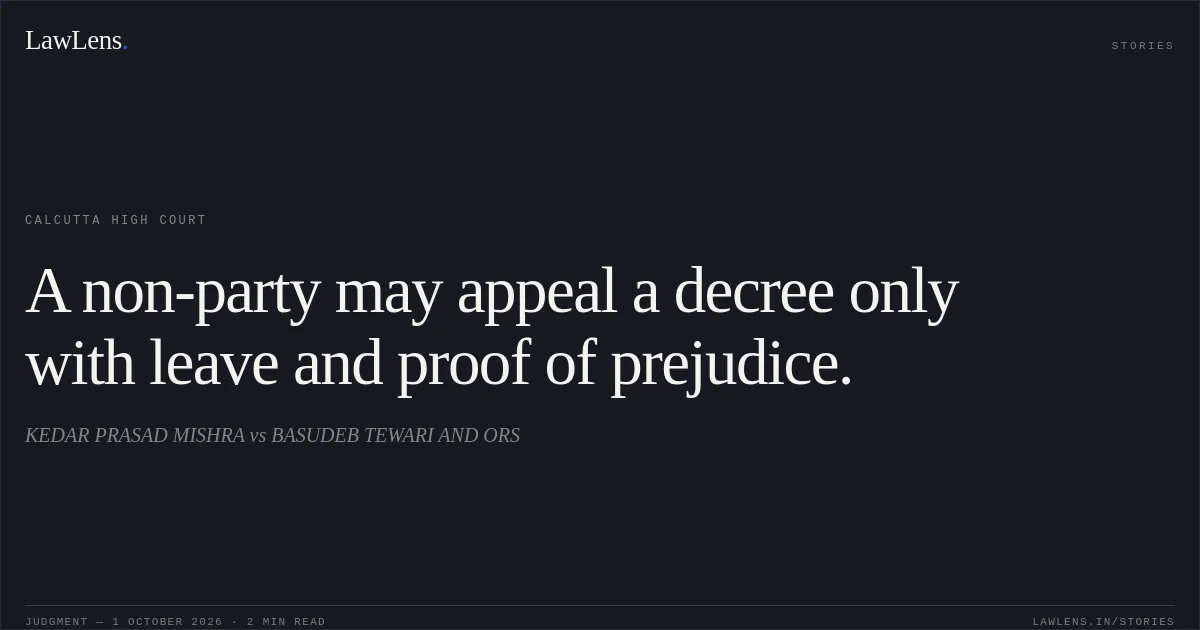
Whether a person who was not a party to the counterclaim could appeal against its decree without obtaining leave of the appellate court or demonstrating that the decree prejudicially affected them.
Source reference: para. 17–19Whether the First Appellate Court’s orders condoning delay and staying the decree could stand when the appellant had not established standing to appeal.
Source reference: para. 18–21Law Applied
Sections 96 and 100 of the Code of Civil Procedure, 1908 provide for appeals from decrees, but do not themselves specify who may appeal.
Source reference: no citationA person who was not a party to the proceedings may appeal only with the appellate court’s leave and upon showing that they are bound by, aggrieved by, or otherwise prejudicially affected by the decree; a stranger cannot appeal without satisfying the court that they qualify as an aggrieved person.
Source reference: para. 17The Court applied the Supreme Court’s decision in H. Anjanappa & Ors. v. A. Prabhakar & Ors., Civil Appeal Nos. 1180–1181 of 2025, 2025 INSC 121, which restated this principle.
Source reference: para. 17The Court also considered the trial court’s rejection of the appellant’s application under Order I Rule 10(2) CPC to be added to the counterclaim proceedings.
Source reference: para. 14Reasoning
The counterclaim decree operated against the plaintiff in the suit and directed that person to deliver possession; it contained no order against the proforma defendant who filed the appeal.
Source reference: para. 15–16The appellant had not been a party to the counterclaim, and the record did not show that the decree prejudiced him or that he had obtained leave to appeal.
Source reference: para. 19The First Appellate Court’s reliance on the appellant’s alleged lack of notice was, in the High Court’s view, perverse because the trial court had considered and rejected his application to be added to the proceedings.
Source reference: para. 18Applying H. Anjanappa, the Court concluded that the appellant had not established a basis to appeal; the orders condoning delay and staying the decree therefore could not stand.
Source reference: para. 17–20Holding
The High Court set aside the impugned orders dated 25 July 2025 and 5 August 2025.
It held that the appeal’s admission could not stand in the absence of leave from the First Appellate Court and dismissed Title Appeal No. 60 of 2025.
Source reference: para. 20–22The civil revision was disposed of accordingly.
Source reference: para. 20–22Acts & Sections Cited
3 provisions across 1 statute referred to in this judgment. Each provision opens on LawLens.
Code of Civil Procedure, 19083
Original Court PDF
KEDAR PRASAD MISHRAvsBASUDEB TEWARI AND ORS
Click to open original judgment
Original judgment, available to read, download and summarize on LawLens.in