Facts
The complainant alleged that Madhya Bihar Gramin Bank invited a tender for furniture and fixtures, which was allocated to co-accused Subrata Basu @ S. Bose.
Source reference: pp. 2–3, paras. 3–4Basu allegedly subcontracted the work to the complainant, who claimed to have completed approximately 70% of the work.
Source reference: pp. 2–3, paras. 3–4A cheque for ₹12 lakh, issued by Basu, was dishonoured with the remark “account blocked/account frozen.”
Source reference: pp. 2–3, paras. 3–4The Judicial Magistrate took cognizance against the petitioner-bank on 9 August 2016.
Source reference: p. 3, para. 5Issues
Whether a bank which is neither the drawer nor the signatory of the dishonoured cheque, and which did not maintain the account on which the cheque was drawn, can be prosecuted under Section 138 of the Negotiable Instruments Act?
Source reference: pp. 3–4, para. 5.1Whether continuation of the Section 138 proceedings against the petitioner-bank amounted to an abuse of the process of the court?
Source reference: p. 4, paras. 6–7Law Applied
The Court applied Section 138 of the Negotiable Instruments Act, 1881, which fastens criminal liability on the person who draws a cheque on an account maintained by that person for discharge of a legally enforceable debt or liability.
Source reference: p. 4, para. 5.1The Court held, relying on Alka Khandu Avhad v. Amar Syam Prasad Mishra, (2021) 4 SCC 675, that Section 138 does not contemplate joint liability and that a person other than the drawer of the cheque cannot be prosecuted for the offence merely because that person is alleged to be connected with the underlying transaction.
Source reference: p. 4, para. 5.1Proceedings that lack the foundational ingredients of Section 138 constitute an abuse of the process of the court.
Source reference: p. 4, para. 7Reasoning
The cheque was allegedly issued and signed by co-accused Subrata Basu, whereas the petitioner was not the drawer or signatory and the relevant account was not maintained by it.
Source reference: pp. 3–4, paras. 5–5.1The Court further noted that the contractual arrangement concerning the work was between the complainant and Basu, and that the petitioner-bank was not shown to have undertaken any obligation under that agreement.
Source reference: pp. 4–5, paras. 7–8Applying the rule in Alka Khandu Avhad, the Court concluded that the alleged status of the bank as a beneficiary or its officials’ refusal to make payment could not substitute for the statutory requirement that the accused must be the drawer of the dishonoured cheque.
Source reference: pp. 4–5, paras. 7–8Consequently, the essential ingredients of Section 138 were absent against the petitioner, making continuation of the prosecution an abuse of process.
Source reference: pp. 4–5, paras. 7–8Holding
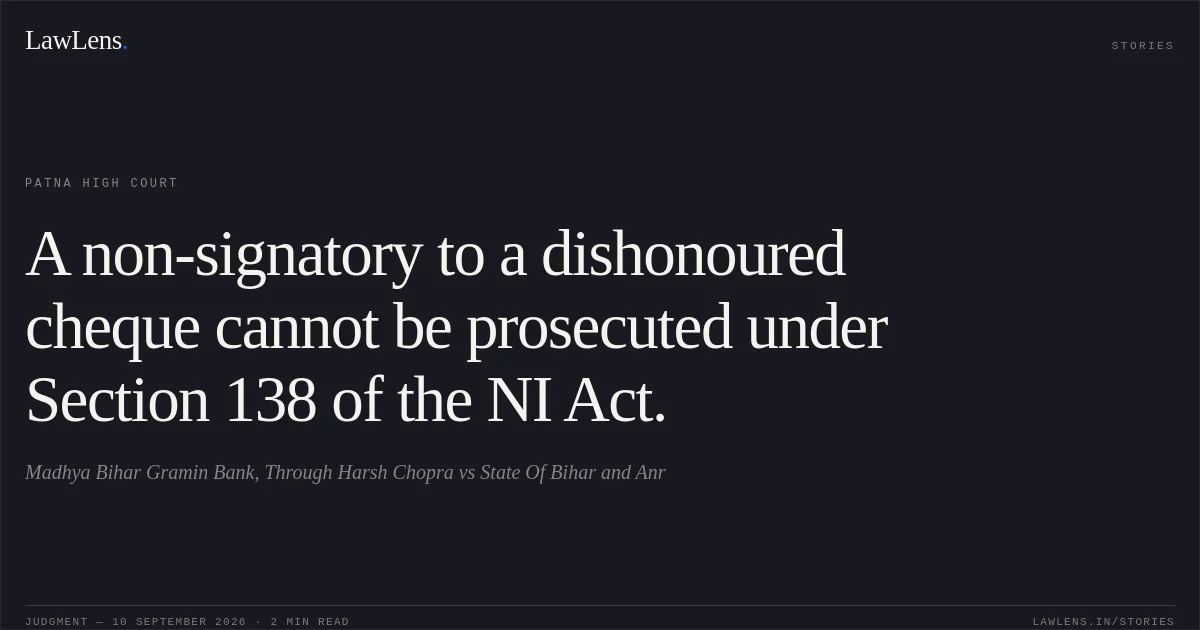
The High Court held that the petitioner-bank, not being the signatory or drawer of the dishonoured cheque, could not be prosecuted under Section 138 of the Negotiable Instruments Act.
It quashed the order taking cognizance dated 9 August 2016 and all subsequent proceedings in Complaint Case No. 1036(C) of 2016 insofar as they concerned the petitioner-bank.
Source reference: p. 5, para. 8Proceedings against co-accused Subrata Basu @ S. Bose were permitted to continue.
Source reference: p. 5, para. 8The application was accordingly allowed.
Source reference: p. 5, para. 9Acts & Sections Cited
1 provisions across 1 statute referred to in this judgment. Each provision opens on LawLens.
Negotiable Instruments Act, 18811
Original Court PDF
Madhya Bihar Gramin Bank, Through Harsh ChopravsState Of Bihar and Anr
Click to open original judgment
Original judgment, available to read, download and summarize on LawLens.in