01Facts
A contract employee sustained grievous injuries, including a fracture, in an accident at the petitioner’s factory.
pp. 3–4The Deputy Director of Factories issued a show-cause notice, considered the petitioner’s reply, and passed an order dated 25 January 2021.
pp. 3–4Before the petitioner’s one-month period to appeal that order had expired, the respondent filed a private complaint alleging an offence under Section 92 of the Factories Act, 1948.
pp. 3–4The Magistrate took cognizance and issued summons.
pp. 3–4The petitioner challenged that order and the pending proceedings under Articles 226 and 227 of the Constitution read with Section 482 of the Code of Criminal Procedure.
pp. 3–402Issues
i.1. Whether the Magistrate’s order taking cognizance and issuing summons under Section 92 of the Factories Act should be set aside where it did not disclose the material or reasons supporting the decision
pp. 4–6ii.2. Whether the complaint and proceedings should be set aside when they were initiated before the petitioner’s period to appeal the Deputy Director’s order had expired
pp. 4–603Law Applied
Section 92 of the Factories Act, 1948, provides for punishment for contravention of the Act and rules made under it.
pp. 4–5The Court proceeded on the basis that the Deputy Director’s order was appealable and that the petitioner’s one-month period to appeal had not expired when the complaint was filed.
pp. 4–5The Court also relied on Section 14 of the Limitation Act to direct that time spent in the present litigation be excluded when entertaining the appeal.
p. 7The judgment cited no precedent.
pp. 4–7Provisions in the judgment · 2 · Linked ones open on LawLens
Code of Criminal Procedure, 1973 Section 482
Limitation Act, 1963 Section 14
04Reasoning
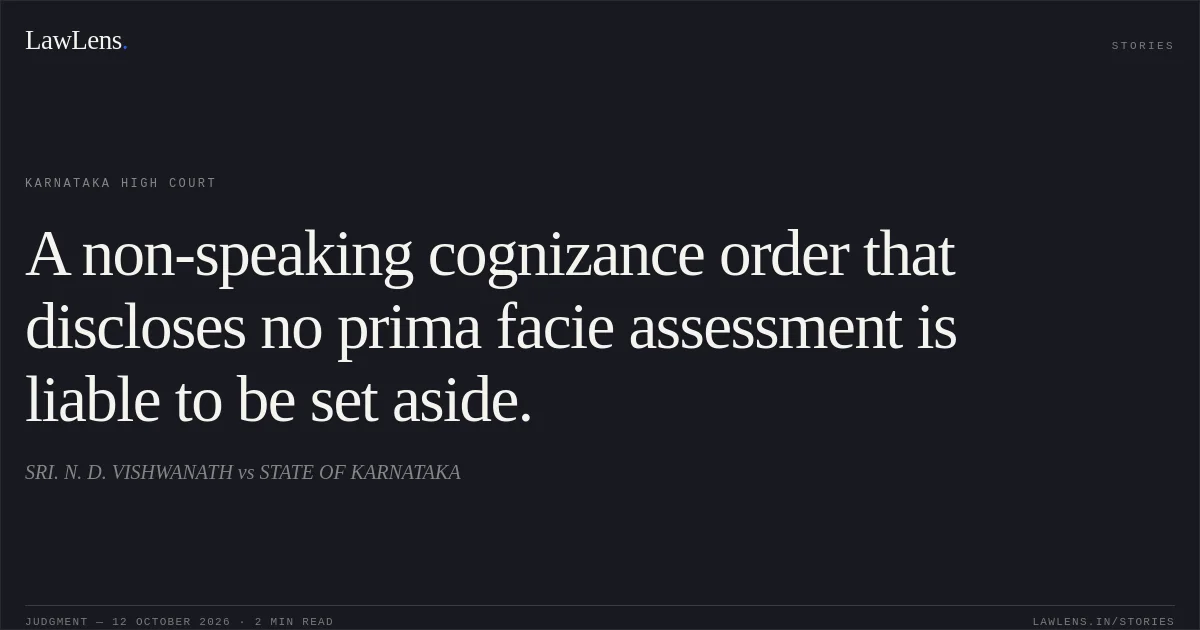
The Magistrate’s order merely stated that cognizance was taken and summons should issue; it did not identify the documents considered or explain their prima facie probative value.
pp. 5–6The Court therefore found the order insufficiently reasoned.
pp. 5–6It also considered that the complaint had been filed before the petitioner’s time to appeal the Deputy Director’s order had expired.
pp. 5–6In those circumstances, the Court set aside the cognizance order and proceedings, while preserving the petitioner’s opportunity to challenge the Deputy Director’s order.
pp. 5–605Holding
The petition was allowed, and the proceedings in C.C. No. 357/2021 (PCR No. 58/2021) were set aside.
p. 7The petitioner was permitted to challenge the Deputy Director’s order.
p. 7The Court directed that the time spent in this litigation be excluded under Section 14 of the Limitation Act when entertaining the appeal, which was to be filed within 15 days from 7 October 2026.
p. 7Original Court PDF
SRI. N. D. VISHWANATHvsSTATE OF KARNATAKA
Click to open original judgment
Original judgment, available to read, download and summarize on LawLens.in