Facts
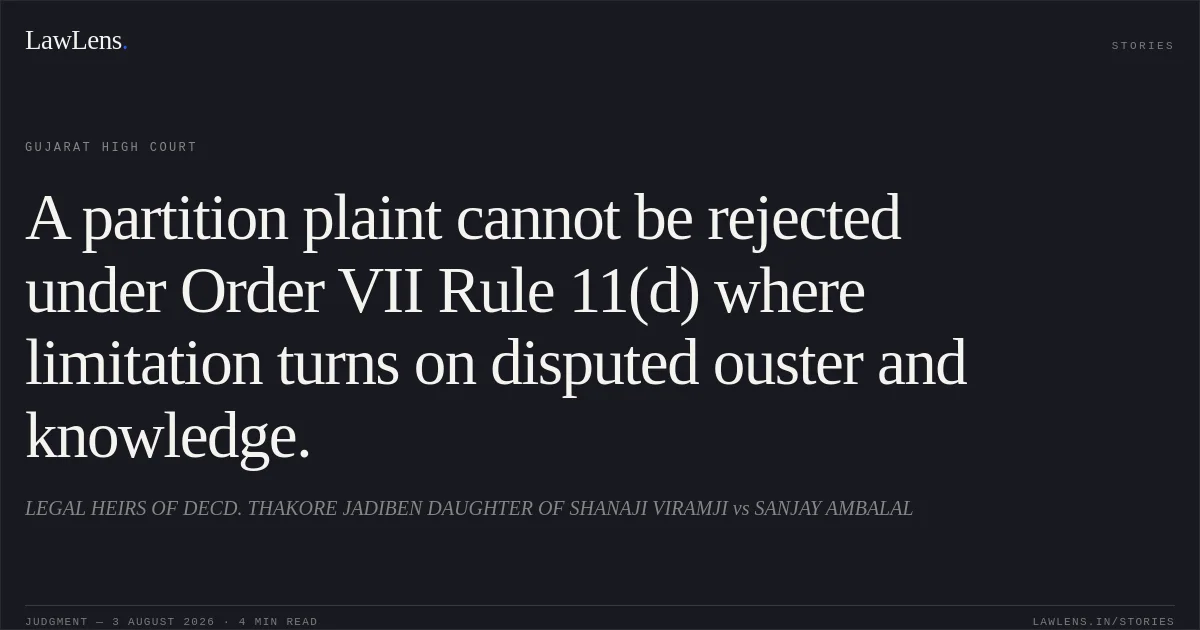
The plaintiff claimed a one-half undivided share in land bearing Survey No. 55, Village Amiyapur, Gandhinagar, originally recorded in the name of Bai Fateh, widow of Mohanji Vaghaji.
Source reference: paras. 3–3.4Bai Fateh died intestate and issueless. The plaintiff asserted that succession devolved upon the branches of her husband’s heirs, including the branches of Thakor Chhaganji Viramji and Thakor Sanaji alias Chhanaji Viramji, and that the plaintiff claimed through Jadiben, daughter of Sanaji.
Source reference: paras. 3–3.4The plaintiff alleged that the Sanaji branch was improperly omitted from the revenue records, while the Chhaganji branch continued to be recorded.
Source reference: paras. 3.3–3.5The heirs of Chhaganji thereafter executed two registered sale deeds concerning the entire property on 25 May 2007 and 03 January 2008.
Source reference: paras. 3.3–3.5The plaintiff instituted Special Civil Suit No. 137 of 2012 seeking declaration of his one-half share, partition and separate possession, and declarations that the sale deeds were void or, alternatively, not binding upon his share.
Source reference: para. 3.4The defendants sought rejection of the plaint under Order VII Rule 11(d) of the Code of Civil Procedure, 1908, contending that the suit was barred by limitation.
Source reference: paras. 3.6–3.8The Trial Court accepted that objection and rejected the plaint on 11 April 2014.
Source reference: paras. 3.6–3.8The plaintiff challenged that order in the present First Appeal.
Source reference: no citationIssues
1. Whether the Trial Court was justified in rejecting the plaint under Order VII Rule 11(d) CPC merely because the prayers concerning cancellation of the registered sale deeds appeared to be beyond the period of limitation, without separately considering the principal relief of partition?
Source reference: para. 9(i)2. Whether the plaintiff’s claim for partition and separate possession involved disputed questions of fact—particularly concerning succession, exclusion, ouster, knowledge and the alleged undivided character of the property—which required a full-fledged trial?
Source reference: para. 9(ii)3. Whether, on a reading of the plaint as a whole, the suit was ex facie barred by limitation or any other law so as to warrant rejection at the threshold under Order VII Rule 11(d) CPC?
Source reference: para. 9(iii)Law Applied
The Court applied Order VII Rule 11(d) CPC, under which a plaint may be rejected only where the suit appears from the statements in the plaint itself to be barred by law.
Source reference: para. 10At that stage, the plaint and documents relied upon by the plaintiff must be read as a whole, the pleaded facts must be accepted as true, and the defence cannot be considered; disputed questions of fact cannot ordinarily be adjudicated.
Source reference: paras. 11–15; Saleem Bhai v. State of Maharashtra, (2003) 1 SCC 557; Sopan Sukhdeo Sable v. Assistant Charity Commissioner, (2004) 3 SCC 137The Court relied on Article 110 of the Limitation Act, 1963, prescribing twelve years for a suit by a person excluded from joint family property, reckoned from when the exclusion becomes known to him, and treated the limitation question concerning exclusion and knowledge as ordinarily triable.
Source reference: para. 24It also applied Section 15(1)(b) of the Hindu Succession Act, 1956, under which the property of a female Hindu dying intestate and issueless devolves upon the heirs of her husband.
Source reference: paras. 27–28Article 59 of the Limitation Act and the principle of deemed notice arising from registration were considered in relation to the sale-deed challenges, but the Court held that those prayers were ancillary to the primary partition claim.
Source reference: paras. 18, 45The Court further relied on the rule that a plaint cannot be rejected in part where at least one relief is maintainable, as affirmed in Central Bank of India v. Rambha Jain, (2025) 4 SCC 638, and Vinod Infra Developers Pvt. Ltd. v. Mahavir Builders, 2025 LiveLaw (SC) 630.
Source reference: paras. 32–34Reasoning
The Court held that the Trial Court had incorrectly treated the suit as one primarily seeking cancellation of the two sale deeds.
Source reference: paras. 17–18, 24–25On a holistic reading of the plaint, the principal relief was declaration of the plaintiff’s alleged one-half share and partition by metes and bounds; the sale-deed challenges were consequential and alternative reliefs.
Source reference: paras. 17–18, 24–25The pleadings alleged that the property remained undivided, that the plaintiff’s branch had never relinquished its rights, and that the Sanaji branch had been omitted from the revenue records through fraud or collusion.
Source reference: paras. 29–30, 37The revenue entries were inconsistent: although the Chhaganji branch was subsequently recorded, the name of Sanaji had earlier appeared and was later omitted without an evident explanation.
Source reference: paras. 19–23These circumstances raised triable questions concerning the plaintiff’s status as an heir, the existence of an undivided share, whether any partition or relinquishment had occurred, whether the plaintiff or his predecessor had been excluded, and when such exclusion became known.
Source reference: paras. 24, 30, 38, 43, 45Such questions could not be resolved merely by relying on the dates of registration of the sale deeds or by treating registration as conclusive deemed knowledge.
Source reference: paras. 24, 30, 38, 43, 45Since the partition claim was not shown from the plaint itself to be barred, the plaint could not be rejected in its entirety even if the limitation of some ancillary reliefs were arguable.
Source reference: paras. 32–35Holding
The High Court allowed the appeal and quashed the Trial Court’s order dated 11 April 2014 rejecting the plaint under Order VII Rule 11(d) CPC.
Special Civil Suit No. 137 of 2012 was restored to the Trial Court for adjudication on merits.
Source reference: para. 53The Trial Court was directed to endeavour to complete the proceedings within six months of receiving the order, with the parties directed to cooperate.
Source reference: para. 53The Court expressly clarified that it had not adjudicated the merits of the plaintiff’s title, share, succession or validity of the sale deeds; those matters were left open for determination after trial.
Source reference: para. 54Acts & Sections Cited
13 provisions across 5 statutes referred to in this judgment. Each provision opens on LawLens.
Code of Civil Procedure, 19082
Hindu Succession Act, 19564
Limitation Act, 19634
Transfer of Property Act, 18821
Securitisation and Reconstruction of Financial Assets and Enforcement of Security Interest Act, 20022
Original Court PDF
LEGAL HEIRS OF DECD. THAKORE JADIBEN DAUGHTER OF SHANAJI VIRAMJIvsSANJAY AMBALAL
Click to open original judgment
Original judgment, available to read, download and summarize on LawLens.in