Facts
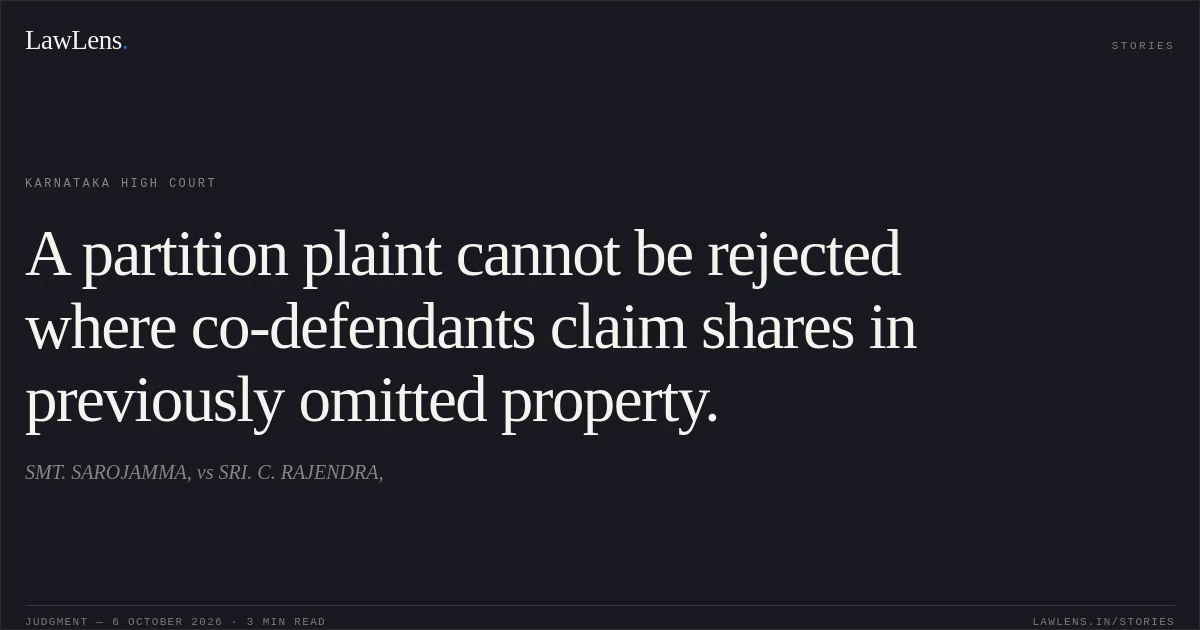
C. Rajendra filed O.S. No. 8817/2018 seeking partition and separate possession of alleged joint-family properties, including a declaration that certain sale and gift deeds were not binding on his share.
Source reference: pp. 6–9Defendants 4 and 5, his sisters, filed written statements claiming shares in the properties.
Source reference: pp. 6–9While the plaintiff’s application to withdraw the suit was pending, defendant 10 applied under Order VII Rule 11(d) CPC to reject the plaint, contending that the suit was time-barred and an abuse of process, given earlier partition suits and a compromise in another suit.
Source reference: pp. 6–9, 21–23The Trial Court allowed the application, relying on limitation, the pending earlier suit, and abuse of process.
Source reference: pp. 9–11Defendants 4 and 5 appealed. They contended, among other things, that one scheduled property—Sy. No. 97/2—was not included in the earlier suits and that rejection would defeat their claim to a share.
Source reference: pp. 11–14, 48–50Issues
1. Whether the appeal could be determined on its merits without notice to certain respondents who had not been served, without prejudicing them.
Source reference: para. 24(i), pp. 20–252. Whether the Trial Court was justified in rejecting the plaint under Order VII Rule 11(d) CPC.
Source reference: para. 24(ii), pp. 20, 26–523. Whether the Trial Court’s order required appellate interference.
Source reference: para. 24(iii), pp. 20, 52–53Law Applied
Under Order VII Rule 11(d) CPC, a plaint may be rejected where, on its own averments and documents relied upon, the suit appears barred by law; the defendant’s pleadings and disputed factual matters are not the basis for that determination.
Source reference: pp. 26–36The court must read the plaint as a whole and may reject it only where the legal bar is apparent from that material, applying the principles in Dahiben v. Arvindbhai Kalyanji Bhanusali and Saleem Bhai v. State of Maharashtra.
Source reference: pp. 26–36In a partition suit, defendants who are members of the joint family may themselves claim shares; withdrawal or termination of the plaintiff’s suit should not, without consideration, foreclose those claims.
Source reference: pp. 21–22, 47–48A prayer that alienations are “not binding” on a claimant’s share is distinct from seeking cancellation of the instruments in their entirety.
Source reference: pp. 51–52Reasoning
The Court found no prejudice to the unserved respondents from hearing the appeal: they had not been served in the suit, had not appealed, and their interests would not be affected by deciding whether the plaint had been properly rejected.
Source reference: paras. 25–30, pp. 21–26On the merits, the Trial Court had relied on matters including the earlier litigation and alleged limitation, rather than determining whether the bar was apparent from the plaint.
Source reference: paras. 32–38, pp. 46–53The Court noted that Sy. No. 97/2 was not part of the earlier suits and that the appellants had independently claimed shares in the current partition suit.
Source reference: paras. 32–38, pp. 46–53It also held that the plaint’s request to treat sale deeds as not binding on the plaintiff’s share was not equivalent to seeking their cancellation; the Trial Court had therefore misconstrued the relief when finding the suit time-barred.
Source reference: paras. 32–38, pp. 46–53The Court did not finally decide the parties’ substantive claims, directing the Trial Court to reconsider the suits on their merits.
Source reference: paras. 38–39, pp. 52–54Holding
The Court held that the Trial Court was not justified in rejecting the plaint and that its order required interference.
The appeal was allowed; the order dated 3 March 2026 rejecting the plaint in O.S. No. 8817/2018 was set aside, and that suit was remanded.
Source reference: paras. 38–39, pp. 52–54The Trial Court was directed to issue summons to all defendants and dispose of O.S. Nos. 26810/2009 and 8817/2018, already clubbed, on their merits and expeditiously, without being influenced by the High Court’s observations.
Source reference: paras. 38–39, pp. 52–54Acts & Sections Cited
6 provisions across 3 statutes referred to in this judgment. Each provision opens on LawLens.
Code of Civil Procedure, 19082
Transfer of Property Act, 18821
Original Court PDF
SMT. SAROJAMMA,vsSRI. C. RAJENDRA,
Click to open original judgment
Original judgment, available to read, download and summarize on LawLens.in