Facts
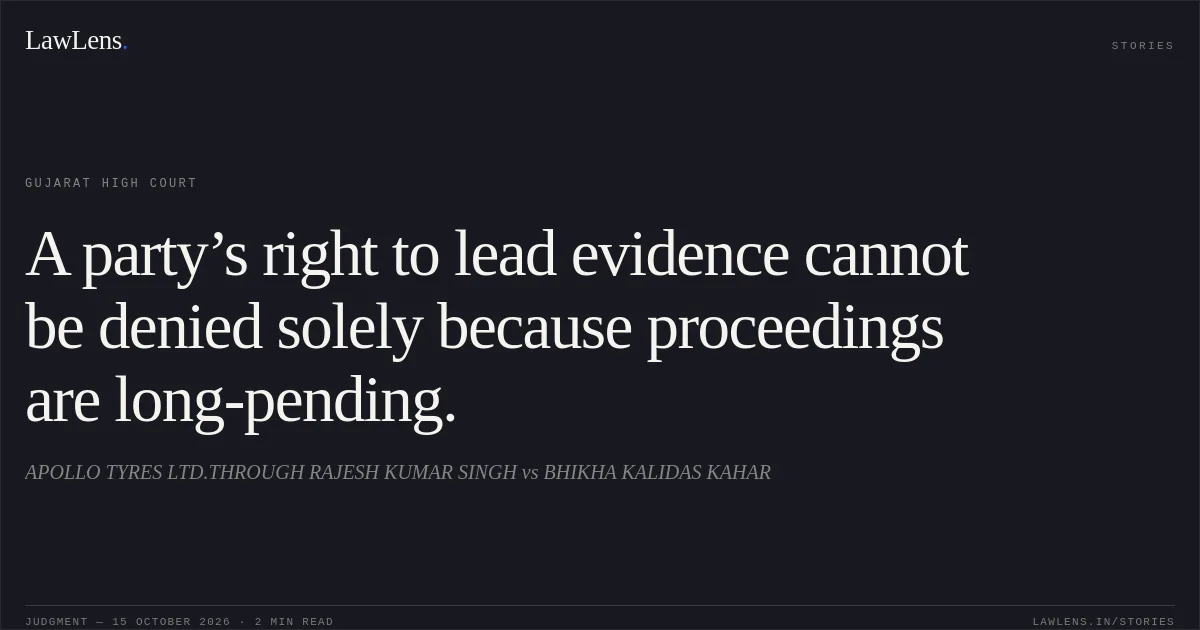
The petitions arose from a long-pending labour reference.
Source reference: no citationOn 1 November 2025, the Labour Court held the departmental inquiry against the respondent-workman illegal and permitted the petitioner-employer to prove the alleged misconduct by oral and documentary evidence
Source reference: para. 4.1; p. 2After the employer was absent on 13 November 2025, the Labour Court allowed the workman’s application to close the employer’s right to lead evidence
Source reference: para. 4.2; p. 3The employer later sought restoration of that right, but the Labour Court rejected its application on 5 February 2026, relying principally on the age of the reference and prior adjournments
Source reference: paras. 4.3, 8; pp. 3, 5The employer challenged that order under Articles 226 and 227 of the Constitution
Source reference: para. 3; p. 1The petitions were decided together because they raised an identical issue on the same facts and materials
Source reference: para. 2; p. 1Issues
1. Whether the Labour Court was justified in refusing to reopen the employer’s right to lead evidence principally because the reference was old and had suffered delay.
Source reference: paras. 8–10; pp. 5–62. Whether, in the circumstances, the employer should be restored an opportunity to lead evidence subject to directions ensuring expeditious disposal.
Source reference: paras. 10–12; pp. 6–7Law Applied
The Court exercised its jurisdiction under Articles 226 and 227 of the Constitution
Source reference: para. 3; p. 1It applied the principles of natural justice and fair opportunity, holding that the age of proceedings and the need for expedition are relevant but cannot, by themselves, justify denying a party an opportunity to lead evidence—particularly where that opportunity had previously been granted. The court must consider the circumstances in which the right was closed, the party’s subsequent steps, and the prejudice caused by refusal.
Source reference: paras. 9–12; pp. 6–7No statute or judicial precedent was expressly cited.
Source reference: no citationReasoning
The Labour Court had permitted the employer to prove the alleged misconduct after finding the departmental inquiry illegal, but subsequently closed the employer’s evidence and rejected its request to reopen that right primarily because the reference had been pending since 2007
Source reference: paras. 7–8; pp. 5–6The High Court considered that the employer had applied to reopen its right after learning of the closure and was willing to lead evidence within a fixed timeframe
Source reference: paras. 8, 10; p. 6Denying the opportunity could materially prejudice the employer’s case, while the workman’s interest in avoiding further delay could be protected through strict timelines and a direction against unnecessary adjournments.
Source reference: paras. 11–12; pp. 6–7Holding
The Court allowed the petitions, quashed the Labour Court’s order dated 5 February 2026, and restored the employer’s right to lead oral and documentary evidence.
It directed the employer to pay ₹1,000 to the respondent, appear on the next hearing date, and avoid unnecessary adjournments; the Labour Court was directed to complete recording the evidence within two months of receiving the order, with day-to-day hearings if necessary.
Source reference: paras. 14–17; pp. 7–8Rule was made absolute.
Source reference: p. 8Original Court PDF
APOLLO TYRES LTD.THROUGH RAJESH KUMAR SINGHvsBHIKHA KALIDAS KAHAR
Click to open original judgment
Original judgment, available to read, download and summarize on LawLens.in