Facts
The petitioner, a police constable, was convicted under Section 498-A IPC on 7 September 2022 and sentenced to two years’ rigorous imprisonment and a fine.
Source reference: para. 2.1–2.3Relying solely on that conviction, the respondents dismissed him on 5 December 2022; his departmental appeal was rejected on 3 January 2023.
Source reference: para. 2.1–2.3The appellate court acquitted him on 16 May 2023, finding that the prosecution had failed to prove the charges.
Source reference: para. 2.3–2.4The respondents nevertheless rejected his reinstatement representation because a criminal revision against the acquittal was pending.
Source reference: para. 2.3–2.4No departmental inquiry had been initiated or conducted against him.
Source reference: para. 3.1Issues
1. Whether the petitioner’s acquittal in appeal entitled him to relief from a dismissal based solely on the trial-court conviction, in the absence of a departmental inquiry.
Source reference: para. 3.1, 6–82. Whether the pendency of a criminal revision against the acquittal justified refusing reinstatement.
Source reference: para. 2.4, 4, 7–93. What consequential relief, including back wages and continuity of service, should be granted.
Source reference: para. 9–11Law Applied
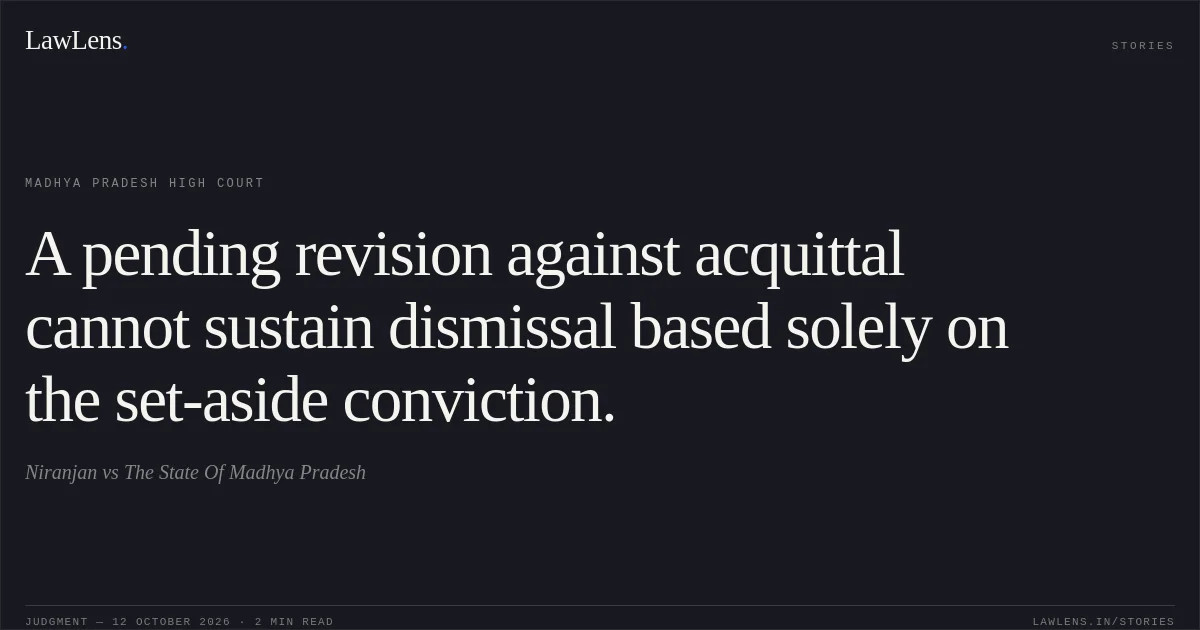
The Court applied the principle that an appeal or revision against an acquittal is not a continuation of the criminal trial and does not, by itself, constitute pending judicial proceedings against the acquitted employee.
Source reference: para. 7It relied on Upendra Singh Patel v. State of Madhya Pradesh and Others, W.P. No. 23316 of 2021, and the authorities discussed there, including Balak Singh Thakur v. State of M.P. and Others, Jagdish Kapasiya v. Revenue Department and Others, and Ram Ratan Tiwari v. State of M.P. and Others, which support that principle.
Source reference: para. 7The Court further held that where dismissal rests solely on a conviction later set aside on appeal, and no departmental inquiry was initiated or conducted, the pending revision alone cannot justify continuing the dismissal.
Source reference: para. 8Reasoning
The petitioner’s dismissal was founded exclusively on the trial-court conviction, which the appellate court set aside after finding that the prosecution had failed to establish the charges.
Source reference: para. 6–7Applying the settled principle that a revision against acquittal does not continue the trial, the Court held that the pending revision was not a valid basis to refuse reinstatement.
Source reference: para. 7–9The absence of any departmental inquiry reinforced that conclusion: there was no independent disciplinary finding supporting the dismissal.
Source reference: para. 3.1, 8Holding
The Court allowed the petition and quashed the dismissal order dated 5 December 2022, the departmental appellate order dated 3 January 2023, and the representation-rejection order dated 3 July 2025.
It directed the respondents to reinstate the petitioner forthwith.
Source reference: para. 9The petitioner was denied back wages for the period from 7 September 2022 to 16 May 2023, but awarded 50% back wages from 22 May 2023—the date he communicated the acquittal—to be paid within three months of reinstatement.
Source reference: para. 10–12He was also granted continuity of service for all other purposes.
Source reference: para. 10–12Acts & Sections Cited
1 provisions across 1 statute referred to in this judgment. Each provision opens on LawLens.
Prevention of Corruption Act, 19881
Original Court PDF
NiranjanvsThe State Of Madhya Pradesh
Click to open original judgment
Original judgment, available to read, download and summarize on LawLens.in