Facts
The revisionist challenged a Family Court order directing him to pay monthly maintenance of ₹20,000 to his wife and ₹10,000 to their minor son from the date of the application under Section 125 Cr.P.C.
Source reference: para. 3–10, 17–19He argued, among other things, that the maintenance award was disproportionate to his income and that his allegation that his wife was living in adultery had not been properly considered.
Source reference: para. 3–10, 17–19In support, he relied on photographs and other electronic material, including material which the Family Court had declined to consider for want of a certificate under Section 65-B of the Evidence Act.
Source reference: para. 3–10, 17–19He had specifically named Sumit Tripathi as the alleged co-adulterer but had not sought to have notice issued to him.
Source reference: para. 3–10, 17–19Issues
1. Whether the Family Court could receive and consider the revisionist’s electronic material under Section 14 of the Family Courts Act despite the objection concerning a certificate under Section 65-B of the Evidence Act.
Source reference: para. 21(i)2. Whether a specifically named alleged co-adulterer must be afforded an opportunity of hearing before a court records an adverse finding against him in proceedings under Section 125 Cr.P.C.
Source reference: para. 21(ii)3. Whether additional evidence could be received at the revisional stage under Sections 391 and 401 Cr.P.C.
Source reference: para. 21(iii)4. Whether the grounds raised by the revisionist disclosed a basis to interfere with the Family Court’s maintenance order.
Source reference: para. 21(iv)Law Applied
Section 14 of the Family Courts Act permits a Family Court to receive material that may assist it in effectively resolving a dispute, even if that material would not otherwise be relevant or admissible under the Evidence Act; receipt of material, however, does not establish its authenticity or evidentiary weight.
Source reference: para. 24–28The court treated Section 125(4) Cr.P.C. as making an allegation of adultery relevant to a wife’s entitlement to maintenance, while recognising that maintenance proceedings are summary and intended to prevent destitution.
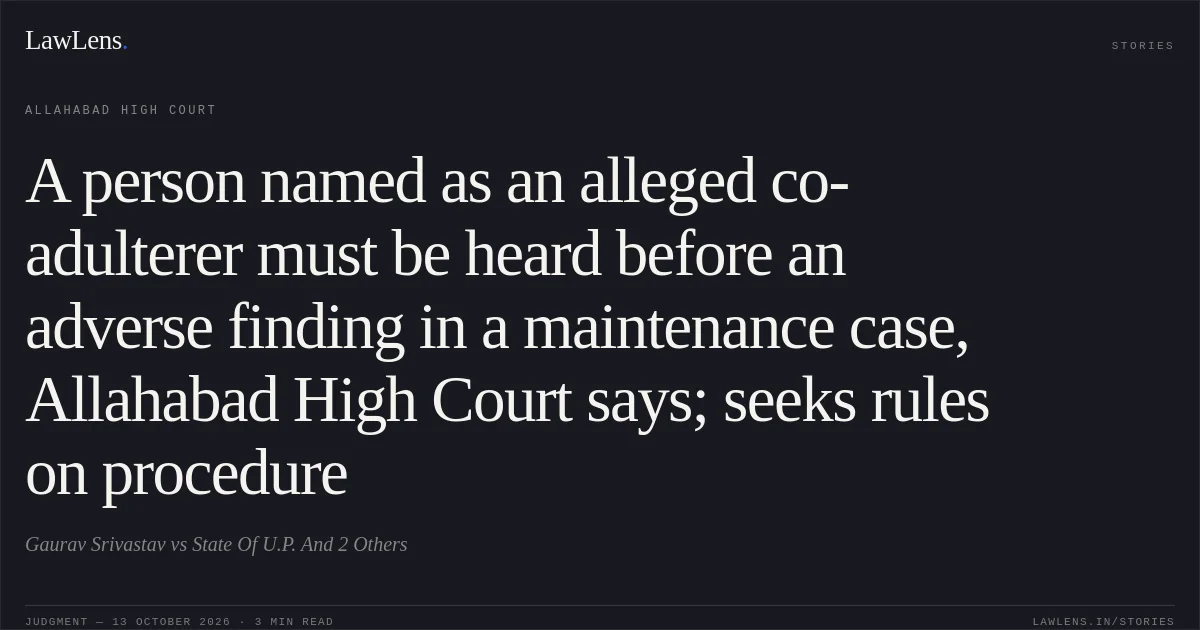
Source reference: para. 29The principle of audi alteram partem requires a specifically identified person to be heard before an adverse finding of adultery is recorded against him.
Source reference: para. 30–34Under Sections 401(1) and 391 Cr.P.C., the High Court may receive additional evidence in revision, but that power is discretionary and requires the evidence to be necessary for effective adjudication.
Source reference: para. 45–46The court also relied on Rajnesh v. Neha on the summary and protective purpose of maintenance proceedings, and on Neeraj Garg v. Sarita Rani and Subramanian Swamy v. Union of India concerning fairness and reputation.
Source reference: para. 29–32Reasoning
The court held that Section 14 of the Family Courts Act could allow the photographs and electronic material to be received, but the material before it did not establish their source, authenticity or reliability; some images were alleged to be duplicates or composites, and no witness was identified to verify them. They therefore could not conclusively establish adultery.
Source reference: para. 24–28, 50Because the revisionist had named Sumit Tripathi but made no effort to have notice issued to him, the court would not accept the allegation or permit an adverse finding against him without an opportunity to respond.
Source reference: para. 34, 40–44The same deficiencies, together with the absence of a demonstrated need for the material, justified declining to admit additional evidence in revision.
Source reference: para. 45–47The court found no revisional error in the Family Court’s consideration of income, separation, written submissions or disclosure affidavits sufficient to warrant interference.
Source reference: para. 48–49Holding
The High Court dismissed the criminal revision and affirmed the Family Court’s maintenance order.
It declined to treat the electronic material as conclusive proof of adultery and refused the request to introduce additional evidence at the revisional stage.
Source reference: para. 47, 50Separately, noting that Section 125 Cr.P.C. contains no express procedure for notice to a specifically named alleged co-adulterer, the court directed the Registrar General to place the matter before the Chief Justice for consideration of appropriate rules or procedural directions.
Source reference: para. 55–56Acts & Sections Cited
13 provisions across 4 statutes referred to in this judgment. Each provision opens on LawLens.
Code of Criminal Procedure, 19738
Family Courts Act, 19841
Information Technology Act, 20001
Hindu Marriage Act, 19553
Original Court PDF
Gaurav SrivastavvsState Of U.P. And 2 Others
Click to open original judgment
Original judgment, available to read, download and summarize on LawLens.in