Facts
The respondents filed a commercial recovery suit for ₹5,39,209, with interest and costs, alleging outstanding bills.
Source reference: p. 1, para. 3The revisionist sought rejection of the plaint under Order 7 Rule 11(d) CPC, arguing that the suit was time-barred. He relied on the plaint’s reference to a notice dated 27 May 2020 and argued that a later notice dated 15 July 2024 could not revive the claim.
Source reference: pp. 1–2, para. 3The Commercial Court rejected the application, finding that whether the 2017 and 2022 transactions were linked or separate, and whether the claim was time-barred, required evidence; it also noted that the 2022 transactions were not alleged to be time-barred.
Source reference: pp. 3–5, paras. 5–7The revisionist challenged that order under Section 115 CPC.
Source reference: p. 1, para. 2Issues
1. Whether the plaint, on its face, showed that the recovery suit was barred by limitation and therefore liable to rejection under Order 7 Rule 11(d) CPC.
Source reference: pp. 1–4, paras. 3–62. Whether the Commercial Court’s refusal to reject the plaint disclosed a jurisdictional error warranting interference under Section 115 CPC.
Source reference: pp. 5–6, paras. 7–8Law Applied
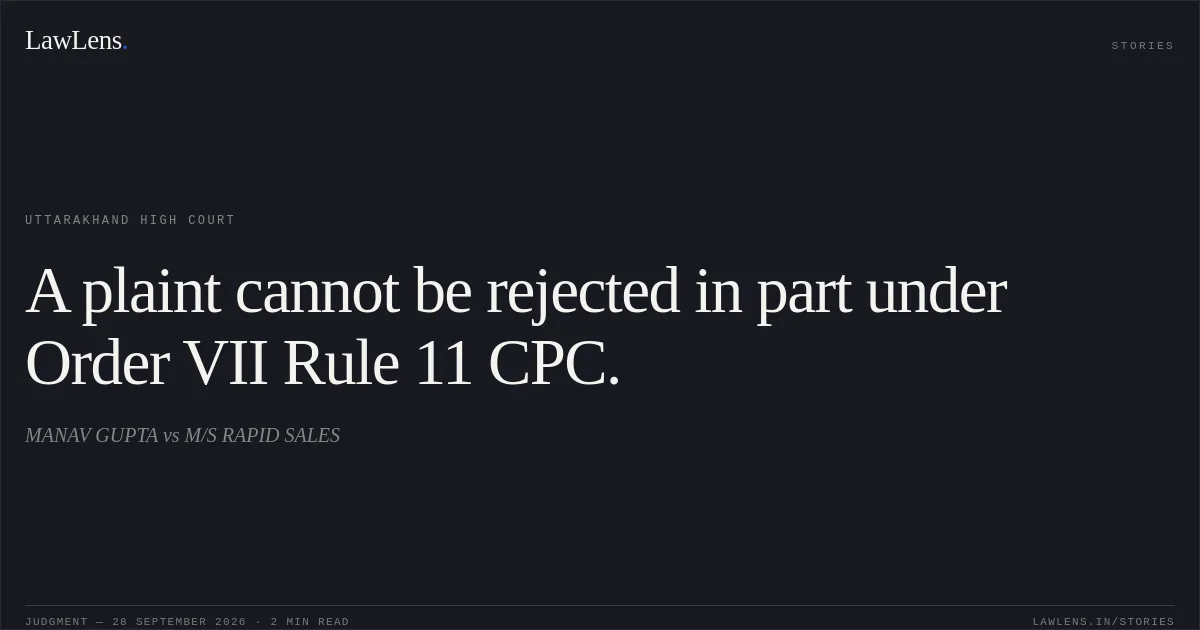
Order 7 Rule 11(d) CPC permits rejection where the suit appears from the statements in the plaint to be barred by law; however, a plaint cannot be rejected only in part (Kum. Geetha v. Nanjundaswamy, 2023 SCC OnLine SC 1407, para. 11, quoted at p. 4, para. 6; see also Sejal Glass Ltd. v. Navilan Merchants (P) Ltd., (2018) 11 SCC 780, and Madhav Prasad Aggarwal v. Axis Bank Ltd., (2019) 7 SCC 158).
Source reference: p. 4, para. 6Limitation may present a mixed question of law and fact that cannot be decided without evidence where the relevant facts are disputed (Ramesh B. Desai v. Bipin Vadilal Mehta, (2006) 5 SCC 638; Chhotanben v. Kirtibhai Jalkrushanbhai Thakkar, (2018) 6 SCC 422).
Source reference: p. 5, para. 7Section 115 CPC permits revisional interference where the subordinate court has committed a jurisdictional error.
Source reference: pp. 1, 5–6, paras. 2, 7–8Reasoning
The plaint referred to pending bills and alleged transactions spanning 2017 and 2022. The Court held that whether those transactions formed a connected series or were separate transactions could not be determined without evidence.
Source reference: pp. 3–5, paras. 4–7Because the 2022 transactions were not alleged to be time-barred, rejecting the plaint on limitation grounds would in effect amount to partial rejection, which Order 7 Rule 11 CPC does not permit.
Source reference: pp. 3–5, paras. 4–7In light of the factual questions involved, the Commercial Court had properly declined to decide limitation at that stage; the High Court found no jurisdictional error warranting revision.
Source reference: p. 5, paras. 7–8Holding
The High Court answered the issues against the revisionist. It held that the limitation question required evidence and that the plaint could not be rejected in part under Order 7 Rule 11 CPC.
Finding no jurisdictional error or gross illegality in the Commercial Court’s order, it dismissed the civil revision.
Source reference: pp. 5–6, paras. 7–9Acts & Sections Cited
1 provisions across 1 statute referred to in this judgment. Each provision opens on LawLens.
Code of Civil Procedure, 19081
Original Court PDF
MANAV GUPTAvsM/S RAPID SALES
Click to open original judgment
Original judgment, available to read, download and summarize on LawLens.in