01Facts
The plaintiff instituted a suit for declaration, partition, and permanent and mandatory injunction, claiming that she was the biological and illegitimate daughter of Late Ram Kumar, who died on 22 October 2016, and was therefore entitled to a share in his movable and immovable estate.
pp. 1–4The plaintiff alleged that her mother, Defendant No.7, disclosed in November–December 2021 that Ram Kumar, and not Late Suresh Gautam, was her biological father.
pp. 2–4After the defendants refused to recognise her as Ram Kumar’s legal heir, she issued a legal notice seeking her share in the estate.
p. 4Defendant No.4 applied under Order VII Rule 11(a) and (d) CPC, contending that the plaint disclosed no cause of action, that the plaintiff had no documentary proof of paternity, and that, even if biologically related to Ram Kumar, she could not claim inheritance because she was allegedly adopted by Suresh Gautam and Defendant No.7.
pp. 4–602Issues
i.Whether the plaint, read as a whole, disclosed a cause of action sufficient to maintain the suit for declaration and partition under Order VII Rule 11(a) CPC.
pp. 6–10, 11–13ii.Whether the suit appeared from the statements in the plaint to be barred by law under Order VII Rule 11(d) CPC on the ground that the plaintiff was allegedly adopted into another family and could not inherit from Ram Kumar.
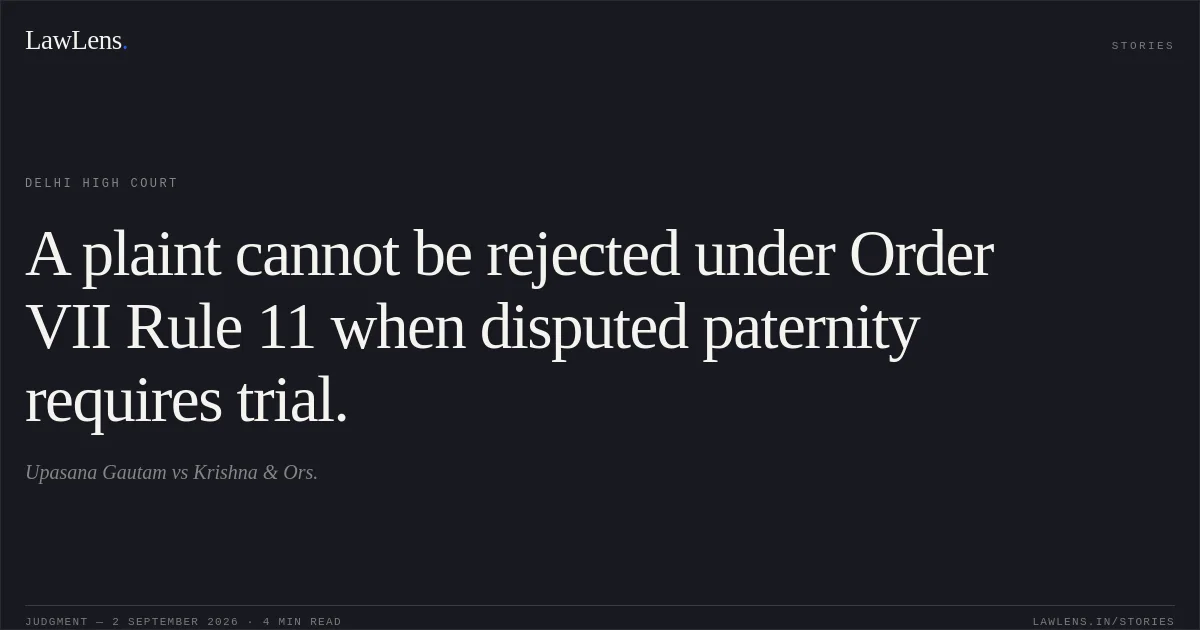
pp. 4–6, 11–13iii.Whether the disputed question of the plaintiff’s biological paternity could be determined at the stage of an application under Order VII Rule 11 CPC, without trial and evidence.
pp. 11–1403Law Applied
Order VII Rule 11(a) CPC permits rejection of a plaint only where it does not disclose a cause of action, while Rule 11(d) applies where the suit appears from the statements in the plaint to be barred by law.
p. 6For deciding an application under clauses (a) and (d), the court must consider the plaint averments alone, assume them to be correct, and disregard the defendant’s defence or disputed evidence: Popat and Kotecha Property v. State Bank of India Staff Assn., (2005) 7 SCC 510, and Vinod Infra Developers Ltd. v. Mahaveer Lunia, 2025 SCC OnLine SC 1208.
pp. 6–11A cause of action comprises the bundle of material facts required to be pleaded and proved to obtain the relief claimed; the court must determine from the plaint whether, if its averments are accepted in entirety, a decree could follow: Liverpool & London S.P. & I Assn. Ltd. v. M.V. Sea Success I & Anr., (2004) 9 SCC 512.
pp. 9–10The plaint must be read as a whole and not by dissecting or isolating individual statements.
pp. 7–9Questions involving disputed facts, evidentiary strength, or the probability of success cannot ordinarily be adjudicated under Order VII Rule 11 CPC.
pp. 10–14Provisions in the judgment · 1 · Linked ones open on LawLens
Code of Civil Procedure, 1908 Section 7
04Reasoning
The plaintiff specifically pleaded that Ram Kumar was her biological father, that she was born from his relationship with Defendant No.7, that Ram Kumar treated her as his daughter, and that the defendants denied her claim to inheritance; these averments constituted a pleaded factual basis for seeking declaration and partition.
pp. 11–13The plaintiff’s DNA report established her relationship with her mother and half-sister but did not independently establish Ram Kumar’s paternity. Nevertheless, the Court held that the sufficiency and reliability of the plaintiff’s evidence, including testimony from her mother, siblings, relatives, and possible medical evidence, could be assessed only at trial.
pp. 12–13The fact that Ram Kumar had died and that the plaintiff had raised the claim only after his death might weaken her case on merits, but it did not eliminate the pleaded cause of action at the threshold stage.
pp. 12–14Similarly, the defendants’ contention that the plaintiff was adopted and consequently barred from inheriting involved factual and legal questions arising from the defence and could not justify rejection of the plaint under Order VII Rule 11.
pp. 4–6, 11–14Since the plaint disclosed a real, though weak and disputed, claim requiring evidence, the statutory conditions for rejection were not satisfied.
p. 1405Holding
The High Court dismissed Defendant No.4’s application under Order VII Rule 11 CPC, holding that the plaint disclosed a cause of action and that the plaintiff’s alleged biological relationship with Ram Kumar was a disputed question of fact requiring trial.
p. 14The Court declined to determine the plaintiff’s paternity, entitlement to inheritance, or the effect of any alleged adoption at the interlocutory stage.
p. 14The suit was directed to be listed before the Joint Registrar for completion of pleadings on 12 October 2026.
p. 14Original Court PDF
Upasana GautamvsKrishna & Ors.
Click to open original judgment
Original judgment, available to read, download and summarize on LawLens.in