Facts
The respondents/plaintiffs instituted O.S. No. 632 of 2022 seeking division and allotment of their alleged 44% undivided share in the land and super built-up area under two Joint Venture Agreements dated 18.08.2014.
Source reference: p. 4Under the agreements, the appellant, owner of two vacant plots measuring 4,800 sq. ft., was to receive 56% of the constructed area, while the respondents were to construct eight flats and receive the remaining 44% share in the land and built-up area.
Source reference: p. 4The appellant asserted that the construction was not completed within the stipulated 15 months and cancelled the Joint Venture Agreements by communication dated 20.04.2016, followed by further notices and demands for removal of construction material and surrender of possession.
Source reference: pp. 2–3The respondents disputed the cancellation and claimed entitlement to the 44% share.
Source reference: no citationThe suit was filed in October 2022.
Source reference: no citationThe appellant’s application under Order VII Rule 11 of the Code of Civil Procedure, 1908, seeking rejection of the plaint as barred by limitation, was dismissed by the Trial Court and the High Court.
Source reference: p. 1The Supreme Court granted leave and examined the plaint to determine whether the suit was ex facie time-barred.
Source reference: p. 1Issues
1. Whether the plaint, on a meaningful reading of its own averments, disclosed that the cause of action arose in 2016 and that the suit filed in October 2022 was barred by limitation, warranting rejection under Order VII Rule 11 CPC.
Source reference: pp. 3–72. Whether the subsequent correspondence and the public notice issued by the respondents on 08.06.2022 created a fresh or continuing cause of action so as to save the suit from limitation.
Source reference: pp. 5–7Law Applied
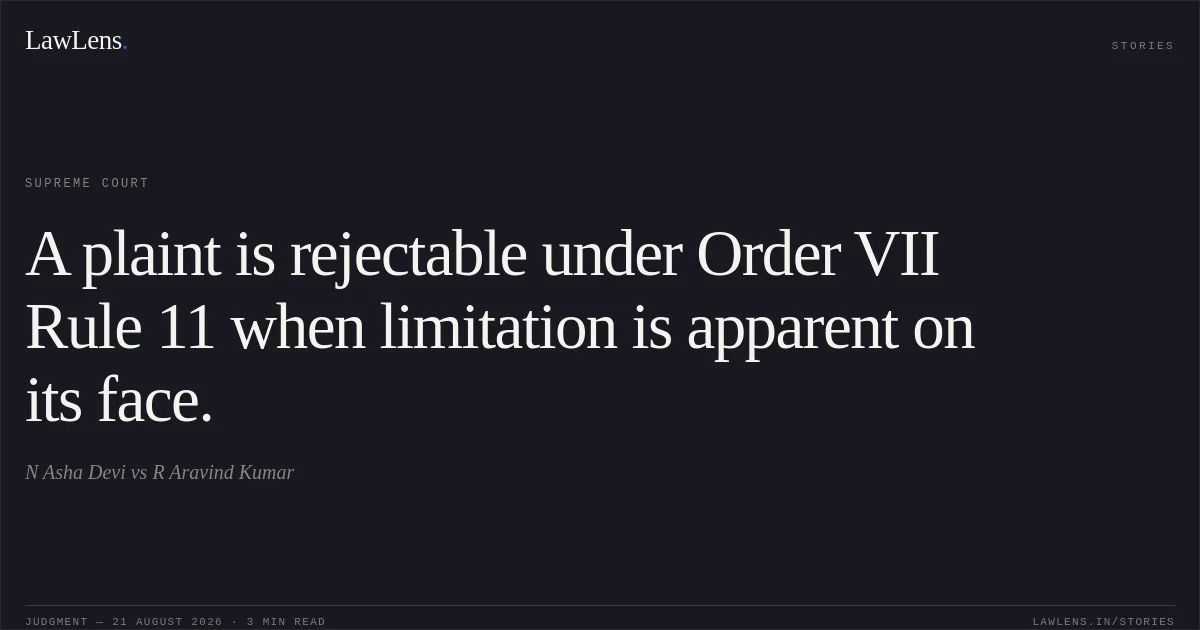
Order VII Rule 11 CPC requires rejection of a plaint where, from the statements in the plaint itself, the suit appears to be barred by law, including limitation.
Source reference: no citationWhile limitation ordinarily constitutes a mixed question of fact and law, the plaint may nevertheless be rejected at the threshold where the bar is apparent and undeniable from the plaint averments.
Source reference: no citationIn Shri Mukund Bhavan Trust v. Shrimant Chhatrapati Udayan Raje Pratapsinh Maharaj Bhonsle, (2024) 15 SCC 675, the Court reiterated that, while considering an application under Order VII Rule 11, the averments in the plaint and the documents annexed to it alone are germane; courts should reject the plaint where the suit is manifestly and hopelessly barred by limitation.
Source reference: pp. 3–4Subsequent communications reiterating an already crystallised dispute do not ordinarily constitute a fresh cause of action.
Source reference: p. 7Reasoning
The Court confined its examination to the plaint, disregarding disputed facts and materials not forming part of the plaint for the purpose of the Order VII Rule 11 application.
Source reference: p. 4The plaint itself identified the relevant events, including the appellant’s cancellation communication dated 20.04.2016, the subsequent notices exchanged in July–November 2016, and the respondents’ assertion that they had acquired their 44% share during that period.
Source reference: pp. 5–6The Court held that the cause of action arose, at the latest, upon the cancellation of the Joint Venture Agreements on 20.04.2016.
Source reference: p. 7The later notices merely reflected the continuing dispute over that cancellation and did not generate an independent cause of action.
Source reference: p. 7The public notice issued on 08.06.2022 was issued in the respondents’ own interest and could not revive a claim that had already become time-barred.
Source reference: p. 7Since the suit was filed only in October 2022, the bar of limitation was apparent from the plaint itself, notwithstanding the general principle that limitation may involve mixed questions of fact and law.
Source reference: no citationHolding
The Supreme Court held that the suit was ex facie barred by limitation and that the Trial Court and High Court had erred in refusing to reject the plaint.
The orders of both courts were set aside, and the plaint in O.S. No. 632 of 2022 pending before the Additional District and Sessions Judge, Chengalpattu, was rejected under Order VII Rule 11 CPC.
Source reference: pp. 6–7The appeal was accordingly allowed.
Source reference: p. 7Original Court PDF
N Asha DevivsR Aravind Kumar
Click to open original judgment
Original judgment, available to read, download and summarize on LawLens.in