Facts
The respondents-plaintiffs instituted O.S. No. 41/2018 alleging that late Chetan Kumar had entered into an Agreement to Sell dated 6 September 2010 with the petitioners-defendants for purchase of agricultural land for ₹30,00,000, of which ₹20,00,000 was paid as advance.
Source reference: paras. 5–7; pp. 6–8, 12–16The defendants allegedly failed to execute the sale deed, and Chetan Kumar subsequently died in a road accident.
Source reference: paras. 5–7; pp. 6–8, 12–16The plaint referred to the agreement, payment of advance, the plaintiffs’ readiness, and the defendants’ alleged failure to perform their obligations.
Source reference: paras. 5–7; pp. 6–8, 12–16The plaintiffs initially sought return of the advance amount with interest, but later filed I.A. No. 6 under Order VI Rule 17 read with Section 151 CPC seeking amendment of the prayers to include specific performance and consequential execution of the sale deed through a court-appointed commissioner if necessary.
Source reference: para. 7; p. 9The Trial Court allowed the application on 25 November 2021.
Source reference: paras. 1–3.3; pp. 3–5The defendants challenged that order under Article 227 of the Constitution, contending that the amendment was belated, lacked due diligence, altered the nature of the suit, and introduced a time-barred claim.
Source reference: paras. 1–3.3; pp. 3–5They also relied on their pending application under Order VII Rule 11(a) and (d) CPC.
Source reference: paras. 1–3.3; pp. 3–5Issues
Whether the Trial Court erred in allowing the plaintiffs’ application under Order VI Rule 17 CPC for amendment of the plaint?
Source reference: para. 8; p. 9Whether the proposed amendment impermissibly changed the nature of the suit from one for refund of money to one for specific performance?
Source reference: paras. 13–15; pp. 12–16Whether the amendment was liable to be rejected for want of due diligence under the proviso to Order VI Rule 17 CPC, having been sought after commencement of proceedings/evidence?
Source reference: paras. 10–12, 16–18; pp. 10–12, 16–20Whether the proposed specific-performance relief was liable to be rejected at the amendment stage as time-barred, particularly when an application under Order VII Rule 11 CPC was pending?
Source reference: para. 20; p. 23Law Applied
The Court applied Order VI Rule 17 CPC, under which amendments necessary for determining the real questions in controversy should ordinarily be allowed, subject to the proviso requiring due diligence where the trial has commenced.
Source reference: para. 10; p. 10It relied on M/s. Ganesh Trading Co. v. Moji Ram, (1978) 2 SCC 91, for the principle that procedural rules facilitate substantive justice and that omissions by counsel may ordinarily be cured by amendment, subject to appropriate costs.
Source reference: paras. 16–16.1; pp. 17–19The Court also relied on Balkar Singh v. Union Territory of Jammu & Kashmir, Civil Appeal No. 2634 of 2025, for the rule that an innocent litigant should not suffer for the fault or lapse of counsel.
Source reference: para. 16.1; p. 19Further, relying on Dinesh Goyal alias Pappu v. Suman Agarwal (Bindal) & Ors., 2024 SCC OnLine SC 2615, and the principles summarised in LIC v. Sanjeev Builders Pvt. Ltd., 2022 SCC OnLine SC 1128, the Court held that amendments should be allowed when necessary for effective adjudication, unless they cause irremediable prejudice, withdraw a binding admission, introduce a wholly new cause of action, change the nature of the suit, are mala fide, or defeat a valuable accrued limitation defence.
Source reference: para. 19; pp. 20–22Reasoning
The Court examined the plaint as a whole rather than relying solely on the original prayer clause.
Source reference: paras. 14–15, 17; pp. 12–16, 19–20It found that the plaint already pleaded the Agreement to Sell, payment of ₹20,00,000, the defendants’ failure to execute the sale deed, the plaintiffs’ readiness and willingness, and the circumstances concerning the property and the defendants’ alleged partition.
Source reference: paras. 14–15, 17; pp. 12–16, 19–20These pleadings contained the essential factual basis of a specific-performance action; the proposed amendment merely supplied the appropriate consequential prayers.
Source reference: paras. 14–15, 17; pp. 12–16, 19–20The omission was attributed to inadvertence and inadequate legal advice, and the Court held that a litigant should not be prejudiced by counsel’s mistake.
Source reference: paras. 16–19; pp. 16–22The amendment did not withdraw any admission, was not mala fide, and did not introduce a wholly new cause of action.
Source reference: paras. 16–19; pp. 16–22Any inconvenience to the defendants could be compensated by costs.
Source reference: paras. 16–19; pp. 16–22The limitation objection and the merits of the Order VII Rule 11 application were not decisive at the amendment stage; the Trial Court was entitled to decide the amendment application first.
Source reference: para. 20; p. 23Holding
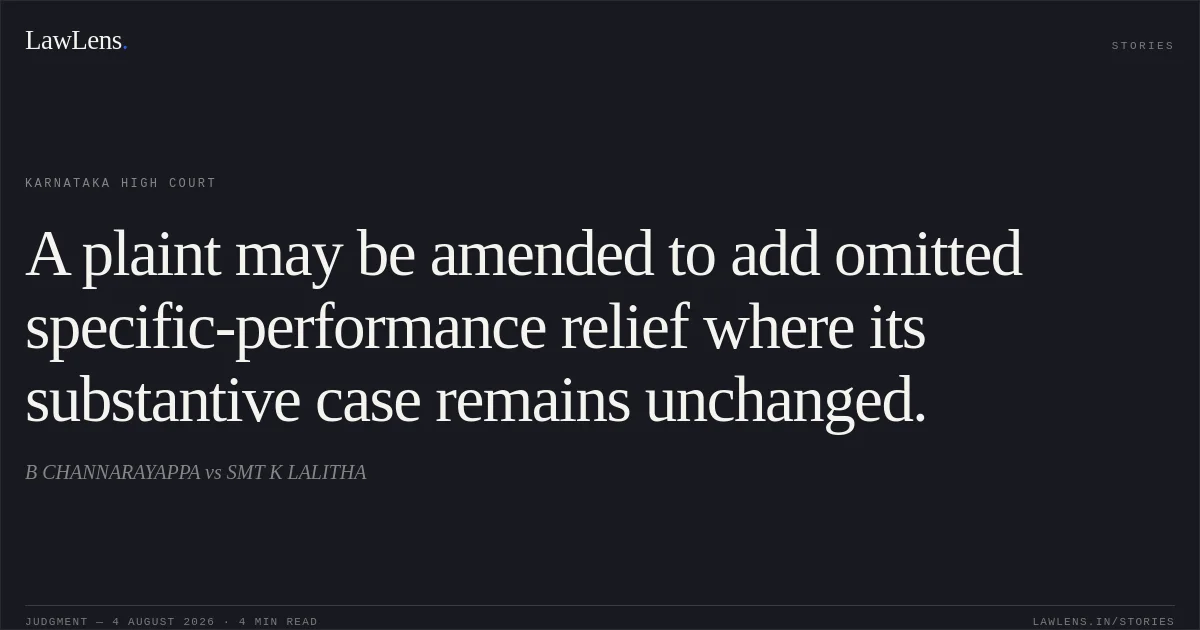
The High Court held that the amendment did not change the nature of the suit and was necessary to determine the real controversy concerning enforcement of the Agreement to Sell.
It therefore declined to interfere with the Trial Court’s order allowing I.A. No. 6.
Source reference: paras. 21–22; p. 24The writ petition was dismissed, subject to the plaintiffs paying ₹7,500 as costs to the defendants for the amendment.
Source reference: paras. 21–22; p. 24All pending applications were closed, and the parties were directed not to seek unnecessary adjournments before the Trial Court.
Source reference: paras. 22–23; p. 24Original Court PDF
B CHANNARAYAPPAvsSMT K LALITHA
Click to open original judgment
Original judgment, available to read, download and summarize on LawLens.in