Facts
The prosecution alleged that Dewanand, a vehicle driver, left for Siudi on 29 October 2011 and was later found dead near the Water Park at Hawai Adda Road.
Source reference: paras. 6–7, pp. 2–3His wife’s fardbeyan led to a case against unknown persons under Sections 302 and 201 IPC; the respondents were subsequently charged under Sections 302, 201 and 120B IPC in two sessions trials.
Source reference: paras. 6–7, pp. 2–3The trial court acquitted all four respondents.
Source reference: paras. 10–13, pp. 4–5The State appealed, contending that the evidence had been wrongly assessed; the respondents maintained that the acquittal was justified in a case based entirely on circumstantial evidence.
Source reference: paras. 10–13, pp. 4–5The High Court first condoned the 72-day delay in filing the appeal.
Source reference: paras. 1–3, p. 1Issues
Whether the trial court’s acquittal was perverse or otherwise liable to interference in an appeal against acquittal.
Source reference: paras. 14–15, pp. 5–6Whether the prosecution evidence proved the respondents’ involvement in the offences under Sections 302, 201 and 120B IPC beyond reasonable doubt.
Source reference: paras. 16–19, pp. 6–7Law Applied
The Court applied the principles governing appeals against acquittal, relying on Mallappa v. State of Karnataka, (2024) 3 SCC 544, and State of Odisha v. Banabihari Mohapatra, (2021) 15 SCC 268.
Source reference: para. 15, pp. 5–6An appellate court may reappreciate evidence, but should not reverse an acquittal merely because another view is possible; interference is warranted where the trial court’s view is illegal or perverse, while a reasonably possible view favouring the accused must be maintained.
Source reference: para. 15, pp. 5–6The prosecution was required to establish the charged offences under Sections 302, 201 and 120B IPC beyond reasonable doubt.
Source reference: paras. 7, 17, pp. 3, 6The Court also considered Sections 25, 26 and 27 of the Evidence Act in assessing the accused persons’ confessional statements.
Source reference: paras. 7, 17, pp. 3, 6Reasoning
The Court found no eyewitness or evidence that any respondent was last seen with the deceased.
Source reference: para. 16, p. 6The FIR and the witnesses’ earlier statements did not identify the accused, whereas some related witnesses made allegations against them in court; the Court considered those witnesses unreliable.
Source reference: para. 16, p. 6It also found that the confessional statements were inconsistent and improbable and could not be relied on under Section 27, being hit by Sections 25 and 26 of the Evidence Act.
Source reference: paras. 17–18, pp. 6–7The medical evidence did not corroborate the prosecution account, and the investigation had not identified the passengers who had travelled with the deceased.
Source reference: paras. 17–18, pp. 6–7These deficiencies left reasonable doubt, and the trial court’s assessment was a possible view supported by the record.
Source reference: para. 19, p. 7Holding
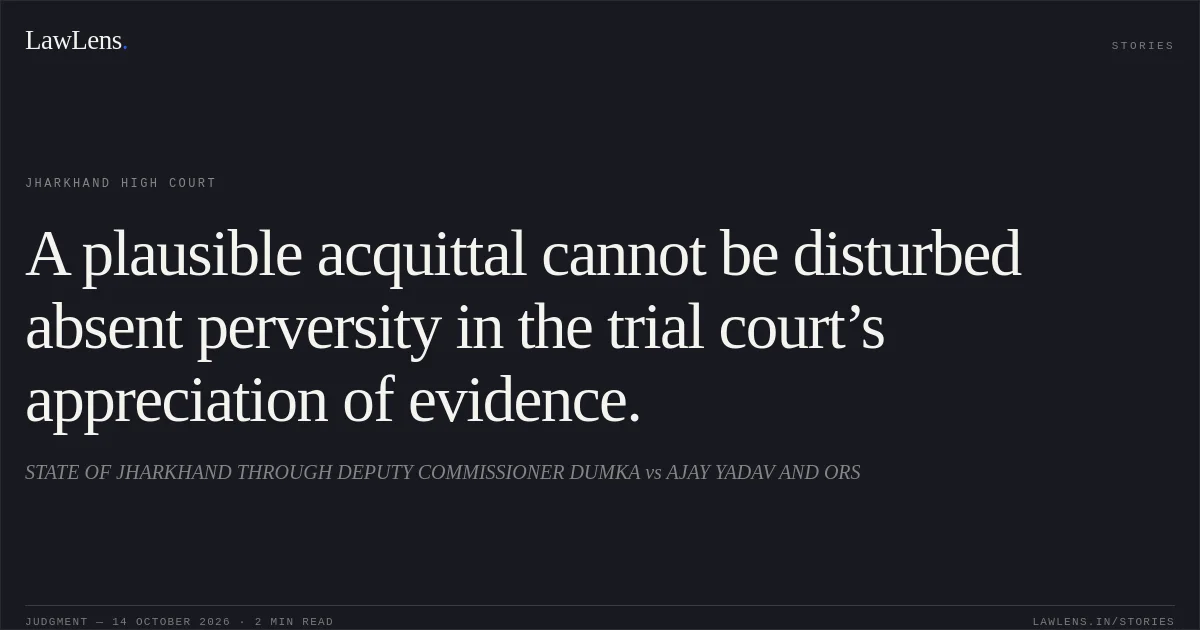
The Court held that the prosecution had not proved the respondents’ guilt and that the trial court’s acquittal disclosed no basis for appellate interference.
The State’s acquittal appeal was dismissed; the 72-day delay had previously been condoned, and any pending interlocutory application was disposed of.
Source reference: paras. 3, 19–21, pp. 1, 7Acts & Sections Cited
4 provisions across 3 statutes referred to in this judgment. Each provision opens on LawLens.
Limitation Act, 19631
Indian Penal Code, 18602
Code of Criminal Procedure, 19731
Original Court PDF
STATE OF JHARKHAND THROUGH DEPUTY COMMISSIONER DUMKAvsAJAY YADAV AND ORS
Click to open original judgment
Original judgment, available to read, download and summarize on LawLens.in