Facts
The State appealed the acquittal of the respondent of offences under Sections 363 and 366 of the IPC.
Source reference: no citationThe prosecution alleged that he took the victim from Bilaspur on 6 November 2016 and that she was recovered with him in Jodhpur on 20 November 2016.
Source reference: para. 2–4The trial court acquitted him, finding that the prosecution had not established that the victim was under 18 and that she had accompanied him voluntarily.
Source reference: para. 2–4The State challenged the assessment of the victim’s age and the conclusion that she had gone with the respondent of her own accord.
Source reference: para. 5Issues
Whether the prosecution proved beyond reasonable doubt that the victim was under 18 on the date of the incident, such that her taking could constitute kidnapping from lawful guardianship
Source reference: para. 8–14Whether the evidence established that the respondent took or induced the victim against her will, or otherwise proved the charged offences under Sections 363 and 366 IPC
Source reference: para. 15–19Whether the trial court’s acquittal was perverse or otherwise warranted interference in an appeal against acquittal
Source reference: para. 19–22Law Applied
Sections 363 and 366 IPC were the charged offences; Section 363 concerns kidnapping from lawful guardianship, while Section 366 addresses kidnapping or abduction with the specified intent concerning a woman.
Source reference: no citationUnder Section 35 of the Evidence Act, an official school record may be admissible, but its evidentiary value in proving age depends on the reliability of the material underlying the recorded entry; Alamelu v. State was cited for this principle.
Source reference: para. 10–11The Court also relied on Rishipal Singh Solanki v. State of Uttar Pradesh and P. Yuvaprakash v. State, which explain the hierarchy and evidentiary assessment of age documents and the limited, non-conclusive role of ossification testing.
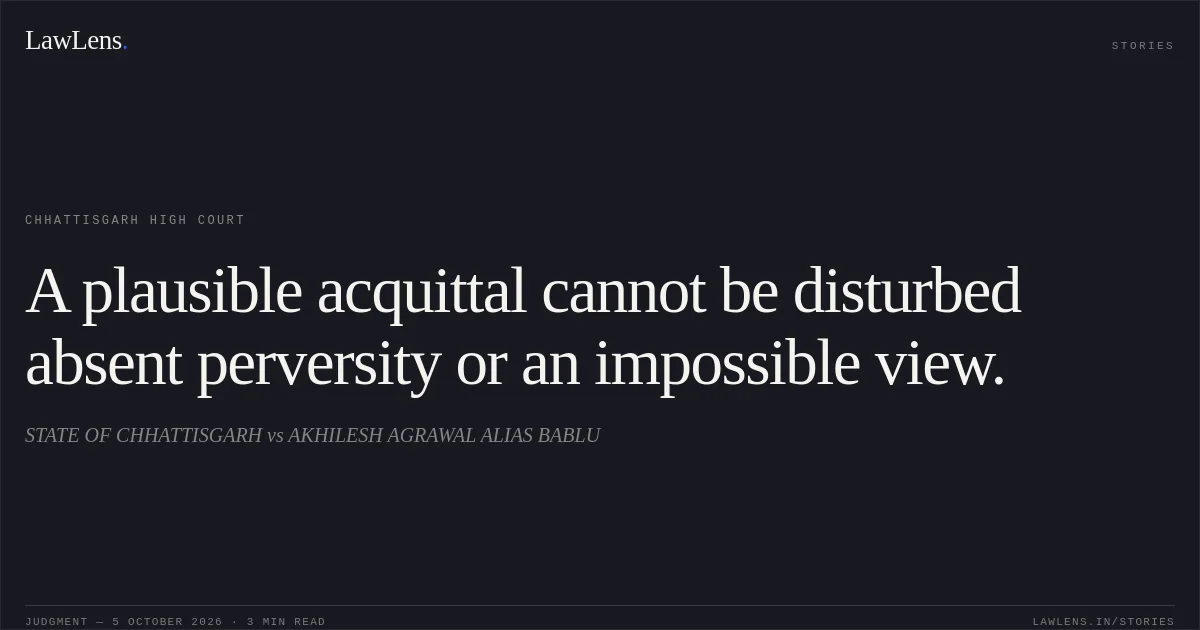
Source reference: para. 12–13On an appeal against acquittal, interference is warranted where the trial court’s view is impossible or perverse; where the evidence permits a plausible view supporting acquittal, the appellate court should not substitute another view merely because it may be more probable (State of Rajasthan v. Kistoora Ram and Jafarudheen v. State of Kerala).
Source reference: para. 20–21Reasoning
The school register recorded the victim’s date of birth as 23 December 1998, but the Head Mistress was not present at the school when the victim was admitted, the admission form was not produced, and the basis for the recorded date of birth was not established.
Source reference: para. 9The ossification report placed her age at about 19 years or above; considering that report alongside the deficiencies in the school-record evidence, the Court held that minority had not been proved.
Source reference: para. 14The victim testified that she travelled and stayed with the respondent at several places, made no complaint during the journey or at the hotels, and had accompanied him after initially refusing his invitation; the brother’s evidence did not describe her protesting or raising an alarm.
Source reference: para. 15, 17–18The Court therefore found the trial court’s conclusions—that the victim’s minority was unproved and that she voluntarily accompanied the respondent—were supported by the evidence and constituted a plausible view.
Source reference: para. 19, 22Holding
The Court held that the prosecution had not established that the victim was under 18 or that the evidence displaced the trial court’s finding of voluntary accompaniment.
The trial court’s acquittal was neither perverse nor illegal, and no basis existed to interfere with it in the acquittal appeal.
Source reference: para. 19, 22The appeal was dismissed.
Source reference: para. 23Acts & Sections Cited
8 provisions across 3 statutes referred to in this judgment. Each provision opens on LawLens.
Indian Penal Code, 18602
Code of Criminal Procedure, 19734
Juvenile Justice (Care and Protection of Children) Act, 2015.2
Original Court PDF
STATE OF CHHATTISGARHvsAKHILESH AGRAWAL ALIAS BABLU
Click to open original judgment
Original judgment, available to read, download and summarize on LawLens.in