Facts
The plaintiffs, Balakka and her daughter Lakshmakka, sued for declaration of title to the suit properties and permanent injunction, asserting that the defendant had no right in them.
Source reference: paras. 3, 9; pp. 6, 10–11Huliyappa, Balakka’s husband, claimed that he and Balakka derived title under a Will dated 10 November 1947 made by his father-in-law, Chikkaramaiah; alternatively, he claimed title by adverse possession.
Source reference: paras. 4, 12; pp. 7, 13–16The trial court decreed the suit in favour of Balakka, and the first appellate court affirmed that decree.
Source reference: para. 6; p. 8Huliyappa’s legal representatives appealed under Section 100 CPC. During the appeal, they relied on a genealogy portraying Huliyappa as a descendant of the common propositus, Kenchappa, whereas Huliyappa’s written statement had traced his claim to the Will from Chikkaramaiah.
Source reference: paras. 10, 13–16; pp. 10–19Issues
1. Whether the trial court and first appellate court were justified in granting a declaration of title to Balakka alone, in light of the asserted co-ownership of Ramakka and Huliyappa.
Source reference: para. 7; p. 92. Whether the courts below erred in appreciating the parties’ relationship.
Source reference: para. 7; p. 9Law Applied
The appeal was brought under Section 100 CPC, and the court considered whether the substantial questions of law warranted interference with concurrent findings.
Source reference: pp. 5, 8–9, 21A party claiming title under a Will must establish the testamentary disposition relied upon; here, the court noted that the original defendant had not produced or proved the alleged Will.
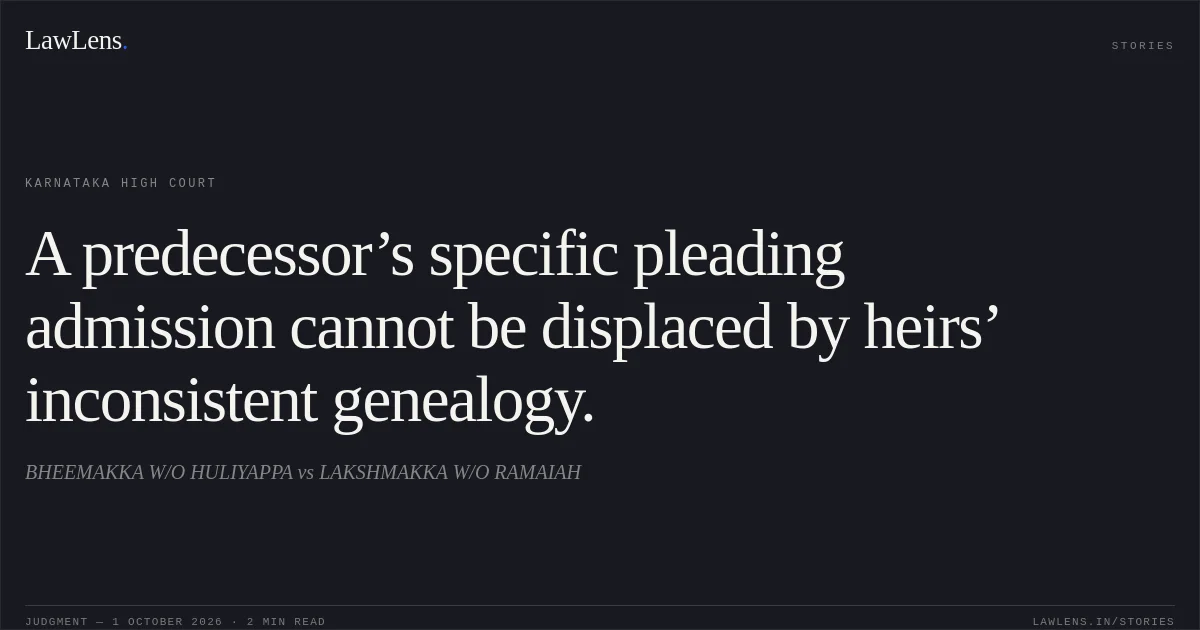
Source reference: paras. 12, 15; pp. 16, 18The court also treated the original defendant’s specific pleading as significant: the later genealogy advanced by his legal representatives could not displace his own pleaded basis of title.
Source reference: paras. 13–16; pp. 17–19No further statutory provision or precedent was cited in the judgment.
Source reference: no citationReasoning
Huliyappa’s written statement acknowledged that the properties belonged to Chikkaramaiah and claimed that Huliyappa and Balakka received them under the 1947 Will. Because the Will was neither produced nor proved, that asserted source of title was not established; the alternative claim of adverse possession had also been rejected concurrently by both courts.
Source reference: paras. 12, 15, 17; pp. 16, 18–20The later genealogy relied on by the appellants was inconsistent with Huliyappa’s own pleading and did not establish an independent claim through Kenchappa. The High Court therefore found no basis to disturb the concurrent findings.
Source reference: paras. 14–18; pp. 17–21Holding
The High Court answered the first substantial question of law in the affirmative, against the appellants, and the second in the negative, also against them.
Finding no ground to interfere with the concurrent judgments, it dismissed the second appeal.
Source reference: para. 19; p. 21Acts & Sections Cited
1 provisions across 1 statute referred to in this judgment. Each provision opens on LawLens.
Code of Civil Procedure, 19081
Original Court PDF
BHEEMAKKA W/O HULIYAPPAvsLAKSHMAKKA W/O RAMAIAH
Click to open original judgment
Original judgment, available to read, download and summarize on LawLens.in