Facts
Respondent No. 2, a widow and Anganwadi Assistant, lodged FIR No. 467 of 2022 at Police Station Rudrapur alleging that the applicant, who was married to her acquaintance, established physical relations with her from 2017 on the false promise of marriage. She also alleged that the applicant knew she was HIV-positive, forcibly had sexual relations with her, took her photographs, and threatened to circulate them.
Source reference: paras. 3–4The FIR was registered under Sections 269, 376 and 323 IPC on 30 July 2022, approximately five years after the alleged relationship commenced.
Source reference: paras. 3–4After investigation, the police filed a charge-sheet under Sections 269, 323 and 376 IPC, and the Chief Judicial Magistrate, Udham Singh Nagar, took cognizance and issued the summoning order dated 4 January 2023.
Source reference: paras. 4–5The applicant invoked the High Court’s inherent jurisdiction under Section 482 Cr.P.C. to quash the charge-sheet and summoning order, contending that the relationship was consensual, the allegations were delayed and uncorroborated, and the victim had admitted accompanying him to coffee shops and hotels.
Source reference: paras. 6–11The State opposed the application, alleging that the applicant had used photographs to blackmail the victim and had subjected her to forcible sexual relations; however, it fairly acknowledged that no medical examination report or photographs/videos had been collected during investigation.
Source reference: paras. 12–15, 20, 24Issues
Whether the allegations in the FIR and the statements under Sections 161 and 164 Cr.P.C. disclosed a prima facie offence under Section 376 IPC, particularly whether the alleged sexual relationship was without the victim’s consent.
Source reference: para. 18Whether the allegations of sexual relations on a false promise of marriage, coercion through photographs, and forcible intercourse were sufficiently supported by the material collected during investigation.
Source reference: paras. 20–24Whether continuation of the criminal proceedings under Sections 269, 323 and 376 IPC amounted to an abuse of the process of law warranting exercise of jurisdiction under Section 482 Cr.P.C.
Source reference: paras. 27–29Law Applied
The Court applied Section 482 Cr.P.C., which confers inherent jurisdiction on the High Court to prevent abuse of the process of any court and secure the ends of justice.
Source reference: no citationThe substantive allegations were examined under Sections 376, 269 and 323 IPC.
Source reference: no citationThe Court observed that although a medical examination is not indispensable for establishing an offence under Section 376 IPC where the allegations are otherwise credible, the absence of medical or other corroborative material was relevant in the circumstances of this case.
Source reference: para. 20Relying on Jothiragawan v. State, 2025 SCC OnLine SC 628, the Court reiterated that admitted, repeated and voluntary sexual relations, including accompanying the accused to hotel rooms, may negate allegations of absence of consent where the prosecution material does not inspire confidence.
Source reference: para. 25On the effect of a long-standing relationship and a subsequent allegation of a promise to marry, the Court relied on Ravish Singh Rana v. State of Uttarakhand, 2025 SCC OnLine SC 1055, which recognised that a prolonged consensual relationship and cohabitation may support an inference of voluntary consent, and on Maheshwar Tigga v. State of Jharkhand, (2020) 10 SCC 108, which held that consent founded on a misconception of fact must bear a close temporal connection to the sexual act and cannot ordinarily be spread over a prolonged period.
Source reference: para. 25Reasoning
The Court found that the relationship between the applicant and the victim had allegedly continued from 2017 for a substantial period, and that the victim’s own statements disclosed that she accompanied the applicant to coffee shops and hotels where the sexual relations allegedly took place.
Source reference: paras. 8, 14, 16, 27The allegations of forcible intercourse were not supported by a medical examination report, photographs, videos, or other documentary evidence; the alleged photographs said to have been used for blackmail were also not recovered during investigation.
Source reference: paras. 20–24The Court further held that the allegations concerning a false promise of marriage were not adequately repeated or substantiated in the victim’s statements under Sections 161 and 164 Cr.P.C., and the State could not identify material establishing that the sexual relationship was induced by such a promise.
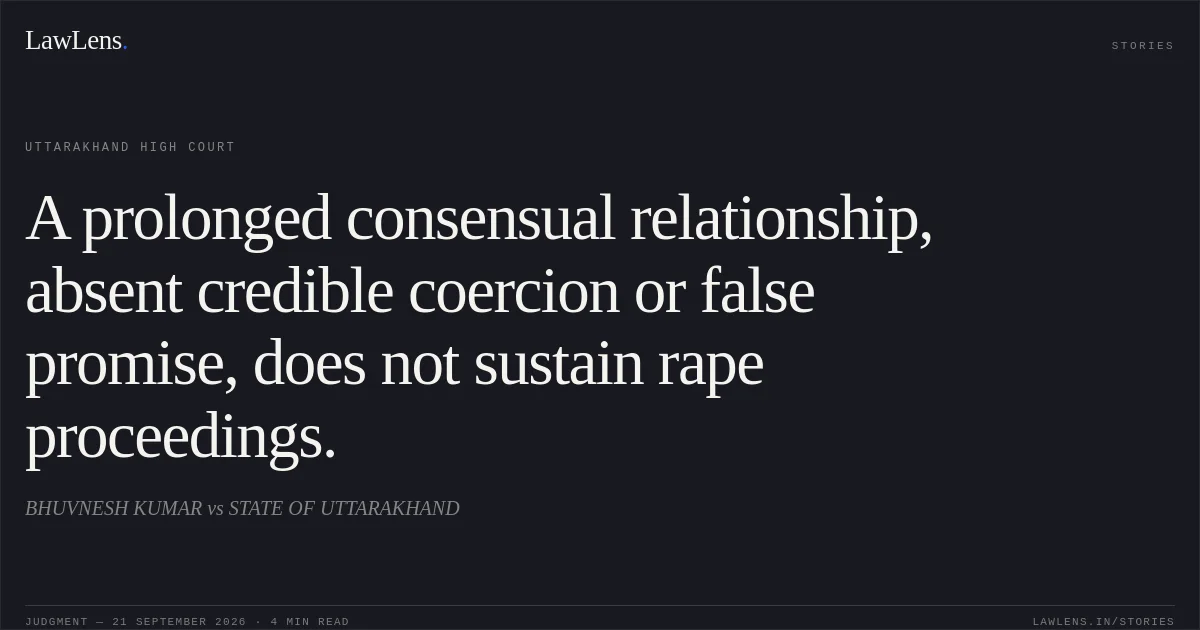
Source reference: para. 22In light of the prolonged relationship, the victim’s conduct, the delay in lodging the FIR, and the absence of corroborative material supporting coercion or forcible intercourse, the Court concluded that the allegations did not inspire sufficient confidence to justify continuation of the prosecution under Section 376 IPC.
Source reference: paras. 27–28Continuing the proceedings in those circumstances would therefore constitute an abuse of the process of law.
Source reference: para. 28Holding
The High Court allowed the application under Section 482 Cr.P.C. and held that the prosecution material did not establish, even prima facie, that the sexual relationship was without the victim’s consent or that it was induced by a false promise of marriage or coercion through photographs.
Accordingly, the charge-sheet dated 1 December 2022 under Sections 376, 269 and 323 IPC and the cognizance/summoning order dated 4 January 2023 in Criminal Case No. 28 of 2023 were quashed.
Source reference: paras. 29–31Pending applications, if any, were disposed of.
Source reference: paras. 29–31Acts & Sections Cited
7 provisions across 2 statutes referred to in this judgment. Each provision opens on LawLens.
Code of Criminal Procedure, 19733
Indian Penal Code, 18604
Original Court PDF
BHUVNESH KUMARvsSTATE OF UTTARAKHAND
Click to open original judgment
Original judgment, available to read, download and summarize on LawLens.in